Erythema migrans (Lyme disease)
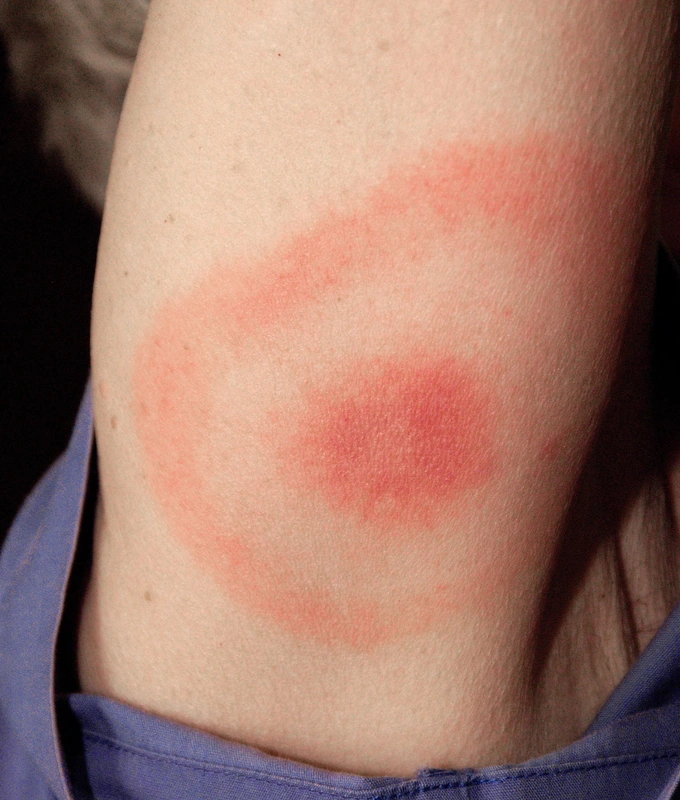
Etiology and Transmission
Pathogen: Borrelia burgdorferi; in Europe also B. afzelii and B. garinii. Transmission by hard ticks (Ixodes ricinus).
- Transmission period: Bacterial transmission usually only after 24 to 36 hours of feeding.
- Statistics: 5–35 % of ticks are infected, transmission risk 5 %, infection risk 1 %.
Diagnosis
Basis: Clinical presentation (EM) and history of tick contact. Serology (Staged Diagnostics):
- 1st Stage: ELISA.
- 2nd Stage: Western Blot for confirmation/identification of specific antibodies.
- Time course: IgM positive after 3 weeks, IgG after months.
- PCR: Detection of DNA from CSF or tissue useful in neuroborreliosis.
- Histology: Inflammatory infiltrates with perivascular plasma cells.
Differential diagnoses
- Livedo reticularis
- Arterial (ischaemic) ulcer
- Venous leg ulcer
- Psoriasis vulgaris (plaque psoriasis)
- Lupus erythematosus gesicht
- Mycosis fungoides
- Tinea corporis
- Granuloma annulare
Practise Erythema migrans (Lyme disease) in the app
Flashcards with spaced repetition, exam questions and spot-the-diagnosis on this topic – in DermaFuchs, free of charge.
In the DermaFuchs app: 2 flashcards · 3 clinical images
Open in browser Download on the App StoreSources (selection)
More bacterial skin infections
Note: This page is intended for medical education and does not replace diagnosis or treatment decisions in individual cases. Treatment and follow-up content is available in the app.