Yaws (framboesia)
- Synonyms
- Yaws, Framboesie, Pian, endemische Treponematose, Treponema pertenue, framboesia, endemic treponematosis
- Specialty
- Dermatology · Bacterial infections
- Images
- Clinical 1
- Last updated
- 10/2026 · Dr. Pascal Bafteh
Contents
Images (1)
Definition
Yaws is a chronic, non-sexually transmitted infection caused by Treponema pallidum subsp. pertenue that affects skin, bone and cartilage. Together with endemic syphilis (bejel) and pinta, it is one of the endemic treponematoses and the most common of them.
Occurrence & epidemiology
Mainly in poor rural communities in warm, humid tropical regions of Africa, Asia, Latin America and the Pacific. About 75–80% of those affected are children under 15 years, with a peak between 6 and 10 years; both sexes are equally affected. Currently 15 countries are known to be endemic, with most cases from the Western Pacific (mainly Papua New Guinea).
Aetiopathogenesis
Humans are believed to be the only reservoir. Transmission is from person to person through skin contact via minor injuries. The incubation period is 9–90 days, with an average of 21 days.
Clinical features
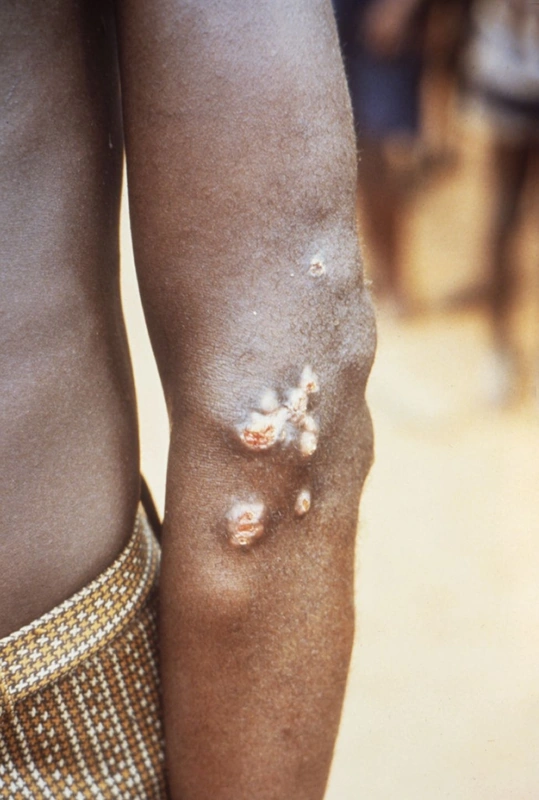
- Primary stage: a papilloma (wart-like tumour) teeming with bacteria, mostly on the limbs, which may ulcerate; regional lymph nodes may be swollen and tender. Regression after 3–6 months, often leaving a pale scar.
- Secondary stage: weeks to months later, multiple raised yellowish lesions, mainly on the face, arms and legs, or pain and swelling of the long bones and fingers (dactylitis).
- Latent stage: no signs of disease and no longer infectious; most people remain in this stage for life.
- Tertiary stage: in about 10%, destructive lesions of the bones of the face, jaw and lower leg.
Diagnosis
- The typical papilloma is easy to recognise clinically; the ulcerative form requires serological confirmation. About 40% of ulcers clinically identified as yaws are caused by Haemophilus ducreyi.
- Serology (e.g. RPR, TPPA): cannot distinguish yaws from syphilis.
- PCR of skin lesions for definitive confirmation.
- Dark-field microscopy of lesion material in the primary and secondary stages.
Differential diagnoses
Keep learning in the app
References (selection)
Cross-references
Mentioned in
Note: This page is intended for medical education and does not replace diagnosis or treatment decisions in individual cases.