Livedo racemosa
Exam relevance: in 4 of more than 50 board exam reports · rank 33
- Synonyms
- livedo reticularis, Sneddon syndrome
- Specialty
- Dermatology · Environmental & photodermatoses
- Images
- Clinical 1
- In the app
- 8 flashcards
- Last updated
- 10/2026 · Dr. Pascal Bafteh
Contents
Images (1)
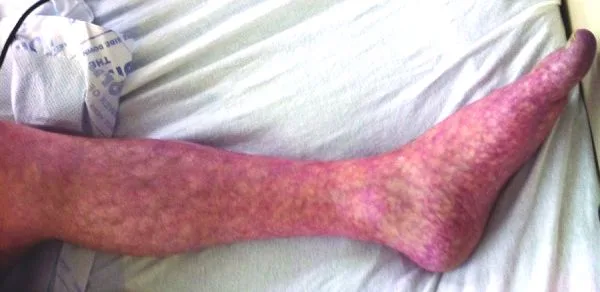
Definition
Livedo reticularis shows a regular, closed net, is cold-induced and reversible on warming (physiological variant: cutis marmorata). Livedo racemosa, by contrast, is bizarre, irregular and broken ("open rings"), asymmetrical and persists even after warming — it always requires work-up.
It is caused by occlusive processes of the dermal arterioles: antiphospholipid syndrome, Sneddon syndrome (livedo racemosa plus cerebral ischaemia), livedoid vasculopathy, vasculitides such as polyarteritis nodosa, cholesterol emboli and other hypercoagulable states. Livedoid vasculopathy is characterised by the triad of livedo racemosa, painful ulcerations and atrophie blanche (whitish, stellate scars, mainly at the malleolus and dorsum of the foot).
Work-up includes a deep, spindle-shaped biopsy from the pale centre of the livedo meshes — that is where the occluded vessel lies — as well as coagulation and autoimmune laboratory tests.
Differential diagnoses
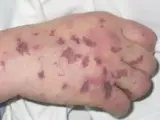 Purpura fulminans
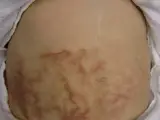 Erythema ab igne
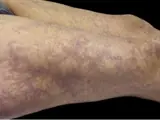 Antiphospholipid syndrome – skin manifestations (livedo racemosa, Sneddon syndrome)
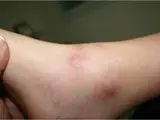 Polyarteritis nodosa
- Arterial (ischaemic) ulcer
- Livedo reticularis
Image credits for the thumbnails
- Purpura fulminans: Глей А.І., Шкурба А.В., Public domain, via Wikimedia Commons · Public domain · Source
- Erythema ab igne: James Heilman, MD, “Hotbottlerash”, CC BY-SA 3.0, via Wikimedia Commons · CC BY-SA 3.0 · Source
- Antiphospholipid syndrome – skin manifestations (livedo racemosa, Sneddon syndrome): Lecaros C, Coulon G, Reculé F et al. (An Bras Dermatol 2024), CC BY 4.0, via PubMed Central (PMC11342997) · CC BY 4.0 · Source · cropped
- Polyarteritis nodosa: Ruby Haviv, Maya Capua, Jacob Amir, Liora Harel, “Cutaneous polyarteritis nodosa”, CC BY 4.0, via Wikimedia Commons · CC BY 4.0 · Source
Treatment principles
- Livedo racemosa itself does not require treatment, but it is a warning sign of an underlying disease.
- Investigating and treating the cause is crucial, for example antiphospholipid syndrome, Sneddon syndrome, vasculitis or connective tissue disease.
- Depending on the underlying disease, anticoagulation or antiplatelet therapy is given, coordinated with neurology, rheumatology and angiology.
Specific treatment regimens with drugs and doses are covered in the DermaFuchs app.
Keep learning in the app
Cross-references
Mentioned in
Keep learning
Keep learning with flashcards, exam questions and spot diagnoses in the DermaFuchs app – free, in your browser or as an app.
Related pages: Arterial (ischaemic) ulcer · Purpura fulminans · Erythema ab igne
Note: This page is intended for medical education and does not replace diagnosis or treatment decisions in individual cases.