Furuncle and carbuncle
- Synonyms
- Furunkel, Karbunkel, Furunkulose, Eiterbeule, Hautabszess, boil, furuncle, carbuncle, furunculosis
- Specialty
- Dermatology · Bacterial infections
- Images
- Clinical 3
- In the app
- 3 flashcards
- Last updated
- 10/2026 · Dr. Pascal Bafteh
Contents
Images (3)
Definition
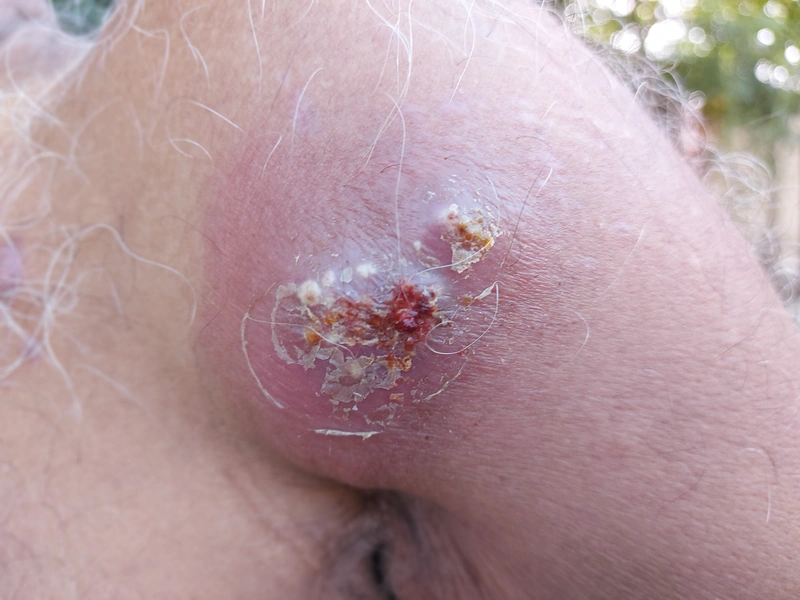
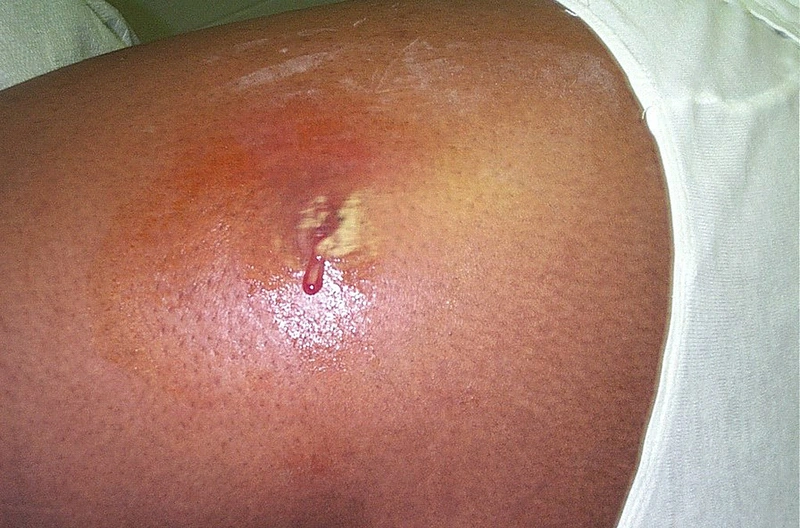
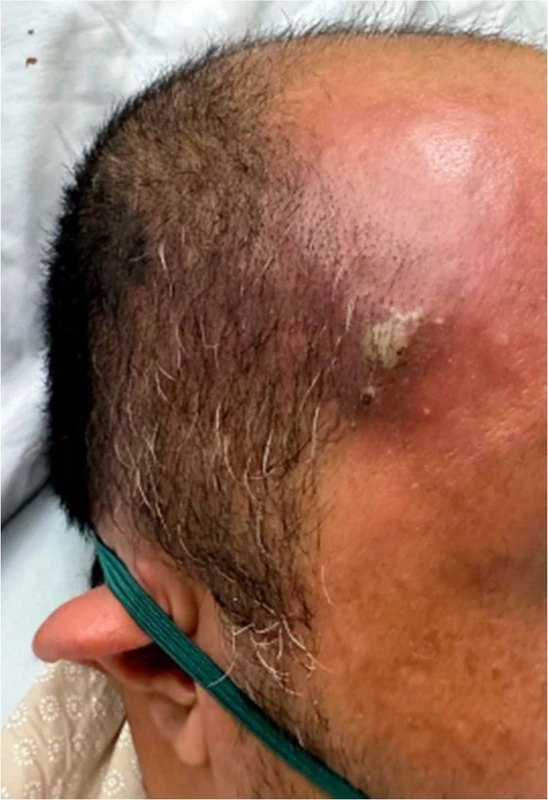
A furuncle (boil) is a deep, abscess-forming inflammation of a hair follicle and its surroundings caused by Staphylococcus aureus. When several adjacent furuncles coalesce, it is called a carbuncle. Repeated occurrence over a longer period is called furunculosis.
Occurrence & epidemiology
Most patients are otherwise healthy but carry S. aureus (about 10–20% of the population; mainly nose, axillae, groins, natal cleft). Further predisposing factors are diabetes mellitus, obesity, immunodeficiency, anaemia, iron deficiency, smoking, hot humid climate, and minor injuries and friction. In recurrent furunculosis, especially with clustering among close contacts, Panton-Valentine leukocidin-producing strains may play a role.
Clinical features
- Very painful, red, warm nodule around a hair that develops into a fluctuant nodule with a central core of pus.
- Mainly the neck, face, breasts, axillae and buttocks; carbuncles especially on the back of the neck, shoulders, hips and buttocks.
- Carbuncles: larger and deeper, with pus draining from several follicular openings, sometimes with fever.
- Danger zone of the mid-face: furuncles in the "danger triangle" (e.g. nose, upper lip) can rarely cause septic cavernous sinus thrombosis.
Diagnosis
- Clinical diagnosis; swab with culture in recurrent or extensive disease, possibly with testing for Panton-Valentine leukocidin.
- With repeated boils, search for predisposing factors such as diabetes mellitus, immune deficiency, anaemia or iron deficiency.
- Superficial folliculitis is sometimes present at the same time.
Differential diagnoses
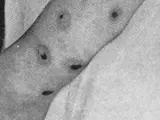
- Candida intertrigo
- Abscess
Image credits for the thumbnails
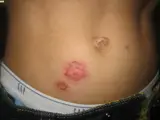
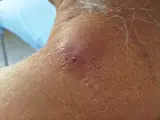
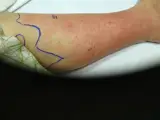
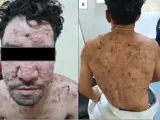
- Erysipelas: Poupou l'quourouce, “Erysipel”, CC BY-SA 3.0, via Wikimedia Commons · CC BY-SA 3.0 · Source
- Impetigo (impetigo contagiosa): Littlekidsdoc, “Bullous impetigo”, CC BY-SA 4.0, via Wikimedia Commons · CC BY-SA 4.0 · Source
- Cutaneous myiasis: Petruss, “Miasis human”, CC0, via Wikimedia Commons · CC0 · Source
- Cellulitis (phlegmon): Stephen Ewen, “Left cellulitis of leg”, CC BY-SA 4.0, via Wikimedia Commons · CC BY-SA 4.0 · Source
- Acne fulminans: Lahrougui A, Aboudourib M, Bendaoud L, Amal S, Hocar O, Cureus 2025, Figure 1, CC BY 4.0, via PubMed Central (PMC12123476) · CC BY 4.0 · Source
- Ecthyma: Norman Purvis Walker, An Introduction to Dermatology (3rd ed., 1905), public domain, via Wikimedia Commons – cropped · Public domain · Source
Treatment principles
- Fluctuant furuncles and carbuncles are treated by incision and drainage; small furuncles often heal with local warmth and antiseptic treatment.
- Systemic antibiotics are indicated for carbuncles, mid-facial location, fever, immunosuppression or surrounding cellulitis; manipulation on the face should be avoided because of the risk of cavernous sinus thrombosis.
- In recurrent furunculosis, testing for Panton-Valentine leukocidin-producing Staphylococcus aureus strains is performed and decolonisation of patients and close contacts is considered.
Specific treatment regimens with drugs and doses are covered in the DermaFuchs app.
Keep learning in the app
References (selection)
Cross-references
Mentioned in
Keep learning: test yourself
One question from the DermaFuchs app on Furuncle and carbuncle – tap an answer.
Question 1 of 1
How is a furuncle clinically defined?
Answer
Correct: deep purulent nodule. A furuncle is a deep, necrotizing folliculitis that presents as a painful, deep purulent nodule, often with a central necrotic plug.
More questions like these – with explanations and spaced repetition – in the app.
Note: This page is intended for medical education and does not replace diagnosis or treatment decisions in individual cases.