Pinta (carate)
- Synonyms
- Carate, Mal del pinto, Treponema carateum, endemische Treponematose, endemic treponematosis
- Specialty
- Dermatology · Bacterial infections
- Images
- Clinical 1
- Last updated
- 10/2026 · Dr. Pascal Bafteh
Contents
Images (1)
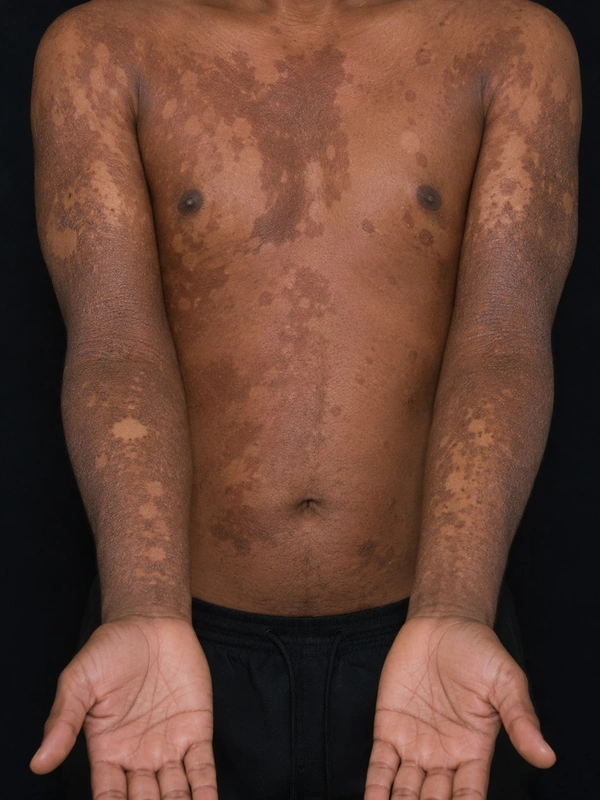 AI illustration
Definition
Pinta is a chronic endemic treponematosis caused by Treponema carateum. Unlike yaws and syphilis, it affects only the skin.
Occurrence & epidemiology
It occurs only in scattered rural areas of Central and South America and was first described in Mexico in the 16th century. WHO lists 15 Latin American countries as previously endemic; the current frequency is unknown owing to a lack of data. Mainly children and young adults are affected.
Aetiopathogenesis
The exact mode of transmission is unknown; infection probably occurs through direct skin or mucous membrane contact.
Clinical features
- Primary stage: after an incubation period of 2–3 weeks, one or more papules that slowly enlarge into itchy, red, scaly plaques; mainly on exposed skin (tops of the feet, legs, backs of the hands, forearms). Regional lymph nodes may enlarge, but there are no systemic symptoms.
- Secondary stage: after 6 months to 3 years, more widespread papules and plaques ("pintids") with abnormal pigmentation and scaling; lesions may be red, white, blue, violet or brown.
- Tertiary stage: late lesions with complete loss of pigment (achromic) and atrophy of the skin.
Diagnosis
- Usually based on the clinical picture and origin from a previously endemic area.
- Syphilis serology positive; T. carateum cannot be distinguished morphologically or serologically from the agents of syphilis, yaws and bejel.
- Dark-field microscopy of swabs from early lesions.
- Biopsy: in early lesions, treponemes can be shown with silver stain.
Differential diagnoses
Keep learning in the app
References (selection)
Cross-references
Mentioned in
Note: This page is intended for medical education and does not replace diagnosis or treatment decisions in individual cases.