Secondary syphilis (lues II)
Definition & Pathogen
- Pathogen: Treponema pallidum (subsp. pallidum), obligate human-pathogenic spirochete, not culturable in vitro.
- Transmission: sexual (mucosal contact), vertical (transplacental → congenital syphilis), rarely transfusion/needlestick.
- Incubation period: 10–90 days (Ø 21) until primary lesion.
- Global incidence rising again since 2010, especially in MSM and HIV co-infection.
Clinical (Stage Course)
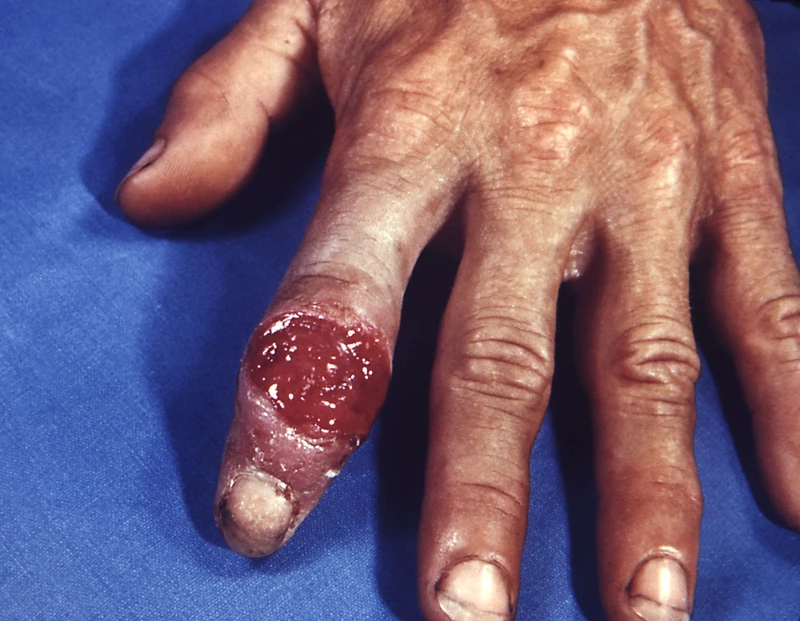
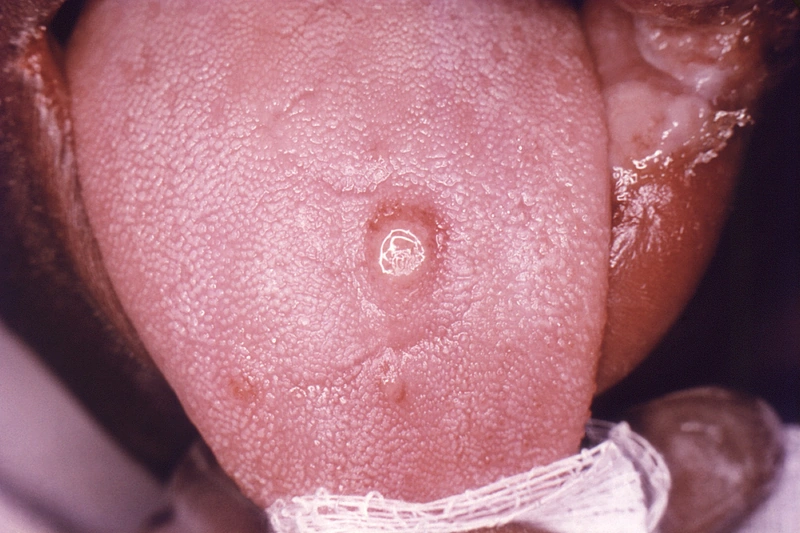
- Primary stage (3–4 weeks): Chancre (painless, indurated) at the inoculation site (genital, oral, anal) + painless regional lymphadenopathy.
- Secondary stage (6–8 weeks post-infection):
- Syphilitic roseola: generalized maculopapular rash incl. palms/soles — pale salmon to pink, ill-defined macules, not raised, without scaling and typically without itch; which is exactly why patients often do not notice them and do not mention them.
- Palmoplantar syphilids: round, livid-red lesions on the palms and soles. The specific marginal sign is the collarette of scale that surrounds the lesion like a collar (Biett collar). Involvement of the palms and soles is the cardinal sign of lues II — hardly any other disease produces lesions there, and that is what gives it away.
- How discreet the findings can be: the same patient on the same day — a clear lesion with a collarette on the palm, only two pale macules on the sole, a few barely visible spots on the trunk. The diagnostic trap is not the striking picture but the inconspicuous one: anyone who does not deliberately search the palms and soles in a young adult with an unclear, non-itchy truncal rash will miss the diagnosis.
- Condylomata lata (perianal, intertriginous, highly infectious)
- Mucous patches (mucosal lesions)
- Moth-eaten alopecia (alopecia areolaris, pathognomonic, occipital)
- Constitutional: fever, generalized lymphadenopathy, splenomegaly
- Latent stage: asymptomatic, serologically positive (early < 1 year, late > 1 year).
- Tertiary stage (years to decades):
- Gummas (granulomatous destruction of skin/bone/organs)
- Cardiovascular syphilis: aortitis, aortic aneurysm, aortic insufficiency
- Neurosyphilis (tabes dorsalis, general paresis, gummatous neurosyphilis)
Diagnostics
- Confirmatory test: FTA-Abs (IgG/IgM differentiation possible).
- Activity marker (non-treponemal): VDRL/RPR (quantitative) — titer correlates with disease activity.
- Neurosyphilis: Lumbar puncture (cell count, protein, VDRL, TPPA index).
- Syphilis serology sequence: Screening TPPA/TPHA → Confirmatory FTA-Abs → Activity marker FTA-Abs-IgM + quantitative VDRL.
- TPPA positive + VDRL negative: Serologic scar or very early infection — follow-up recommended.
- Direct detection (primary stage): dark-field microscopy of ulcer exudate, PCR from lesion.
Complications & Special Forms
- Lues maligna: severe ulcerative-necrotic variant in HIV co-infection.
- Congenital syphilis:
- Early (< 2 yrs): pemphigus syphiliticus palmoplantar, coryza syphilitica, hepatosplenomegaly, osteochondritis
- Late (> 2 yrs): Hutchinson triad (notched teeth, interstitial keratitis, sensorineural deafness), saddle nose, saber shin
- Jarisch-Herxheimer reaction: Fever/rash/chills 2–8 h after first penicillin dose — caused by the breakdown of treponemes with release of lipoproteins and a subsequent cytokine surge. Prophylaxis: prednisolone 1 mg/kg BW p.o. or i.v. 30–60 min before the first penicillin dose, especially in neurosyphilis, ocular and cardiovascular syphilis and with a high organism load in the secondary stage; in pregnancy a pronounced reaction may trigger preterm contractions. The Jarisch-Herxheimer reaction is not a penicillin allergy — the antibiotic is continued and managed purely symptomatically (antipyretics, fluids).
Differential diagnoses
- Gumma in tertiary syphilis
- Lepromatous leprosy
- Pyoderma gangrenosum
- Mycosis fungoides
- Erythema migrans (Lyme disease)
- Pityriasis rosea
- Psoriasis vulgaris (plaque psoriasis)
- Palmoplantar psoriasis
Practise Secondary syphilis (lues II) in the app
Flashcards with spaced repetition, exam questions and spot-the-diagnosis on this topic – in DermaFuchs, free of charge.
In the DermaFuchs app: 4 flashcards · 13 clinical images
Open in browser Download on the App StoreSources (selection)
More sexually transmitted infections
Note: This page is intended for medical education and does not replace diagnosis or treatment decisions in individual cases. Treatment and follow-up content is available in the app.