Atypical fibroxanthoma
- Synonyms
- AFX
- Specialty
- Dermatology · Skin tumours
- Images
- Histology 1 · Clinical 2
- In the app
- 2 flashcards
- Last updated
- 10/2026 · Dr. Pascal Bafteh
Contents
Images (3)
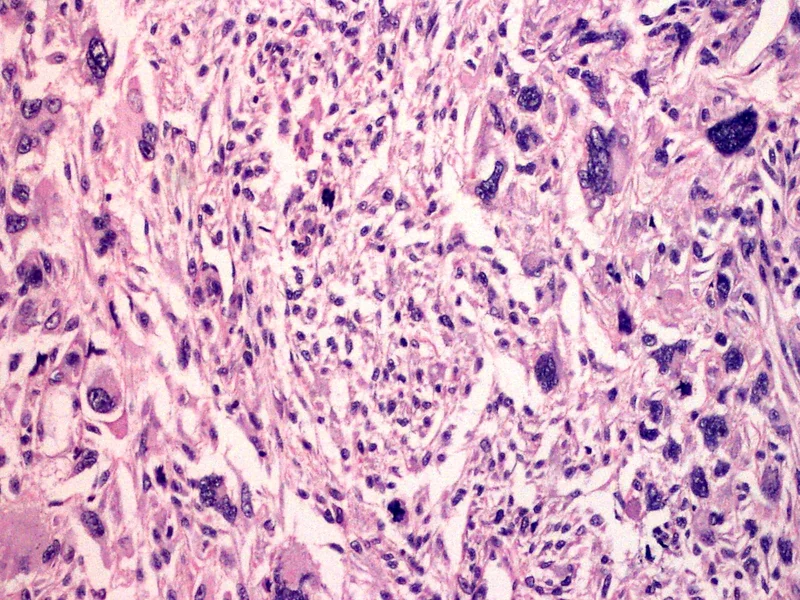 Histology
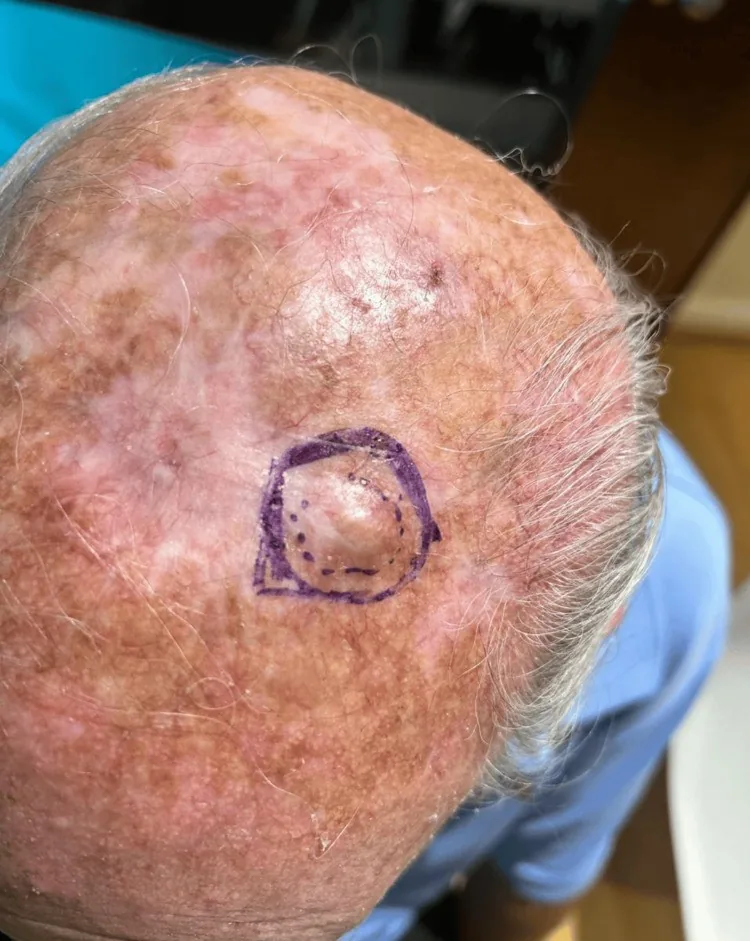
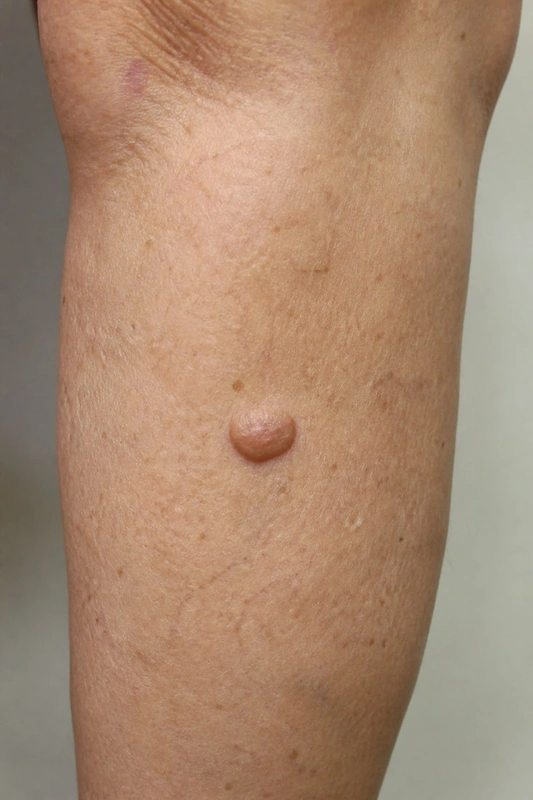 AI illustration
Definition
Atypical Fibroxanthoma (AFX)
Definition & Clinical Presentation
- AFX = superficial, dermally localized fibrohistiocytic neoplasm of UV-exposed skin in older patients.
- Clinical Presentation: ulcerated nodule on UV-exposed skin — bald scalp of older men, ear helix, nose, cheek.
- Patients: men affected about 8× more often, age peak in the 7th–8th decade, fair skin type.
Histology & IHC
- Dermally localized (NO subcutaneous involvement — key for PDS differentiation!), pleomorphic spindle/giant cells with atypical mitoses.
- IHC: CD10+ + CK− + S100/SOX10− + desmin− — exclusion of SCC + melanoma is mandatory.
Differential diagnoses
 Dermatofibroma
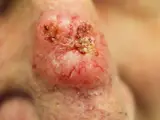 Basal cell carcinoma
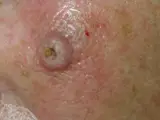 Keratoacanthoma
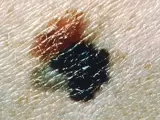 Melanoma
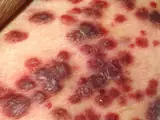 Kaposi's sarcoma
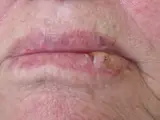 Cutaneous squamous cell carcinoma
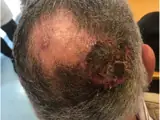 Cutaneous angiosarcoma
Image credits for the thumbnails
- Dermatofibroma: Jmarchn, “Pigmented and tenderness dermatofibroma”, CC BY-SA 3.0, via Wikimedia Commons · CC BY-SA 3.0 · Source
- Basal cell carcinoma: Bin im Garten, “Basaliom am Nasenrücken 2”, CC BY-SA 3.0, via Wikimedia Commons · CC BY-SA 3.0 · Source
- Keratoacanthoma: Klaus D. Peter, Wiehl, Germany, “Spinaliom”, CC BY 3.0 DE, via Wikimedia Commons · CC BY 3.0 DE · Source
- Melanoma: National Cancer Institute (unknown photographer), “Melanoma (4)”, Public Domain, via Wikimedia Commons · Public domain · Source
- Kaposi's sarcoma: unknown author, “Kaposi's Sarcoma”, Public Domain, via Wikimedia Commons · Public Domain · Source
- Cutaneous squamous cell carcinoma: Klaus D. Peter, Wiehl, Germany, “Spinaliom3”, CC BY 3.0 DE, via Wikimedia Commons · CC BY 3.0 DE · Source
- Cutaneous angiosarcoma: Messias H, Martins M, Zagalo C et al. (Cancer Rep (Hoboken) 2022), CC BY 4.0, via PubMed Central (PMC9575495) · CC BY 4.0 · Source
Treatment principles
- The treatment of choice is complete excision with histological margin control, preferably as micrographically controlled surgery.
- Radiotherapy may be considered if surgery is contraindicated.
- After complete removal the prognosis is good; histological distinction from pleomorphic dermal sarcoma, which requires more extensive surgery and closer follow-up, is essential.
Guideline: AWMF guideline register (no. 032-057)
Specific treatment regimens with drugs and doses are covered in the DermaFuchs app.
Keep learning in the app
Cross-references
Mentioned in
- Merkel cell carcinoma
- Microcystic adnexal carcinoma
- Cutaneous angiosarcoma
- Cutaneous leishmaniasis
- Morphea
- Swimming Pool Granuloma
- Keratoacanthoma
- Seborrhoeic keratosis
- Spitz naevus (spindle and epithelioid cell naevus)
- Paget disease of the nipple (mammary Paget disease)
- Primary cutaneous anaplastic large cell lymphoma (pcALCL)
Keep learning: test yourself
One question from the DermaFuchs app on Atypical fibroxanthoma – tap an answer.
Question 1 of 1
What is the average age of patients with Atypical Fibroxanthoma?
Answer
Correct: > 70 years. Patients with Atypical Fibroxanthoma typically have a male predominance and are over 70 years old.
More questions like these – with explanations and spaced repetition – in the app.
Note: This page is intended for medical education and does not replace diagnosis or treatment decisions in individual cases.