Melanoma
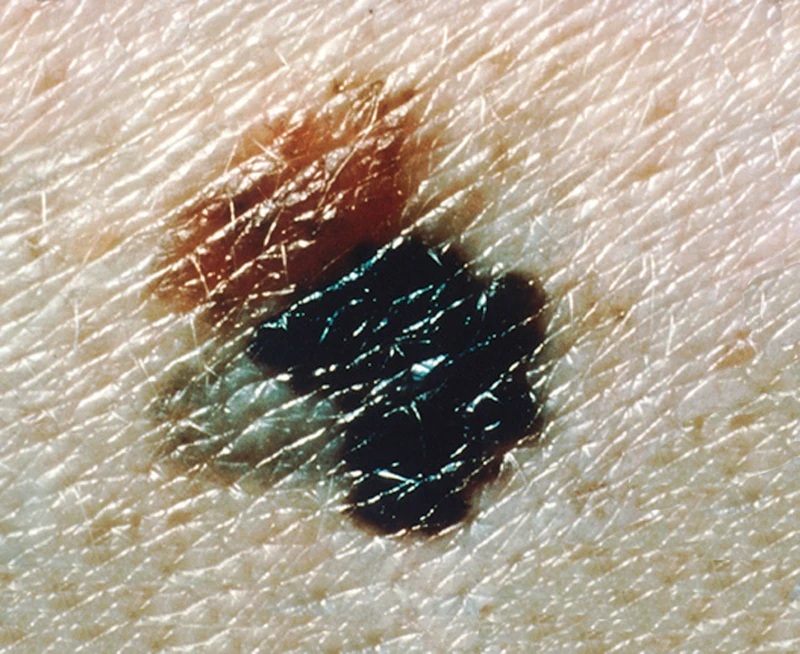
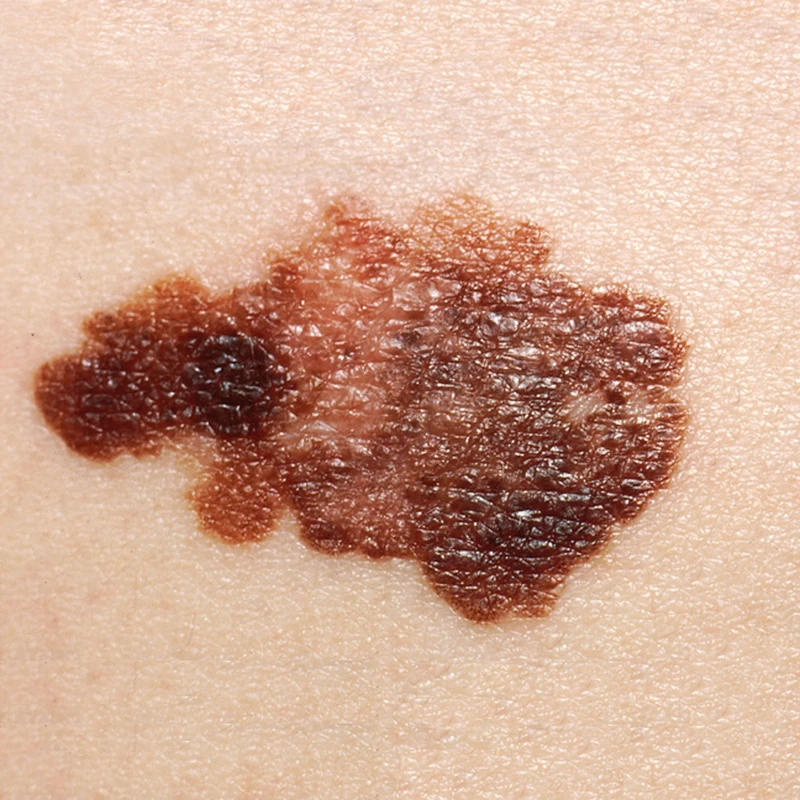
Epidemiology & Fundamentals
- Origin: 70% de novo, only 30% on nevi. Precursors in children: Giant Nevi or Spitz Nevi.
- Genetics: FAMM syndrome due to mutation in CDK4 and CDKN2A.
- Risk: XP (x1000), >100 nevi (x11), PA (x7), IS (x6). Lifetime risk: 2%.
- Statistics: Approx. 3000 metastases/year in DE (SCC: 1500).
- Types: Cutaneous (SSM > Nodular > LMM > ALM); Non-cutaneous (Choroidal/Ocular > Mucosal > GI > Meningeal > MUP).
Diagnostics & Genetics & Metastasis
Excision & Diagnostics
- Excision: Initial 3–5 mm SA, no punch biopsy (PB). Tumor thickness according to Breslow (from Str. Granulosum downwards).
- Why excise narrowly at first? A generous safety margin at the very first excision destroys the lymphatic drainage of the region and renders a later sentinel lymph node biopsy unreliable; the thickness-adapted margin is only taken at re-excision once histology is available.
- Preoperative thickness estimation: High-frequency ultrasound (20 MHz) provides only an approximate preoperative value; stage and safety margin are governed by the histological Breslow thickness.
- ABCDE: Asymmetry, Border, Color, Diameter (>6 mm), Elevation.
The MAPK/ERK pathway — why BRAF matters in melanoma
- The chain: A growth factor binds a receptor tyrosine kinase (e.g. c-KIT) → RAS → RAF → MEK → ERK → nucleus. There ERK switches on cyclin D1 and MITF, the master regulator of melanocytes: division, survival, pigment production. Physiologically the chain is short and switches itself off again.
- What the V600 mutation does: Replacing valine with glutamic acid at codon 600 keeps the kinase permanently active, even without a signal from RAS — the pathway is constitutively on and the cell divides without any external trigger.
- Where in the chain does what sit? RAS lies upstream of RAF, MEK downstream. That is why a BRAF inhibitor does not help in NRAS-mutated disease: the defect sits one step higher and bypasses the drug.
- Four groups (TCGA): BRAF (~50 %), RAS (~30 %), NF1 (~14 %), triple wild type. NF1 brakes RAS — if it fails, the pathway also runs unchecked. The triple wild type group collects acral, mucosal and uveal melanomas (there rather c-KIT or GNAQ/GNA11).
- UV or not? BRAF V600E carries no typical UV signature (C→T at dipyrimidine sites); BRAF-mutated melanomas arise rather on the intermittently exposed trunk of younger people, NF1-mutated ones on chronically sun-damaged skin of older people.
- Why always BRAF plus MEK? Under BRAF blockade alone the pathway is switched back on below RAF within a few months (resistance). The combination blocks two consecutive steps → longer progression-free survival and fewer secondary skin tumours.
- Paradoxical activation — the reason testing is mandatory: In cells without a BRAF mutation (especially RAS-mutated ones) a BRAF inhibitor drives the RAF molecules to dimerise via CRAF and thereby strengthen the ERK signal. Clinically this shows up as keratoacanthomas and squamous cell carcinomas under vemurafenib. A BRAF inhibitor must therefore never be given in BRAF wild type disease.
- Second axis (cell cycle): Running parallel to MAPK is CDKN2A → p16^INK4a^ → CDK4/6 → Rb. In FAMM syndrome exactly this brake fails — which is why CDKN2A and CDK4 are the germline genes there, not BRAF.
Testing in practice (from Stage Ib)
- BRAF V600: test in all melanomas.
- NRAS: in BRAF wild type.
- c-KIT: in ALM and mucosal melanoma (Therapy: Imatinib/Sunitinib).
Metastasis Definition
- Satellite: < 2 cm from the primary.
- In-Transit: > 2 cm from the primary to the nearest lymph node.
- Sentinel (SLN): Micrometastasis (≤ 2 mm, histological only) vs. Macrometastasis (> 2 mm, clinical/ultrasound).
Differential diagnoses
- Dysplastic naevus
- Lentigo maligna
- Basal cell carcinoma
- Reed nevus (pigmented spindle cell nevus)
- Keratoacanthoma
- Seborrhoeic keratosis
- Dermatofibroma
- Pyogenic granuloma
Practise Melanoma in the app
Flashcards with spaced repetition, exam questions and spot-the-diagnosis on this topic – in DermaFuchs, free of charge.
In the DermaFuchs app: 10 flashcards · 16 clinical images
Open in browser Download on the App StoreSources (selection)
- Joshi et al. 2025
- AWMF S3 Melanom 2024
- Cancer Genome Atlas Network. Genomic Classification of Cutaneous Melanoma. Cell. 2015;161(7):1681-1696.
- Long GV, Stroyakovskiy D, Gogas H, et al. Combined BRAF and MEK inhibition versus BRAF inhibition alone in melanoma. N Engl J Med. 2014;371(20):1877-1888.
- Su F, Viros A, Milagre C, et al. RAS mutations in cutaneous squamous-cell carcinomas in patients treated with BRAF inhibitors. N Engl J Med. 2012;366(3):207-215.
- AWMF S3 Melanoma 2026
More skin tumours
- Basal cell carcinoma
- Lentigo maligna
- Cutaneous squamous cell carcinoma
- Actinic keratosis
- Actinic cheilitis
- Merkel cell carcinoma
- Microcystic adnexal carcinoma
- Dermatofibroma
Note: This page is intended for medical education and does not replace diagnosis or treatment decisions in individual cases. Treatment and follow-up content is available in the app.