Cutaneous leishmaniasis
General & Epidemiology
- Third most common vector-borne disease worldwide after malaria + dengue.
- Pathogens are Leishmania protozoa of the family Trypanosomatidae with promastigote/amastigote change.
- Reservoir are rodents/dogs with humans primarily in L. tropica.
- Vector: Sandflies (Phlebotomus in the Old World, Lutzomyia in the New World) — crepuscular/nocturnal.
- Occurrence: Mediterranean region (Portugal, Spain — Mallorca, Southern France, Italy), Africa, Middle East, South and Central America, India.
- Geographical concentration: More than 90 % of all cutaneous leishmaniasis cases occur in only about nine countries — in the Old World Afghanistan, Algeria, Iran, Iraq, Syria and Saudi Arabia, in the New World Brazil, Colombia and Peru.
- Predilection sites: Face and arms (exposed skin areas).
Life Cycle / Pathogenesis Cascade
- Sandfly bites infected host → takes up amastigotes.
- In the sandfly midgut, maturation to promastigotes (flagellated, infectious form).
- Sandfly bites new host → injects promastigotes into the skin.
- Phagocytosis by macrophages + dendritic cells → in the phagolysosome vacuole, transformation to amastigotes (intracellular, without flagellum).
- Replication of amastigotes in macrophages → inflammation + granuloma formation → skin manifestation.
- Repeat sandfly bite → uptake of amastigotes → cycle.
Three Clinical Forms
Cutaneous Leishmaniasis ("Oriental Sore")
- Old World pathogens: L. tropica, L. major, L. infantum.
- New World pathogens: L. mexicana, L. (Viannia) braziliensis, L. amazonensis.
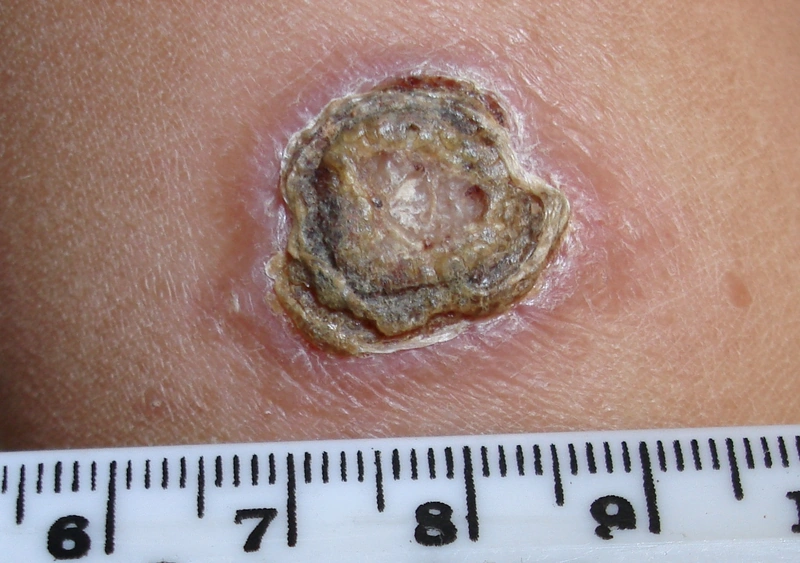
- Clinical presentation shows red nodule → plaque → ulcer with volcano-like rim, often painless, slow development 2–8 weeks after bite.
- Localization: Face, arms, legs — uncovered skin areas.
- Spontaneous healing in 6–18 months for many species; leaves an atrophic sunken scar.
Mucocutaneous Leishmaniasis ("Espundia")
- Main causative agents: L. (Viannia) braziliensis, L. panamensis (South America).
- Clinical presentation: mucosa of nose/oropharynx months–years after cutaneous manifestation with tapir nose/septal perforation.
- Complication: Aspiration pneumonia, stridor, oral dysfunction, cosmetic disfigurement.
Visceral Leishmaniasis ("Kala-Azar", black fever)
- Pathogens are L. donovani/infantum/chagasi with visceral involvement.
- Clinical presentation: Involvement of bone marrow, liver, spleen, lymph nodes — fever episodes, hepatosplenomegaly, pancytopenia, hypergammaglobulinemia, hyperpigmentation ("Kala-Azar" = black fever), cachexia.
- Untreated mortality > 95 %.
Diagnostics
- Specimen collection: with 4–6 mm punch biopsy from active border, divided for culture/histo/Giemsa/PCR.
- Giemsa staining: Detection of intracellular amastigotes ("Leishman-Donovan bodies") in macrophages.
- Leishmania PCR (sensitive, species differentiation possible).
- Culture on NNN medium (Novy-MacNeal-Nicolle) — standard laboratory requirement in tropical medicine.
- For L. donovani / L. infantum with suspected visceral L.: the procedure is exclude visceral manifestation with bone marrow puncture + ultrasound + rK39.
Differential diagnoses
- Sporotrichosis
- Cutaneous myiasis
- Pyogenic granuloma
- Ecthyma
- Secondary syphilis (lues II)
- Atypical fibroxanthoma
- Swimming Pool Granuloma
- Yaws
Practise Cutaneous leishmaniasis in the app
Flashcards with spaced repetition, exam questions and spot-the-diagnosis on this topic – in DermaFuchs, free of charge.
In the DermaFuchs app: 3 flashcards · 7 clinical images
Open in browser Download on the App StoreSources (selection)
- World Health Organization. Leishmaniasis — fact sheet. Geneva: WHO.
- Burza 2018 Lancet — Leishmaniasis
- AWMF S1 Leishmaniase 2021
More parasitic skin diseases
- Demodicosis
- Filariasis
- Cutaneous larva migrans
- Pediculosis capitis
- Caterpillar dermatitis caused by oak processionary moth (Thaumetopoea processionea)
- Crusted (Norwegian) scabies
- Scabies
- Tungiasis
Note: This page is intended for medical education and does not replace diagnosis or treatment decisions in individual cases. Treatment and follow-up content is available in the app.