Microcystic adnexal carcinoma
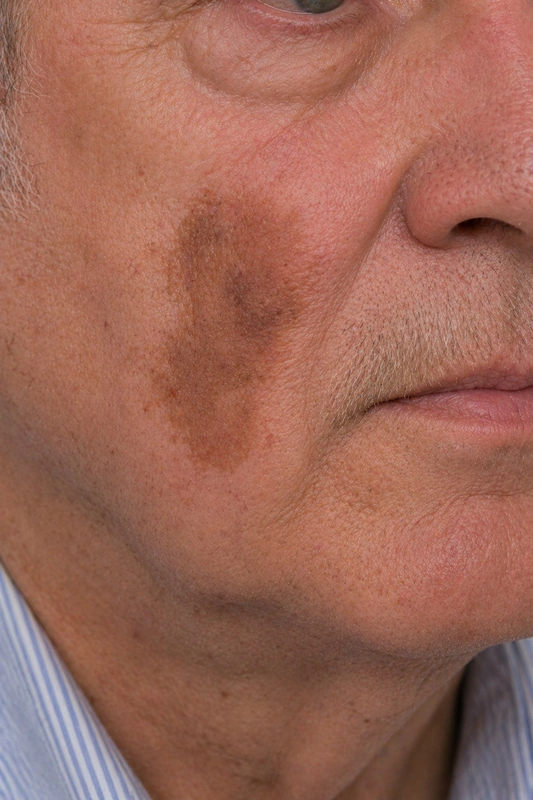
Definition & Epidemiology
- Definition low-grade eccrine + infiltrative — sweat gland tumor on the face (cheeks, upper lip, nose) of adults.
- Incidence: very rare (~ 0.02 / 100,000 / year).
- Female:Male ~ 2:1.
- Common history: History of radiation in the facial area (latent 30 years).
Clinical Presentation
- Solitary, slowly growing, indolent, firm, skin-colored or yellowish-red plaque or nodule on the face — typically perioral / paranasal / cheeks.
- Clinically often confused in differential diagnosis with BCC, trichoepithelioma, sebaceous gland hyperplasia → diagnosis often only histological.
- Caution: deep growth + perineural 50–80% — pain, paresthesia as late symptoms.
- Metastasis: none / extremely rare — prognostically favorable despite local destruction.
Histology
- Superficially cystic structures (eponymous "microcystic").
- In depth infiltrative strands with ductal differentiation — differential diagnosis from the sclerodermiform variant of BCC often histomorphologically difficult.
- IHC: EMA+, CK7+, CEA+, possibly p63+ — ductal eccrine differentiation.
- Histological DD: desmoplastic trichoepithelioma, syringomatous carcinoma, sclerodermiform BCC.
Differential diagnoses
- Basal cell carcinoma
- Trichoepithelioma
- Epidermoid cyst
- Epidermal cyst (atheroma)
- Eccrine hidrocystoma
- Atypical fibroxanthoma
- Dermatofibroma
- Keratoacanthoma
Practise Microcystic adnexal carcinoma in the app
Flashcards with spaced repetition, exam questions and spot-the-diagnosis on this topic – in DermaFuchs, free of charge.
In the DermaFuchs app: 1 flashcards · 3 clinical images
Open in browser Download on the App StoreMore skin tumours
- Basal cell carcinoma
- Melanoma
- Lentigo maligna
- Cutaneous squamous cell carcinoma
- Actinic keratosis
- Actinic cheilitis
- Merkel cell carcinoma
- Dermatofibroma
Note: This page is intended for medical education and does not replace diagnosis or treatment decisions in individual cases. Treatment and follow-up content is available in the app.