Cutaneous angiosarcoma
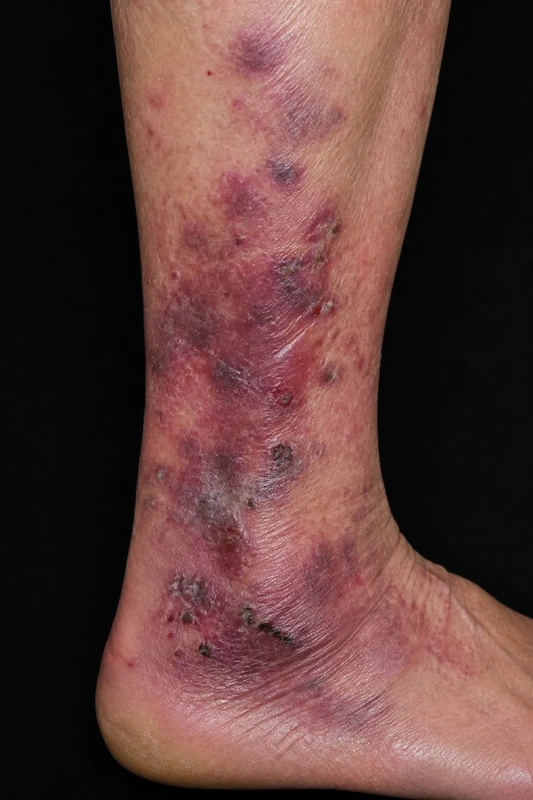
General
Angiosarcoma is a rare, highly malignant endothelial soft tissue sarcoma with vascular differentiation, accounting for approximately 2% of all soft tissue sarcomas. Its incidence has increased in recent decades from about 0.13/100,000 (1975) to about 0.33/100,000.
- Risk factors: Important risk factors include chronic lymphedema (Stewart-Treves syndrome), radiation.
- Prognosis: The prognosis is characterized by a 10-year survival rate of approximately <20%, due to early metastasis to the lungs, liver, and lymph nodes.
Types
Distinguished are:
- Sporadic (cutaneous) angiosarcoma (often head and neck region)
- Lymphedema-associated angiosarcoma (Stewart-Treves syndrome)
- Post-radiation angiosarcoma
- Epithelioid angiosarcoma
The most common cutaneous angiosarcoma is the sporadic angiosarcoma in the head.
Diagnostics
- Histology: Diagnosis is confirmed by deep biopsies with immunohistochemical detection of endothelial markers.
- Immunohistochemistry: The most sensitive marker is CD31.
- Clinical sign: A clinical indicator can be the "tilt phenomenon" (apparent displaceability of livid lesions).
- Staging: PET-CT is preferred for staging.
Differential diagnoses
- Kaposi's sarcoma
- Haemangioma
- Dermatofibrosarcoma protuberans
- Basal cell carcinoma
- Merkel cell carcinoma
- Atypical fibroxanthoma
- Port-wine stain
Practise Cutaneous angiosarcoma in the app
Flashcards with spaced repetition, exam questions and spot-the-diagnosis on this topic – in DermaFuchs, free of charge.
In the DermaFuchs app: 7 flashcards · 2 clinical images
Open in browser Download on the App StoreSources (selection)
More skin tumours
- Basal cell carcinoma
- Melanoma
- Lentigo maligna
- Cutaneous squamous cell carcinoma
- Actinic keratosis
- Actinic cheilitis
- Merkel cell carcinoma
- Microcystic adnexal carcinoma
Note: This page is intended for medical education and does not replace diagnosis or treatment decisions in individual cases. Treatment and follow-up content is available in the app.