Swimming Pool Granuloma
- Synonyms
- fish tank granuloma, Mycobacterium marinum
- Specialty
- Dermatology · Bacterial infections
- Images
- Clinical 2
- In the app
- 2 flashcards
- Last updated
- 10/2026 · Dr. Pascal Bafteh
Contents
Images (2)
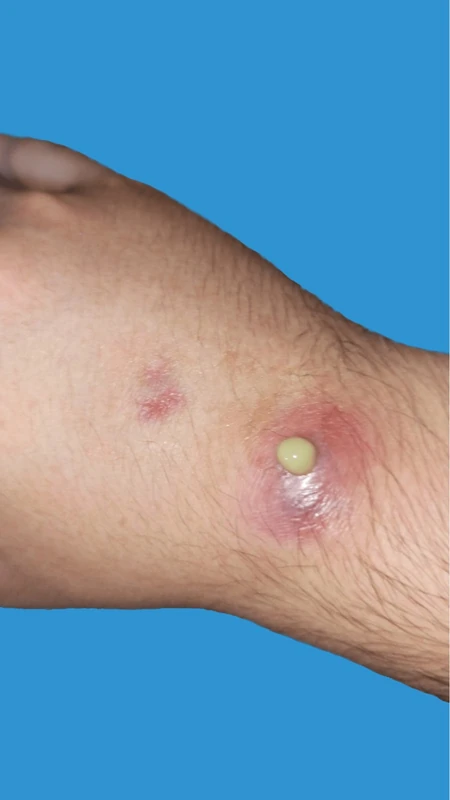
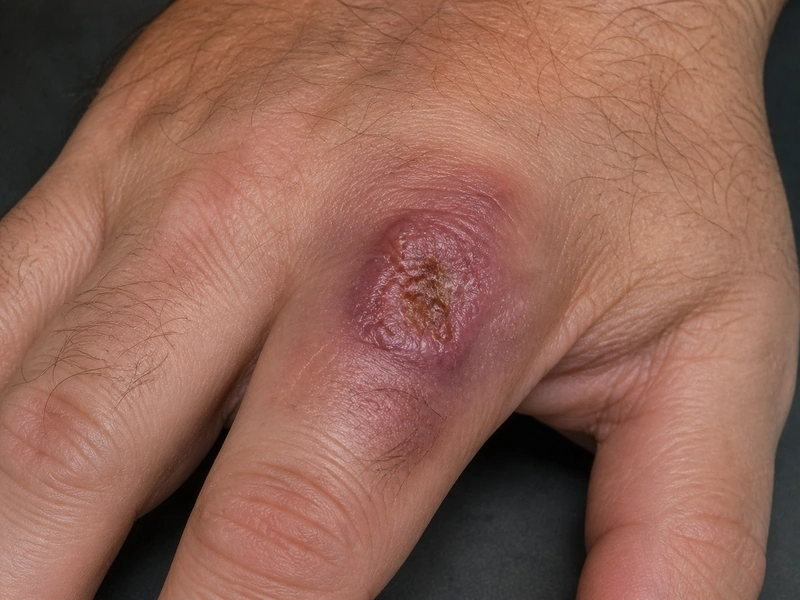 AI illustration
Definition
Swimming pool or fish tank granuloma is a skin infection with Mycobacterium marinum, a non-tuberculous mycobacterium found in fresh and salt water. Infection usually follows recreational or occupational exposure to contaminated fresh or salt water (e.g. fish tanks, swimming pools); typically a single nodule or pustule, mainly on the elbows, knees, tops of the feet, knuckles or fingers, sometimes with further nodules along the lymphatics (sporotrichoid spread).
- Source is aquariums/pools with fish injuries via percutaneous inoculation.
- Clinical features: livid nodule, verrucous plaque, or ulcerating lesion on hand / forearm 2–4 weeks after exposure; sporotrichoid ascending arrangement possible.
- Course: asymptomatic or moderately painful, spontaneous remission possible within 1–2 years.
Diagnosis
- The exposure history is crucial.
- Biopsy with histology, tissue culture (special conditions such as a lower temperature; the laboratory needs to know of the suspicion) and PCR.
- Distinction from sporotrichosis and other mycobacterioses.
Differential diagnoses
 Pyogenic granuloma
 Warts (verrucae vulgares)
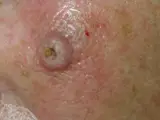 Keratoacanthoma
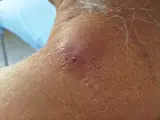 Cutaneous myiasis
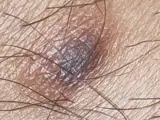 Dermatofibroma
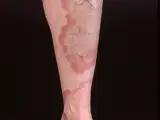 Granuloma annulare
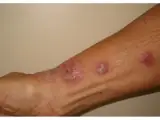 Sporotrichosis
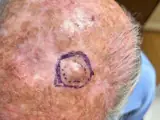 Atypical fibroxanthoma
Image credits for the thumbnails
- Pyogenic granuloma: kilbad, “Pyogenic granuloma on a finger-1”, CC BY 3.0, via Wikimedia Commons · CC BY 3.0 · Source
- Warts (verrucae vulgares): Abbassyma (English Wikipedia), “Verruca vulgaris”, Public Domain, via Wikimedia Commons · Public domain · Source
- Keratoacanthoma: Klaus D. Peter, Wiehl, Germany, “Spinaliom”, CC BY 3.0 DE, via Wikimedia Commons · CC BY 3.0 DE · Source
- Cutaneous myiasis: Petruss, “Miasis human”, CC0, via Wikimedia Commons · CC0 · Source
- Dermatofibroma: Jmarchn, “Pigmented and tenderness dermatofibroma”, CC BY-SA 3.0, via Wikimedia Commons · CC BY-SA 3.0 · Source
- Granuloma annulare: Kreuter et al., “Generalized granuloma annulare”, CC BY-SA 2.0, via Wikimedia Commons · CC BY-SA 2.0 · Source
- Sporotrichosis: Gomes RDSR, do Valle ACF, Freitas DFS et al. (J Fungi (Basel) 2023), CC BY 4.0, via PubMed Central (PMC10455193) · CC BY 4.0 · Source
- Atypical fibroxanthoma: Apichoto-Mata I, García-Contreras SJ, Garnica B (Cureus 2026), CC BY 4.0, via PubMed Central (PMC12949712) · CC BY 4.0 · Source
Treatment principles
- Swimming pool granuloma may heal spontaneously over months but is usually treated with prolonged antibiotic therapy, ideally after identification of the organism and susceptibility testing.
- Deep infection involving tendon sheaths or joints may require surgical debridement.
- For aquarium owners, wearing gloves when cleaning the tank is an important preventive measure.
Specific treatment regimens with drugs and doses are covered in the DermaFuchs app.
Keep learning in the app
References (selection)
Cross-references
Keep learning: test yourself
One question from the DermaFuchs app on Swimming Pool Granuloma – tap an answer.
Question 1 of 1
What is the typical environmental source for Mycobacterium marinum infections?
Answer
Correct: aquariums/pools. Mycobacterium marinum is an atypical mycobacterium commonly found in aquatic environments like aquariums and pools.
More questions like these – with explanations and spaced repetition – in the app.
Note: This page is intended for medical education and does not replace diagnosis or treatment decisions in individual cases.