Palmoplantar psoriasis
- Synonyms
- psoriasis of hands and feet
- Specialty
- Dermatology · Inflammatory skin diseases
- Images
- Clinical 2
- In the app
- 4 flashcards
- Last updated
- 10/2026 · Dr. Pascal Bafteh
Contents
Images (2)
Definition
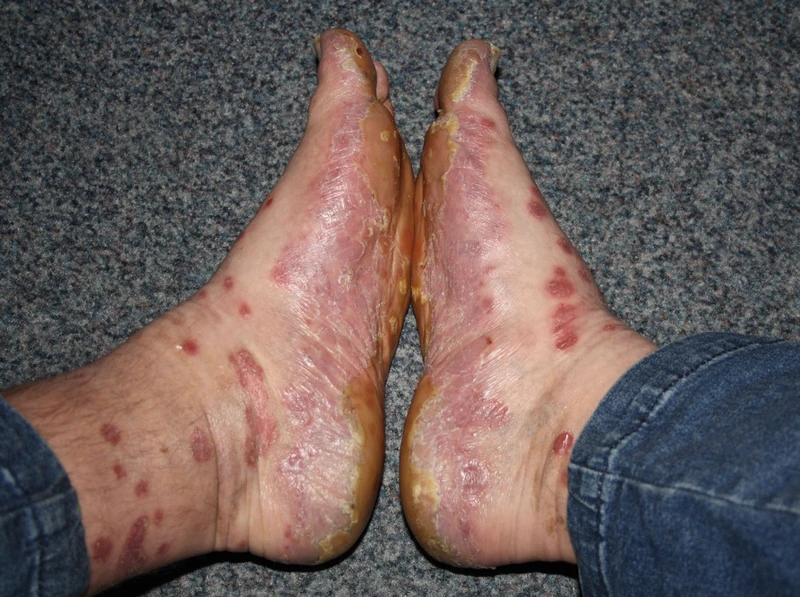
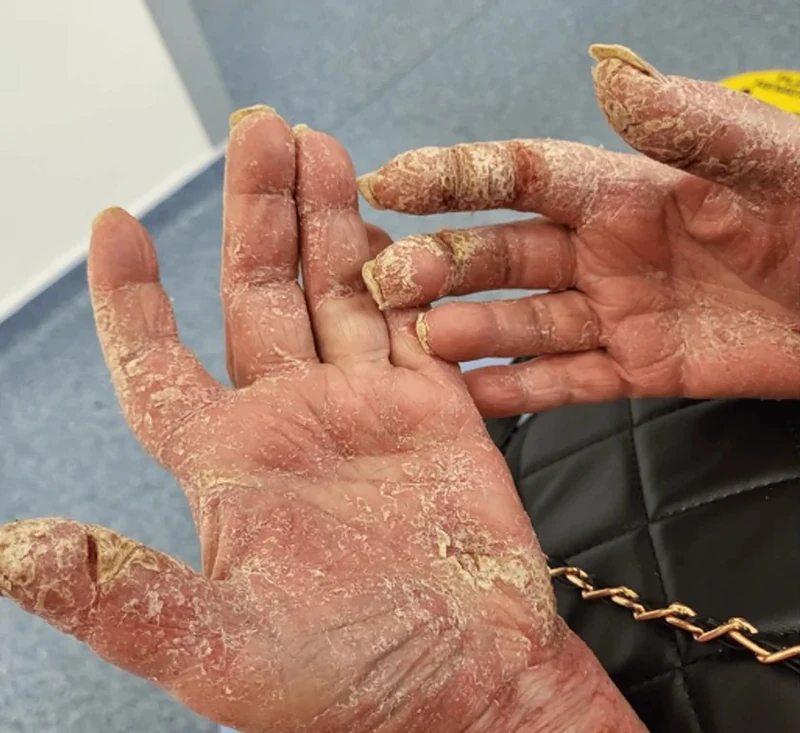
Palmoplantar psoriasis is psoriasis of the palms and soles, either localised or as part of generalised chronic plaque psoriasis. Palmoplantar pustulosis with yellow-brown pustules is no longer classified as psoriasis but is associated with it (10–25% of those affected also have plaque psoriasis).
Hyperkeratotic, painfully fissured plaques on palms and soles with yellowish compact scaling. Frequent fissures with functional impairment. Chronic, often refractory; frequent transition to pustular form (Barber type).
Well-circumscribed thick plaques with central fissures on otherwise uninvolved integument.
Occupational disease (Germany): With occupational exposure (moisture, chemicals) report as BK 5101.
Differential diagnosis: chronic hand/foot eczema, keratoderma, tinea manuum/pedis, hyperkeratotic lichen planus.
Clinical features
- Two patterns: well-defined red scaly plaques as elsewhere, or diffuse thickening and scaling without redness (acquired keratoderma); often deep painful fissures, usually symmetrical and chronic.
- Triggers may be skin injury, infection or hand dermatitis.
- More often associated with nail psoriasis and psoriatic arthritis than psoriasis at other sites.
Diagnosis
- Clinical; mycology (microscopy, culture) to exclude tinea.
- Distinction from hyperkeratotic hand dermatitis and other acquired keratodermas; the diagnosis is supported by psoriasis at other sites; biopsy rarely needed.
Differential diagnoses
 Dyshidrotic eczema (pompholyx)
 Keratoacanthoma
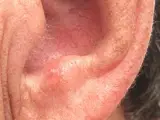 Actinic keratosis
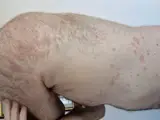 Guttate psoriasis
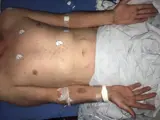 Secondary syphilis (lues II)
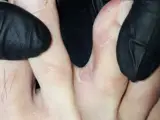 Tinea pedis
Image credits for the thumbnails
- Dyshidrotic eczema (pompholyx): Inwe (Wikimedia Commons), “Dyshidrosis”, CC BY-SA 3.0, via Wikimedia Commons · CC BY-SA 3.0 · Source
- Keratoacanthoma: Klaus D. Peter, Wiehl, Germany, “Spinaliom”, CC BY 3.0 DE, via Wikimedia Commons · CC BY 3.0 DE · Source
- Actinic keratosis: Future FamDoc, “Actinic keratosis on ear”, CC BY-SA 4.0, via Wikimedia Commons · CC BY-SA 4.0 · Source
- Guttate psoriasis: Richard Keatinge, “Guttate psoriasis 66 year old male”, CC BY-SA 4.0, via Wikimedia Commons · CC BY-SA 4.0 · Source
- Secondary syphilis (lues II): Ehlers S, Sergent S, Ashurst J (Clin Pract Cases Emerg Med 2020), CC BY 4.0, via PubMed Central (PMC7676796) · CC BY 4.0 · Source
- Tinea pedis: Tang21237, “Interdigital tinea between the 3rd and 4th interdigital spaces”, CC BY-SA 4.0, via Wikimedia Commons · CC BY-SA 4.0 · Source
Treatment principles
- Palmoplantar psoriasis is regarded as difficult to treat; topically, potent glucocorticoids are combined with keratolytics and vitamin D analogues, supplemented by localised phototherapy.
- Because of the considerable functional impairment, involvement of the hands and feet justifies early systemic therapy, including biologics, even when the area is small.
- Mechanical stress and irritants should be avoided.
Guideline: AWMF guideline register (no. 013-001)
Specific treatment regimens with drugs and doses are covered in the DermaFuchs app.
Keep learning in the app
References (selection)
Cross-references
Mentioned in
More inflammatory skin diseases
Keep learning
Keep learning with flashcards, exam questions and spot diagnoses in the DermaFuchs app – free, in your browser or as an app.
Related pages: Psoriasis inversa · Dyshidrotic eczema (pompholyx) · Keratoacanthoma
Note: This page is intended for medical education and does not replace diagnosis or treatment decisions in individual cases.