Psoriasis inversa
- Synonyms
- inverse psoriasis, flexural psoriasis
- Specialty
- Dermatology · Inflammatory skin diseases
- Images
- Clinical 2
- In the app
- 8 flashcards
- Last updated
- 10/2026 · Dr. Pascal Bafteh
Contents
Images (2)
Definition
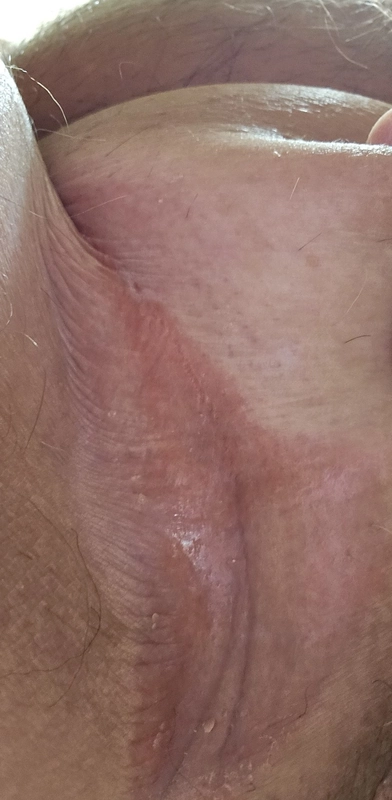
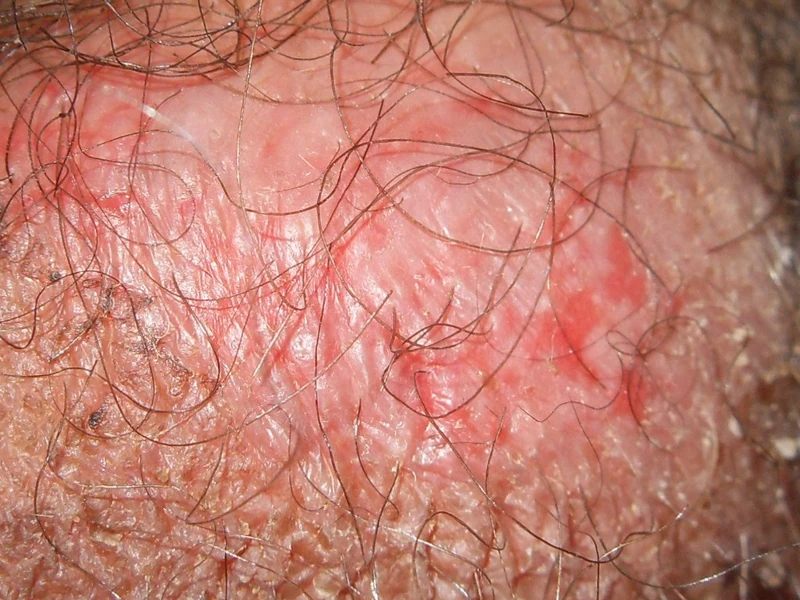
Sharply demarcated, shiny red, non-scaling plaques in intertriginous areas (axillae, inframammary, inguinal, perianal, genital). No scaling due to moisture; sometimes painful with fissures or maceration. Frequent secondary Candida or bacterial superinfection.
Differential diagnosis: Candida intertrigo, erythrasma, seborrheic eczema, irritant eczema.
- Clinical Presentation: Typical are sharply demarcated red plaques with moist surface and NO silvery scaling.
Diagnosis
- Clinical diagnosis: shiny, smooth, deep red, well-defined patches usually without silvery scale, often with a fissure in the fold; supported by psoriasis at other sites (ear canal, behind the ears, scalp, elbows, knees).
- Distinction from seborrhoeic dermatitis (thinner, salmon-pink, less well-defined patches; overlap as "sebopsoriasis"); mycology, as secondary Candida infection is common; Wood's light to exclude erythrasma.
- Consider other causes of intertrigo such as Hailey-Hailey disease; biopsy if the picture is unclear.
Differential diagnoses
 Erythrasma
 Seborrhoeic dermatitis
 Hidradenitis suppurativa (acne inversa)
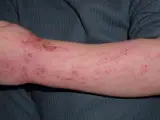 Atopic dermatitis (atopic eczema)
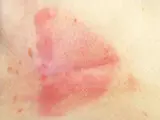 Intertrigo
Image credits for the thumbnails
- Erythrasma: unknown (Commons user), “Erythrasma”, CC BY-SA 4.0, via Wikimedia Commons · CC BY-SA 4.0 · Source
- Seborrhoeic dermatitis: Roymishali, “Seborrhoeic dermatitis highres”, CC BY-SA 3.0, via Wikimedia Commons · CC BY-SA 3.0 · Source
- Hidradenitis suppurativa (acne inversa): Dr. Thomas Brinkmeier, “Acne inversa, Hurley-Stadium II, ©WIKIDERM”, CC BY 4.0, via Wikimedia Commons · CC BY 4.0 · Source
- Atopic dermatitis (atopic eczema): Eisfelder, “Atopic dermatitis child”, CC BY-SA 3.0, via Wikimedia Commons · CC BY-SA 3.0 · Source
- Intertrigo: Pera F, Suman C, Cosma M, Mazza S, Brunani A, Cancello R (J Cosmet Dermatol 2025), CC BY 4.0, via PubMed Central (PMC12042251) – panel B “before” (cropped) · CC BY 4.0 · Source
Treatment principles
- Skin in the flexures is thin and prone to atrophy; topical glucocorticoids are therefore used only at low potency and for short periods, while topical calcineurin inhibitors and vitamin D analogues are suitable for longer-term treatment.
- Candidal or bacterial superinfection should be excluded or treated concomitantly.
- Because of the high disease burden, involvement of sensitive sites may justify systemic therapy even when the affected area is small.
Guideline: AWMF guideline register (no. 013-001)
Specific treatment regimens with drugs and doses are covered in the DermaFuchs app.
Keep learning in the app
References (selection)
Cross-references
Mentioned in
Keep learning: test yourself
Two questions from the DermaFuchs app on Psoriasis inversa – tap an answer.
Question 1 of 2
How does inverse psoriasis typically present in the diaper area?
Answer
Correct: glazed-red plaques. Due to the moist environment of the skin folds, inverse psoriasis lacks the typical silvery scale and instead presents as sharply demarcated, glazed-red plaques.
Question 2 of 2
In which specific body areas does psoriasis inversa typically present as sharply demarcated, shiny red, non-scaling plaques?
Answer
Correct: intertriginous. Psoriasis inversa (intertriginous psoriasis) lacks the typical silvery scale due to the moist environment of skin folds.
More questions like these – with explanations and spaced repetition – in the app.
Note: This page is intended for medical education and does not replace diagnosis or treatment decisions in individual cases.