Gonorrhoea
For patients: easy-to-read leaflets in English (page in German) →
Exam relevance: in 3 of more than 50 board exam reports · rank 45
- Synonyms
- Tripper, gonorrhea, the clap, gonococcal infection
- Specialty
- Dermatology · Sexually transmitted infections
- Images
- Clinical 2
- In the app
- 3 flashcards
- Last updated
- 10/2026 · Dr. Pascal Bafteh
Contents
Images (2)
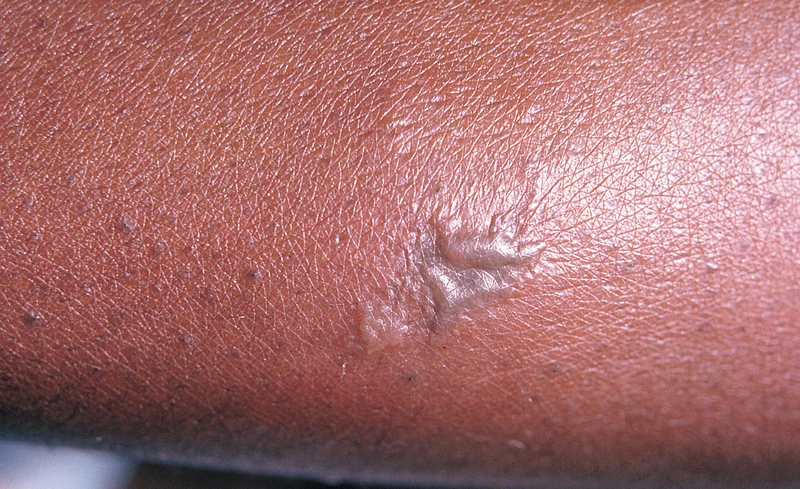
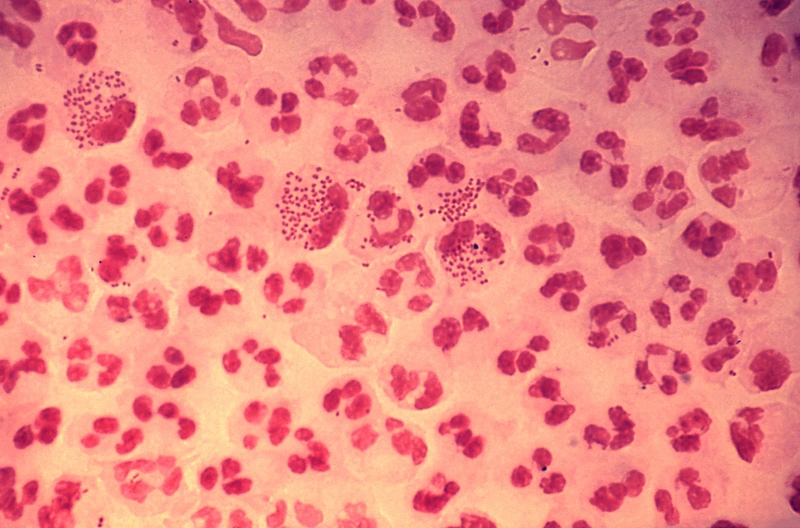
Definition
Gonorrhoea is a sexually transmitted infection caused by the bacterium Neisseria gonorrhoeae. Common sites of infection are the mucous membranes of the urethra, endocervix, rectum, pharynx and conjunctiva. Infected mothers can pass it to the newborn during vaginal delivery, causing conjunctivitis.
Aetiopathogenesis
- Pathogen: Gram-negative diplococci (Neisseria gonorrhoeae), intracellular in neutrophils.
- Transmission: sexual mucosal contact (genital, anal, oral), vertical (ophthalmia neonatorum).
- Incubation: 2–7 days.
Clinical features
- The incubation period is on average two to seven days. The infection is asymptomatic in 10–15% of men and in up to 80% of women.
- Men: painful urination, often mucopurulent urethral discharge, testicular pain and swelling due to epididymo-orchitis, anal symptoms with proctitis.
- Women: increased vaginal discharge, lower abdominal pain (pelvic inflammatory disease), painful urination, tender Bartholin glands, anal symptoms.
- Pharyngeal infection is largely asymptomatic.
- Disseminated gonococcal infection in 0.5–3% of infected individuals: tenosynovitis, joint pain or purulent arthritis, fever and skin lesions – macules, papules, pustules and vesicles on the trunk, limbs, palms and soles, usually sparing the face, scalp and mouth.
Diagnosis
- Microscopy (Gram stain) showing Gram-negative diplococci in men with urethral discharge (sensitivity 90–95%); not suitable in women because of low sensitivity.
- Culture from swabs of the affected sites (endocervix, urethra, rectum, pharynx).
- Nucleic acid amplification tests (NAAT) from swabs or urine.
Differential diagnoses
 Secondary syphilis (lues II)
 Herpes simplex (cold sores)
 Palmoplantar psoriasis
 Reactive arthritis (Reiter syndrome)
Image credits for the thumbnails
- Secondary syphilis (lues II): Ehlers S, Sergent S, Ashurst J (Clin Pract Cases Emerg Med 2020), CC BY 4.0, via PubMed Central (PMC7676796) · CC BY 4.0 · Source
- Herpes simplex (cold sores): unknown (Commons user), “Cold sore”, Public Domain, via Wikimedia Commons · Public Domain · Source
- Palmoplantar psoriasis: MCvanVeen, “Psoriasis July 2016”, CC BY-SA 4.0, via Wikimedia Commons · CC BY-SA 4.0 · Source
- Reactive arthritis (Reiter syndrome): Mohammad2018, “Keratoderma blennorrhagica”, CC BY-SA 4.0, via Wikimedia Commons · CC BY-SA 4.0 · Source
Treatment principles
- Treatment follows the current guideline with systemic antibiotics, usually given parenterally; oral cephalosporins and quinolones are no longer first choice because of resistance.
- Because of increasing resistance, a culture with susceptibility testing should be obtained before treatment whenever possible.
- Sexual partners are notified, examined and treated, other sexually transmitted infections are excluded, and a test of cure is recommended, especially for pharyngeal infection.
Guideline: AWMF guideline register (no. 059-004)
Specific treatment regimens with drugs and doses are covered in the DermaFuchs app.
Keep learning in the app
References (selection)
Cross-references
More sexually transmitted infections
Keep learning: test yourself
One question from the DermaFuchs app on Gonorrhoea – tap an answer.
Question 1 of 1
Which pathogen causes gonorrhea and is typically found intracellularly in neutrophils?
Answer
Correct: Gram-negative diplococci (Neisseria gonorrhoeae). Neisseria gonorrhoeae is a Gram-negative diplococcus that characteristically infects and survives within neutrophils.
More questions like these – with explanations and spaced repetition – in the app.
Note: This page is intended for medical education and does not replace diagnosis or treatment decisions in individual cases.