Hand eczema
Exam relevance: in 6 of more than 50 board exam reports · rank 24
- Synonyms
- hand dermatitis
- Specialty
- Dermatology · Allergies
- Images
- Clinical 4
- In the app
- 5 flashcards
- Last updated
- 10/2026 · Dr. Pascal Bafteh
Contents
Images (4)
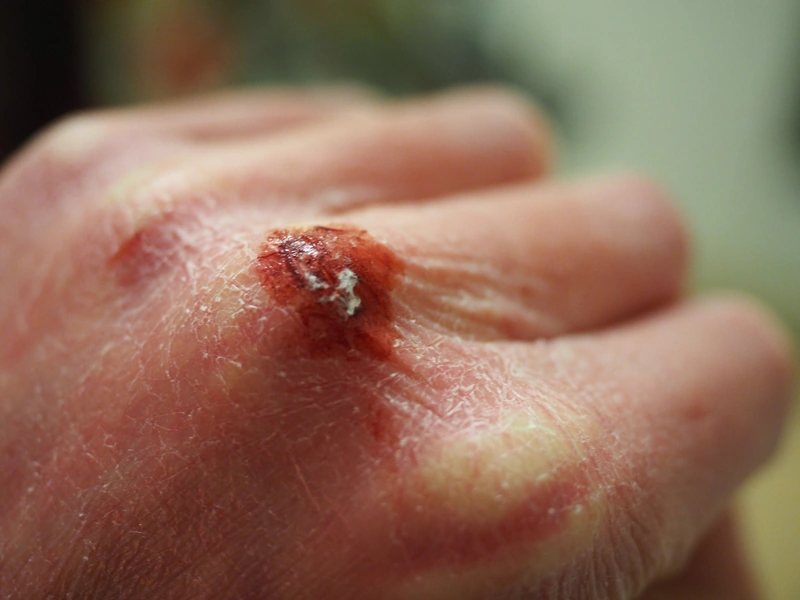
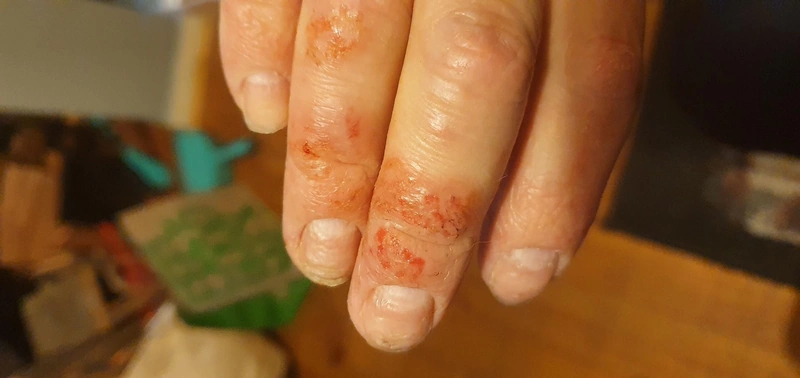
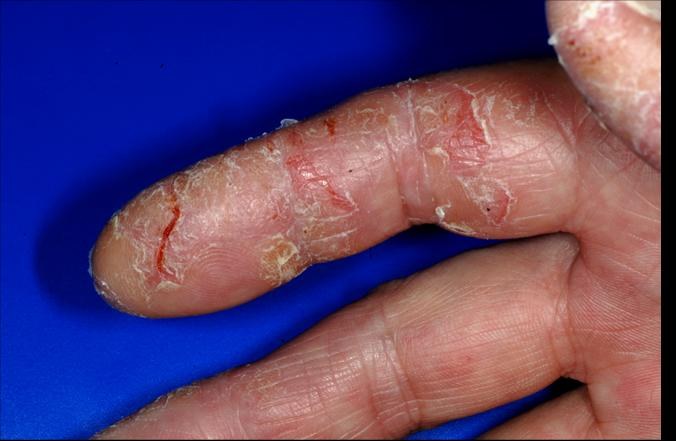
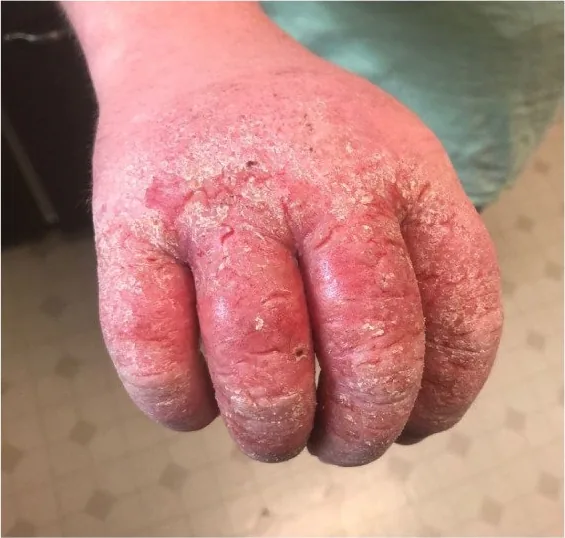
Classification
Special Forms
- Airborne allergic (Airborne allergens → exposed areas face/neck/hands)
- Photoallergic (UV-augmented sensitization → photopatch test)
Innovations 2024–2026
- The DKG standard series is periodically updated; the acrylate screening allergen 2-hydroxyethyl methacrylate (HEMA, 1% petrolatum) has been a fixed component of the standard series since 2019.
- Tap water iontophoresis — when accompanying palmar hyperhidrosis keeps the eczema going; home device as a medical aid under § 33 SGB V.
Aetiopathogenesis
Etiological Classification
- Allergic Contact Dermatitis (ACD): Pathomechanism Type IV delayed reaction with spread phenomenon.
- Acute: erythema + vesicles.
- Chronic: hyperkeratotic / rhagadiform.
- Diagnosis: via patch test.
- Atopic Hand Dermatitis: Manifestation of an atopic diathesis — primarily dorsum of the hand, finger webs + volar wrist, vesicular eczema patterns, often associated with filaggrin mutation.
- Protein Contact Dermatitis (PCD): Pathomechanism IgE Type I to animal hair, plant proteins, flour (bakers). Initially often urticarial, diagnosis via prick test with late reading + specific IgE.
- Irritant / Cumulative Irritant Contact Dermatitis (ICD): Threshold-exceeding irritation (water, detergents, friction) — typically finger web spaces + dorsum of the hand, rough, dry, NO spread phenomenon (DD important for ACD!).
- Mixed forms (common: occupationally induced ICD + additional ACD).
Clinical features
Clinical / Morphological Classification
- Hyperkeratotic (tylotic): Clinical presentation hyperkeratosis palmar, little pruritus, chronic — DD: palmoplantar psoriasis.
- Hyperkeratotic-rhagadiform hand eczema: Mixed type of tylotic + fissures, common in mechanically stressed areas.
- Dyshidrotic Eczema (Pompholyx): tiny vesicles on palmar/plantar surfaces + sides of fingers, relapsing in flares, intensely itchy, often atopic.
- Nummular Hand Eczema: often with atopic skin diathesis, coin-sized erythematosquamous plaques, often on the back of the hand.
- Pulpitis sicca: dry, shiny fingertips with painful fissures — a manifestation of atopic dermatitis (pulpitis in general is often irritant, less often allergic).
Diagnosis
Diagnostics
- Skin status: Localization pattern + concomitant manifestations (atopic stigmata, nail changes).
- Prick test (Type I, atopy, PCD), patch test with DKG standard series + occupation-specific series (hairdresser, car mechanic, etc.).
DKG Standard Series (Top Allergens Patch Test)
The current German Contact Allergy Group series contains ~30 most common contact allergens.
- Most common contact allergen overall: Nickel(II) sulfate (~ 15–20 % of tested patients).
- Occupational dermatosis trigger in hairdressers: p-Phenylenediamine in hair dyes, plus ammonium persulfate (bleaching).
- Occupational dermatosis trigger in bricklayers / construction workers: Potassium dichromate in leather.
- Top allergen in nail technicians / cosmetic acrylates: HEMA (Hydroxyethyl methacrylate).
- Most important preservative allergen of the baseline series: Methylisothiazolinone (MI) — cosmetics, detergents, wall paint.
- Common dual sensitisation with nickel: Cobalt (dual sensitisation, not a true cross-reaction; jewellery/coins).
- Classic rubber vulcanization accelerator allergen: Thiuram mix (rubber gloves).
- "Aroma marker" — indicator allergen for fragrances: Balsam of Peru — also contained in foodstuffs, cigarettes, pharmaceuticals.
- Adhesive / soldering iron occupation allergen: Colophony (plasters, athletic tape, soldering irons).
- Synthetic resins / construction industry allergen: Epoxy resin in casting resin, insulators, artworks.
- Most severe systemic reaction / "black henna" tattoos: p-Phenylenediamine — can lead to erythema multiforme-like reactions.
- Mix I contains, among others: cinnamal · cinnamyl alcohol · eugenol · isoeugenol · geraniol · hydroxycitronellal · α-amylcinnamal · oak moss absolute.
- Mix II contains, among others: HICC/Lyral · citral · citronellol · farnesol · coumarin · α-hexylcinnamal.
Further DKG allergens (selection): N-Isopropyl-N-Phenyl-PPD (IPPD), Mercapto mix, Formaldehyde, Fragrance mix I + II, Turpentine, Propolis, CMI, Sandalwood oil, Compositae mix II, MBT, HICC / Lyral, IPBC, Sorbitan sesquioleate, Ylang-Ylang oil, Jasmine absolute, Benzisothiazolinone, and sodium lauryl sulfate (irritant control, not an allergen).
Reading: 48 h + 72 h (+ optional 7 d).
- Grading: +, ++, +++ according to erythema / infiltration / vesicles / confluence.
- Photopatch: separately with UV-A 5 J/cm² + standard
Differential diagnoses
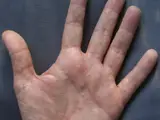 Dyshidrotic eczema (pompholyx)
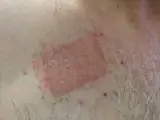 Contact dermatitis (contact eczema)
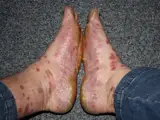 Palmoplantar psoriasis
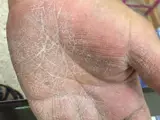 Tinea manuum
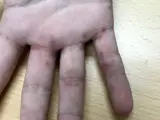 Scabies
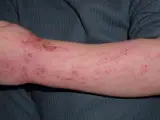 Atopic dermatitis (atopic eczema)
 Pitted keratolysis
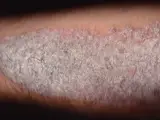 Psoriasis vulgaris (plaque psoriasis)
Image credits for the thumbnails
- Dyshidrotic eczema (pompholyx): Inwe (Wikimedia Commons), “Dyshidrosis”, CC BY-SA 3.0, via Wikimedia Commons · CC BY-SA 3.0 · Source
- Contact dermatitis (contact eczema): Dr.khatmando, “Severe contact dermatitis buprenorphine transdermal patch”, CC BY-SA 4.0, via Wikimedia Commons · CC BY-SA 4.0 · Source
- Palmoplantar psoriasis: MCvanVeen, “Psoriasis July 2016”, CC BY-SA 4.0, via Wikimedia Commons · CC BY-SA 4.0 · Source
- Tinea manuum: Mohammad2018, “Tinea manum”, CC BY-SA 4.0, via Wikimedia Commons · CC BY-SA 4.0 · Source
- Scabies: Gzzz, “Scabies hand and fingers 1”, CC BY-SA 4.0, via Wikimedia Commons · CC BY-SA 4.0 · Source
- Atopic dermatitis (atopic eczema): Eisfelder, “Atopic dermatitis child”, CC BY-SA 3.0, via Wikimedia Commons · CC BY-SA 3.0 · Source
- Pitted keratolysis: Evan Saap, CC BY-SA 4.0 · CC BY-SA 4.0 · Source
- Psoriasis vulgaris (plaque psoriasis): MediaJet, “An Arm Covered With Plaque Type Psoriasis”, CC BY-SA 3.0, via Wikimedia Commons · CC BY-SA 3.0 · Source
Treatment principles
- The foundation is avoidance of allergens and irritants, consistent skin protection with suitable protective gloves and regular use of emollients, supported in occupational cases by the statutory accident insurance dermatologist procedure.
- Topical glucocorticoids are used, with calcineurin inhibitors or topical JAK inhibitors for steroid-sparing maintenance, supplemented by phototherapy of the hands.
- In severe chronic hand eczema, systemic retinoids with strict contraception, JAK inhibitors or immunosuppressants are options.
Guideline: AWMF guideline register (no. 013-053)
Specific treatment regimens with drugs and doses are covered in the DermaFuchs app.
Keep learning in the app
References (selection)
Cross-references
Keep learning: test yourself
One question from the DermaFuchs app on Hand eczema – tap an answer.
Question 1 of 1
What is the primary clinical presentation of the tylotic subtype of chronic hand eczema?
Answer
Correct: hyperkeratosis. Hyperkeratotic (tylotic) hand eczema presents with prominent hyperkeratosis and rhagades on the palms, typically without significant pruritus.
More questions like these – with explanations and spaced repetition – in the app.
Note: This page is intended for medical education and does not replace diagnosis or treatment decisions in individual cases.