Tinea pedis
- Synonyms
- athlete's foot, foot fungus
- Specialty
- Dermatology · Fungal infections
- Images
- Clinical 2
- In the app
- 4 flashcards
- Last updated
- 11/2026 · Dr. Pascal Bafteh
Contents
Images (2)
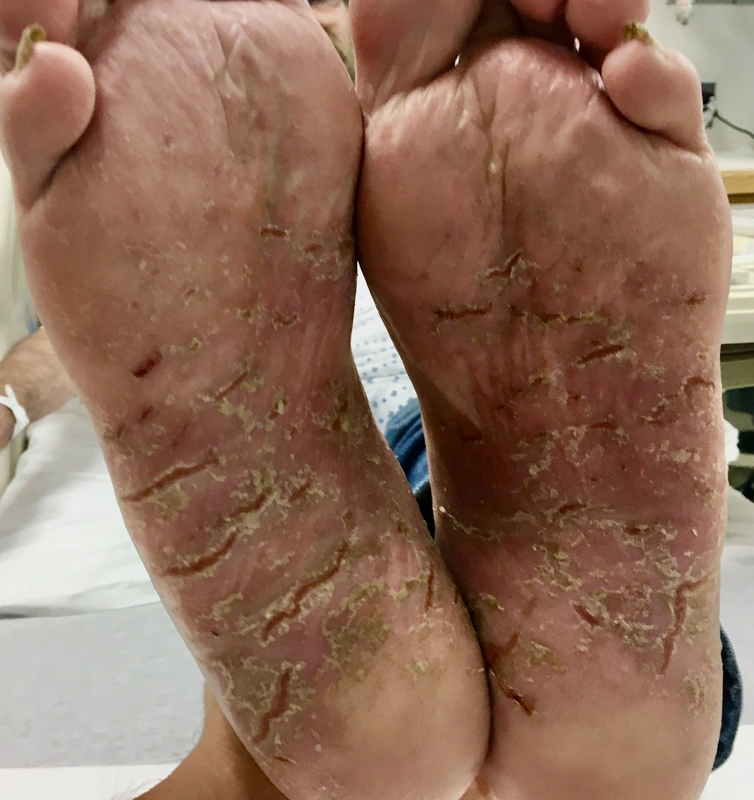
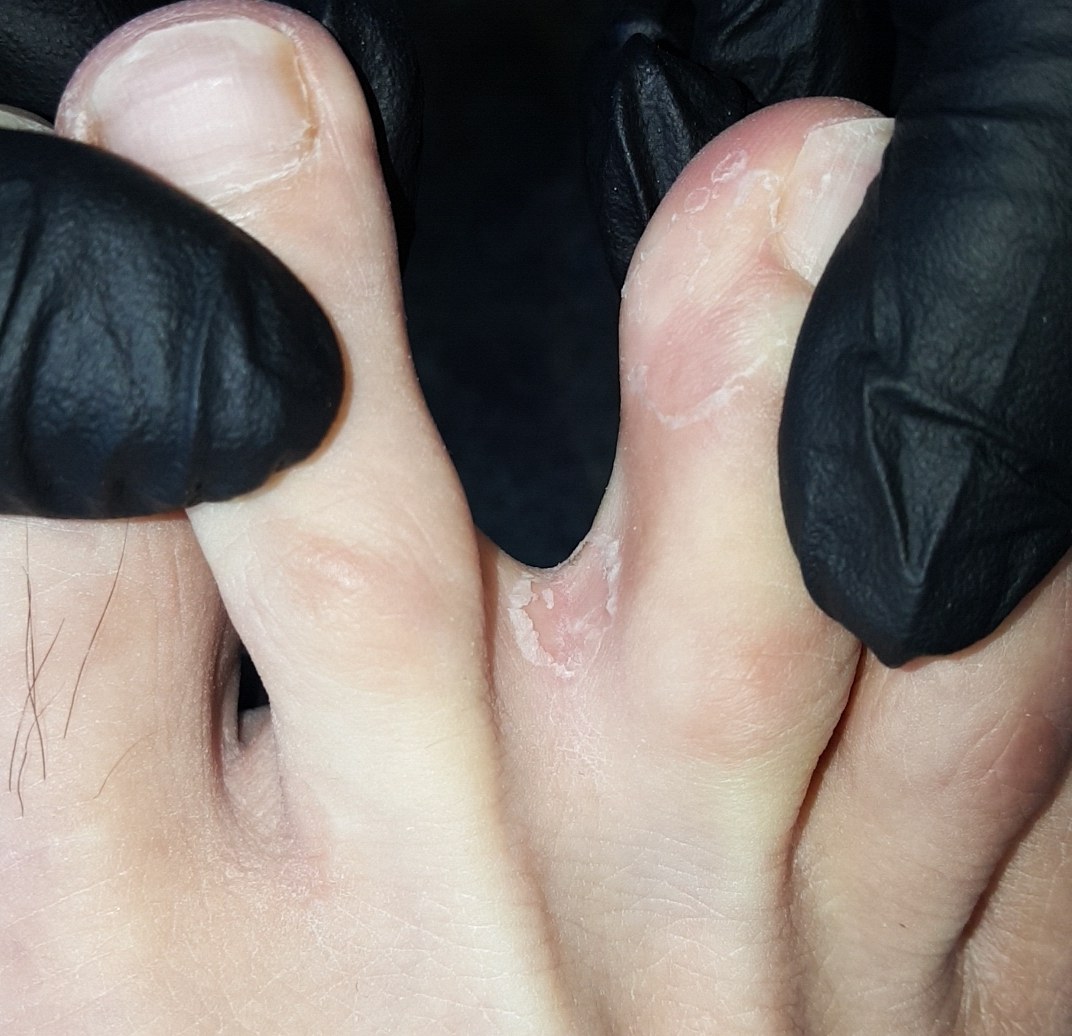
Definition
Tinea pedis (athlete's foot) is a dermatophyte infection of the skin of the feet, usually caused by Trichophyton rubrum, T. interdigitale or Epidermophyton floccosum. It is the most common dermatophyte infection and may be accompanied by tinea cruris, tinea manuum or onychomycosis.
- Clinical forms: Interdigitalis (macerated scaling mainly 4th/5th web space) + Plantaris squamosa (chronic hyperkeratosis in „moccasin distribution") + vesiculobullous form — interdigital form most common.
- Moccasin type: chronic hyperkeratotic tinea plantaris with fine flour-like scaling on plantae — DD dry foot / psoriasis palmoplantaris.
- Pathogens: T. rubrum (anthropophilic, most common) and T. interdigitale.
Occurrence & epidemiology
According to Leung et al., the global prevalence is about 3% and the lifetime risk up to 70%. It mainly affects adolescents and young adults, with a peak between 16 and 45 years of age; males are affected about three times as often as females. Athletes (especially elite athletes, e.g. walking barefoot in swimming pools and locker rooms), military personnel and residents of long-term care facilities are affected more often. According to DermNet, infection is usually acquired by direct contact, e.g. via shared towels or walking barefoot in public changing rooms; according to Leung et al., transmission within the family is the most common route; indirect transmission via contaminated belongings of an affected person (e.g. shoes, socks, bedding) is also possible. Predisposing factors are occlusive footwear, excessive sweating, immunodeficiency, diabetes mellitus, immunosuppressive drugs, and poor circulation or lymphoedema. The damaged barrier in the toe webs can become a portal of entry for erysipelas.
Clinical features
Three main forms are distinguished:
- Interdigital form (the most common form, especially in children): erythema, whitish scaling, peeling and maceration in the toe webs, typically between the fourth and fifth toes. Itch is the leading symptom; fissures may burn and hurt. Secondary bacterial infection causes odour, erosions and crusting ("dermatophytosis complex").
- Hyperkeratotic (moccasin-type) form, the second most common: chronic scaling plaques with variable erythema on the heel, sole and sides of the foot – the area covered by a moccasin; the dorsum is usually spared except for its distal part. It itches little or not at all, runs a chronic course and is persistent.
- Vesiculobullous (inflammatory) form: intensely itchy, sometimes painful vesicles (1–3 mm) and bullae on erythematous skin, preferably on the instep and medial sole; it develops more rapidly than the other forms.
Further variants: an occult form without visible lesions – common according to Leung et al., especially in elite athletes (detected by culture in swimmers and marathon runners); rarely an ulcerative form with rapidly spreading erosions and ulcers between the toes, mainly in diabetes mellitus, peripheral vascular disease or immunodeficiency; and tinea incognito: unrecognised tinea exposed to immunosuppressive agents loses its typical appearance (blurred margin, less erythema, scale and itch).
When tinea manuum coexists, typically only one hand is involved while the tinea pedis is bilateral (two feet–one hand syndrome); concomitant onychomycosis is common.
Diagnosis
- Direct microscopy with potassium hydroxide (KOH) of scales from the active edge: septate hyphae.
- Fungal culture to identify the species (not always needed if microscopy is typical); examination of nails, groins and palms as well.
- Distinction from dyshidrotic eczema, irritant or allergic contact dermatitis (e.g. to footwear components), plantar psoriasis, plantar pustulosis and plantar keratoderma – these are usually symmetrical and bilateral; interdigitally also erythrasma (Wood's light).
Differential diagnoses
 Erythrasma
 Palmoplantar psoriasis
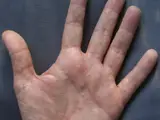 Dyshidrotic eczema (pompholyx)
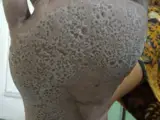 Pitted keratolysis
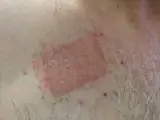 Contact dermatitis (contact eczema)
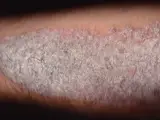 Psoriasis vulgaris (plaque psoriasis)
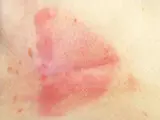 Intertrigo
Image credits for the thumbnails
- Erythrasma: unknown (Commons user), “Erythrasma”, CC BY-SA 4.0, via Wikimedia Commons · CC BY-SA 4.0 · Source
- Palmoplantar psoriasis: MCvanVeen, “Psoriasis July 2016”, CC BY-SA 4.0, via Wikimedia Commons · CC BY-SA 4.0 · Source
- Dyshidrotic eczema (pompholyx): Inwe (Wikimedia Commons), “Dyshidrosis”, CC BY-SA 3.0, via Wikimedia Commons · CC BY-SA 3.0 · Source
- Pitted keratolysis: Evan Saap, CC BY-SA 4.0 · CC BY-SA 4.0 · Source
- Contact dermatitis (contact eczema): Dr.khatmando, “Severe contact dermatitis buprenorphine transdermal patch”, CC BY-SA 4.0, via Wikimedia Commons · CC BY-SA 4.0 · Source
- Psoriasis vulgaris (plaque psoriasis): MediaJet, “An Arm Covered With Plaque Type Psoriasis”, CC BY-SA 3.0, via Wikimedia Commons · CC BY-SA 3.0 · Source
- Intertrigo: Pera F, Suman C, Cosma M, Mazza S, Brunani A, Cancello R (J Cosmet Dermatol 2025), CC BY 4.0, via PubMed Central (PMC12042251) – panel B “before” (cropped) · CC BY 4.0 · Source
Treatment principles
- Tinea pedis is usually treated with topical antifungals, including the toe web spaces.
- Systemic therapy is considered for extensive, hyperkeratotic disease, concomitant onychomycosis or treatment failure.
- Prevention of recurrence includes keeping the feet dry, breathable footwear and disinfecting shoes and socks; tinea pedis is also a common portal of entry for erysipelas.
Guideline: AWMF guideline register (no. 013-002)
Specific treatment regimens with drugs and doses are covered in the DermaFuchs app.
Keep learning in the app
References (selection)
Cross-references
Mentioned in
Keep learning: test yourself
One question from the DermaFuchs app on Tinea pedis – tap an answer.
Question 1 of 1
What is the characteristic clinical presentation of the moccasin type of tinea pedis?
Answer
Correct: chronic hyperkeratotic tinea plantaris with fine flour-like scaling on plantae. The moccasin type of tinea pedis presents as chronic hyperkeratotic tinea plantaris with fine, flour-like scaling covering the soles.
More questions like these – with explanations and spaced repetition – in the app.
Note: This page is intended for medical education and does not replace diagnosis or treatment decisions in individual cases.