Onychomycosis
Overview
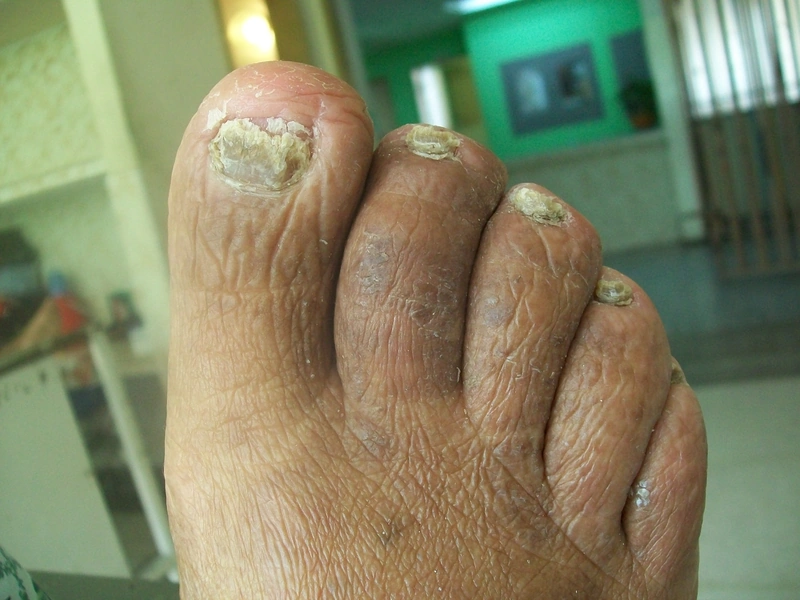
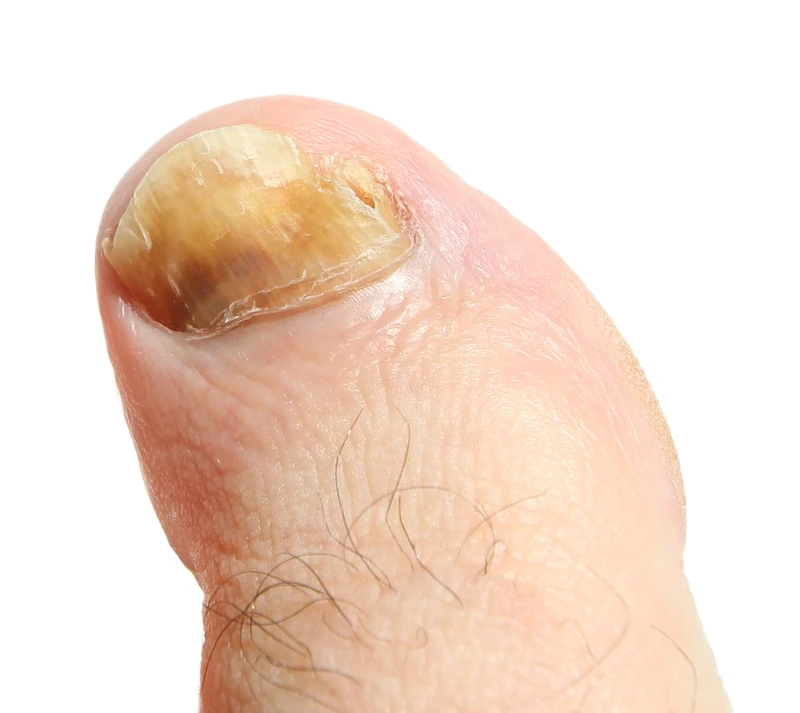
- Clinical features: thickening with onycholysis, yellow-brown discoloration, subungual hyperkeratosis — great toe nail most common.
- Pathogen: The most common causative organism of onychomycosis is Trichophyton rubrum; dermatophytes account for the large majority of cases. Yeasts (mainly Candida) rather affect fingernails in wet work, moulds (Scopulariopsis, Fusarium, Aspergillus) are rare — yet therapeutically important, because terbinafine does not reliably cover them.
- Risk factors: age, diabetes, tinea pedis, trauma, immunosuppression, occlusion.
- Systemic study data: 31–57% complete clinical cure, 43–76% mycological cure.
- Caution: Always co-treat tinea pedis for recurrence prophylaxis.
Overview
- Guideline (continuous) regimen: terbinafine 250 mg/day for 6 weeks for fingernails, 12 weeks for toenails; itraconazole 200 mg/day on the same schedule.
- Practice pulse regimen: Itraconazole 2 × 200 mg/day for one week per month — 2 cycles for fingernails, 3 cycles for toenails. During the drug-free weeks the agent remains active because it persists in nail keratin for months.
- Why the interval: lower cumulative dose and cost, better adherence, shorter windows of relevant CYP3A4 interaction. For terbinafine, pulse dosing is not approved (studies show comparable cure rates, but it stays off-label).
- Fluconazole 150–450 mg once weekly until the nail has grown out is a further interval regimen, but off-label for onychomycosis in Germany and limited to azole-susceptible pathogens.
- Common to all regimens: Obtain mycological proof before starting (microscopy, culture or PCR) — clinical inspection alone identifies only about half of nail changes correctly; assess success only after the nail has grown out, not at the end of treatment.
Differential diagnoses
- Tinea pedis
- Palmoplantar psoriasis
- Pitted keratolysis
- Erythrasma
- Candida intertrigo
- Psoriasis vulgaris (plaque psoriasis)
- Lichen planus
- Hand eczema
Practise Onychomycosis in the app
Flashcards with spaced repetition, exam questions and spot-the-diagnosis on this topic – in DermaFuchs, free of charge.
In the DermaFuchs app: 5 flashcards · 11 clinical images
Open in browser Download on the App StoreSources (selection)
- Sahoo et al. 2016
- Leung AKC, Lam JM, Leong KF, Hon KL, Barankin B, Leung AAM, Wong AHC. Onychomycosis: An Updated Review. Recent Pat Inflamm Allergy Drug Discov. 2020;14(1):32-45.
Note: This page is intended for medical education and does not replace diagnosis or treatment decisions in individual cases. Treatment and follow-up content is available in the app.