Guttate psoriasis
Exam relevance: in 4 of more than 50 board exam reports · rank 33
- Synonyms
- drop-like psoriasis
- Specialty
- Dermatology · Inflammatory skin diseases
- Images
- Clinical 5
- In the app
- 10 flashcards
- Last updated
- 10/2026 · Dr. Pascal Bafteh
Contents
Images (5)
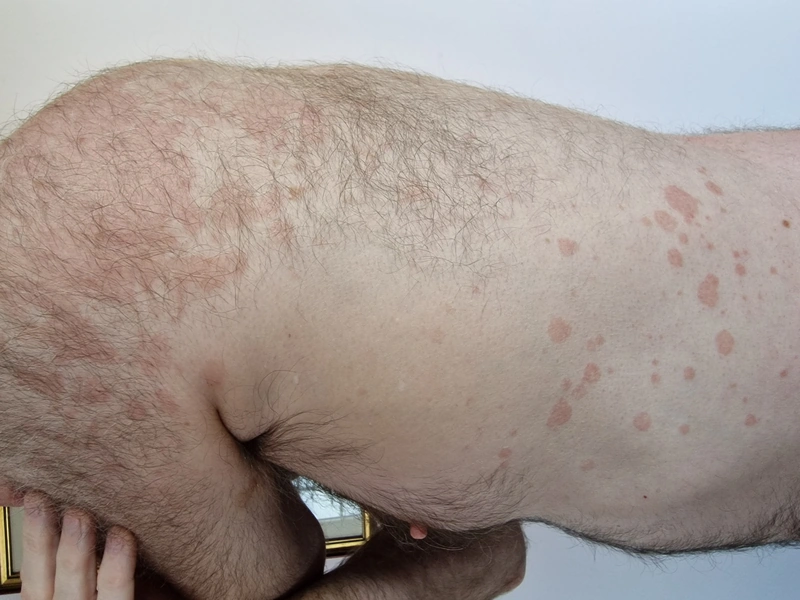
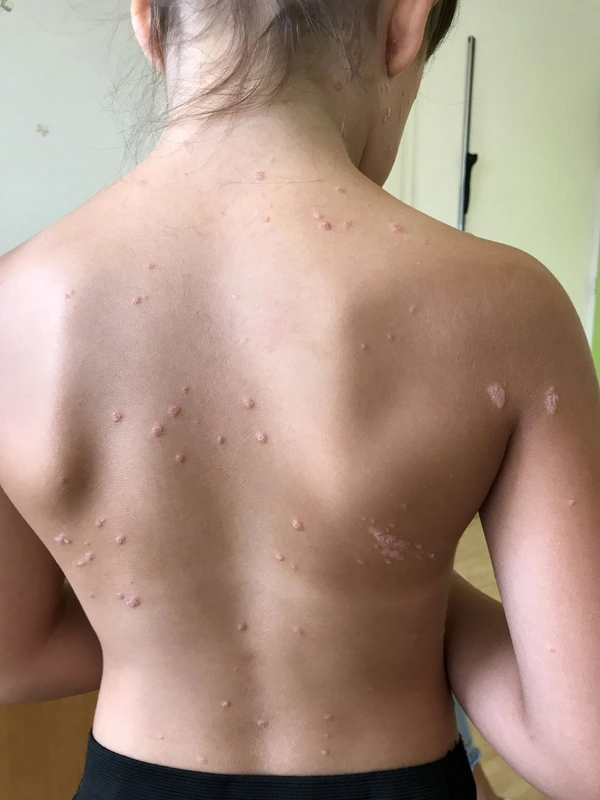
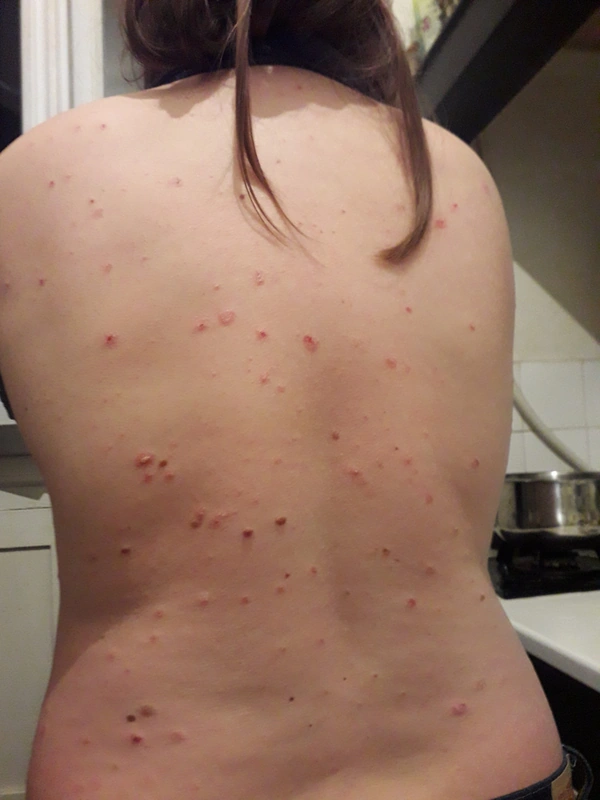
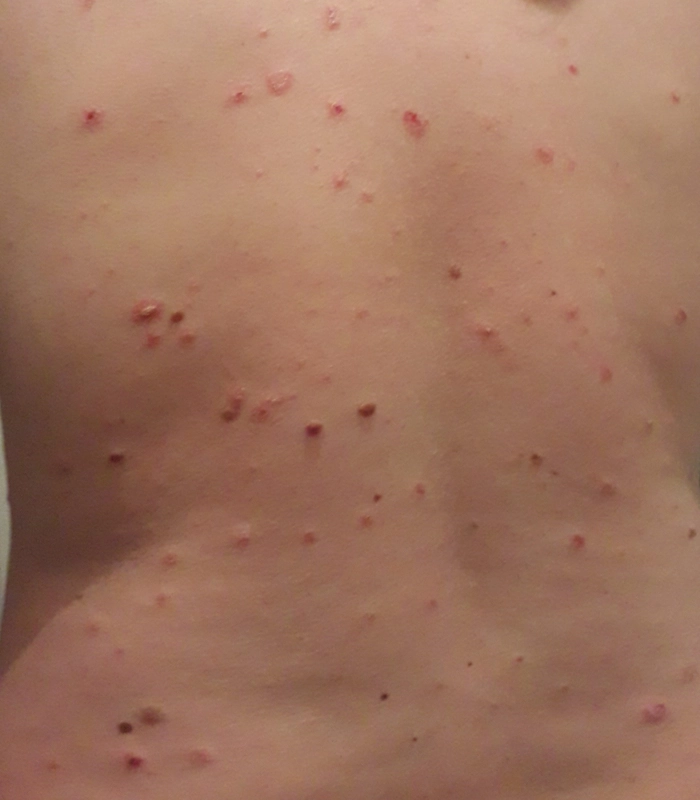
Definition
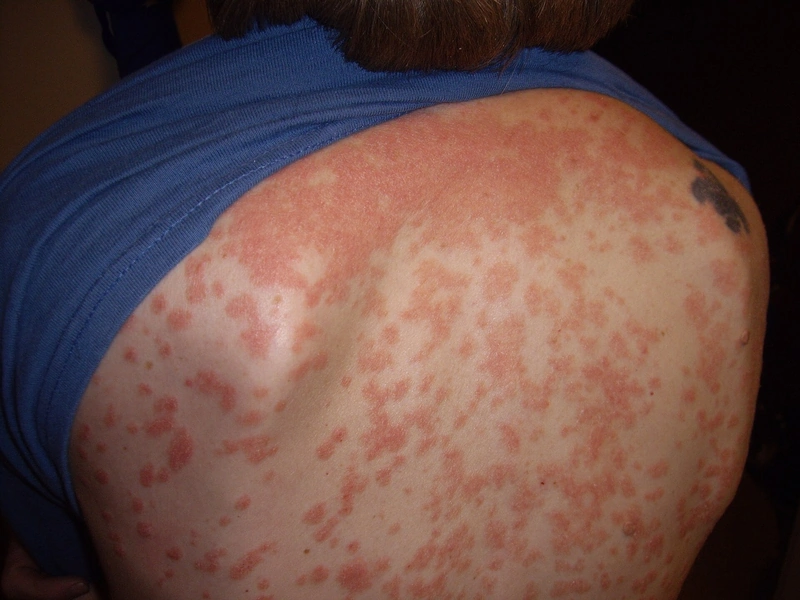
Guttate psoriasis is an acute eruptive form of psoriasis with numerous small, drop-like lesions. It mainly affects children and young adults (the second most common form of psoriasis in children) and is often the first presentation of psoriasis.
Acute eruption of numerous droplet-shaped, erythemato-squamous papules (2–10 mm), mainly on the trunk and proximal extremities. Often 1–2 weeks after streptococcal pharyngitis. Fine loose scale; pruritus usually moderate. Common in children and adolescents. Mostly self-limiting but may progress to plaque psoriasis (in a large cohort about 12 %).
Differential diagnosis: pityriasis rosea, drug exanthem, secondary syphilis, pityriasis versicolor.
Aetiopathogenesis
Guttate psoriasis typically develops 1–2 weeks after a streptococcal infection of the upper respiratory tract, particularly tonsillitis, or at other sites such as perianal streptococcal dermatitis. Beta-haemolytic streptococci stimulate T cells in predisposed individuals, which drive inflammation in the skin.
Diagnosis
- Clinical, with a history of preceding infection; throat or perianal swab, antistreptolysin titre (ASO) or anti-DNase B.
- Dermoscopy (diagnostic): uniformly distributed red dotted vessels and diffuse white-grey scale; scale is often subtle in early lesions; biopsy can confirm the diagnosis.
- Distinction from pityriasis rosea, pityriasis lichenoides and secondary syphilis (serology).
Differential diagnoses
 Pityriasis rosea
 Nummular eczema (discoid eczema)
 Tinea corporis
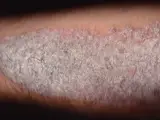 Psoriasis vulgaris (plaque psoriasis)
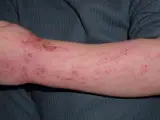 Atopic dermatitis (atopic eczema)
 Secondary syphilis (lues II)
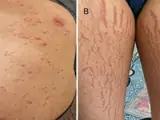 Pityriasis lichenoides chronica (PLC)
- Measles
Image credits for the thumbnails
- Pityriasis rosea: Aceofhearts1968, “Pityriasis rosea-1”, Public Domain, via Wikimedia Commons · Public domain · Source
- Nummular eczema (discoid eczema): Ifnord, “Nummular dermatitits”, CC BY-SA 4.0, via Wikimedia Commons · CC BY-SA 4.0 · Source
- Tinea corporis: Corina G., “Tinea corporis”, Public Domain, via Wikimedia Commons · Public domain · Source
- Psoriasis vulgaris (plaque psoriasis): MediaJet, “An Arm Covered With Plaque Type Psoriasis”, CC BY-SA 3.0, via Wikimedia Commons · CC BY-SA 3.0 · Source
- Atopic dermatitis (atopic eczema): Eisfelder, “Atopic dermatitis child”, CC BY-SA 3.0, via Wikimedia Commons · CC BY-SA 3.0 · Source
- Secondary syphilis (lues II): Ehlers S, Sergent S, Ashurst J (Clin Pract Cases Emerg Med 2020), CC BY 4.0, via PubMed Central (PMC7676796) · CC BY 4.0 · Source
- Pityriasis lichenoides chronica (PLC): Ahmed HB, Aziz JMA, Salih MKB et al. (Clin Case Rep 2026), CC BY 4.0, via PubMed Central (PMC13478903) · CC BY 4.0 · Source
Treatment principles
- A preceding streptococcal infection is common; it is sought and treated with antibiotics if confirmed.
- Guttate psoriasis may resolve spontaneously; treatment is topical and, in extensive disease, UVB phototherapy is highly effective.
- If it progresses to chronic plaque psoriasis, treatment follows severity as in psoriasis vulgaris.
Guideline: AWMF guideline register (no. 013-001)
Specific treatment regimens with drugs and doses are covered in the DermaFuchs app.
Keep learning in the app
References (selection)
Cross-references
Mentioned in
Keep learning: test yourself
Two questions from the DermaFuchs app on Guttate psoriasis – tap an answer.
Question 1 of 2
Besides anti-streptolysin O and anti-hyaluronidase, which other streptococcal antibody is relevant in the serology of guttate psoriasis?
Answer
Correct: anti-DNase B. Anti-DNase B is a reliable marker for prior Group A streptococcal infection, which is a classic trigger for guttate psoriasis.
Question 2 of 2
Which acute, self-limiting papulosquamous disease is a classic differential diagnosis for guttate psoriasis?
Answer
Correct: pityriasis rosea. Pityriasis rosea presents with an acute exanthem of scaly lesions on the trunk, making it a primary differential diagnosis for guttate psoriasis.
More questions like these – with explanations and spaced repetition – in the app.
Note: This page is intended for medical education and does not replace diagnosis or treatment decisions in individual cases.