Tinea barbae
- Synonyms
- barber's itch
- Specialty
- Dermatology · Fungal infections
- Images
- Clinical 3
- In the app
- 3 flashcards
- Last updated
- 10/2026 · Dr. Pascal Bafteh
Contents
Images (3)
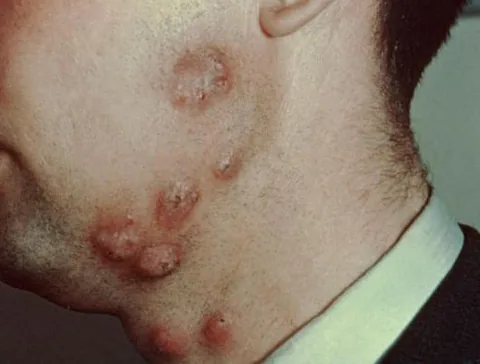
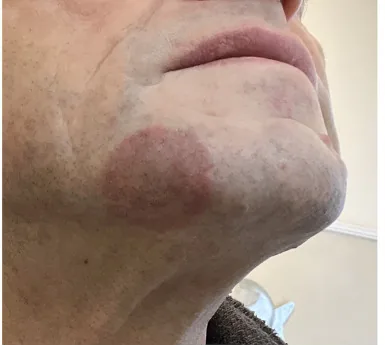
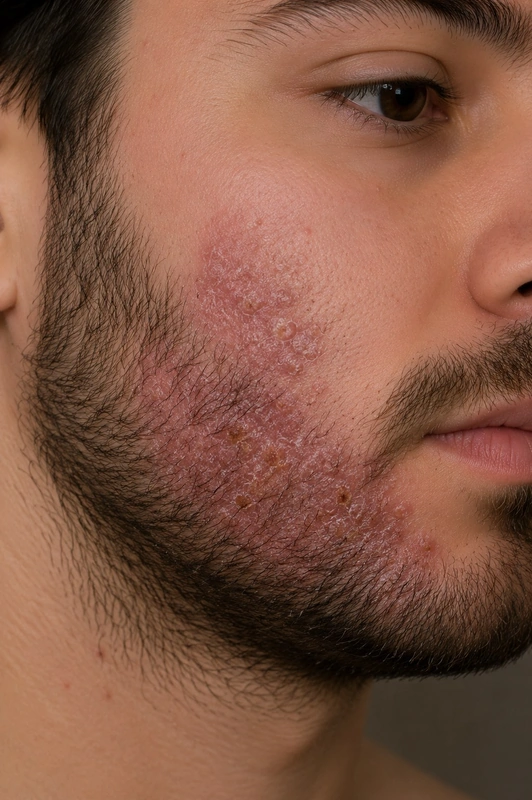 AI illustration
Definition
Tinea barbae is a dermatophyte infection of the beard area in men that affects not only the skin but also the beard hairs and follicles. It is usually caused by zoophilic species such as Trichophyton verrucosum (from cattle) or T. mentagrophytes var. equinum (from horses), and therefore mainly affects farmers; person-to-person transmission is rare.
- Clinical features: severely inflammatory folliculitis in the beard area with pustules, crusts, beard alopecia — despite marked inflammation often surprisingly little pain or itch; regional LN swelling possible.
- Pathogens: T. tonsurans, T. mentagrophytes, T. verrucosum.
- Risk factors: animal contact, shaving trauma, contact sports.
Diagnosis
- Clinically usually highly inflamed with lumps, pustules and crusting around the hairs (kerion); the hairs pull out easily; surprisingly little itch or pain.
- Confirmed by microscopy and culture of skin scrapings and hairs plucked with their roots (ectothrix infection).
Differential diagnoses
 Acne vulgaris
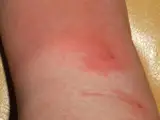 Erysipelas
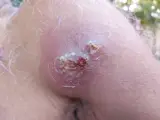 Furuncle and carbuncle
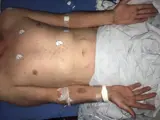 Secondary syphilis (lues II)
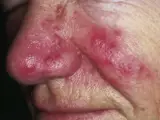 Rosacea
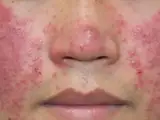 Demodicosis
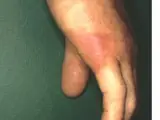 Erysipeloid
Image credits for the thumbnails
- Acne vulgaris: Sedef94, “Kürəkdə düyünlü və kistik sızanaqlar (Acne Vulgaris) 08”, CC BY-SA 4.0, via Wikimedia Commons · CC BY-SA 4.0 · Source
- Erysipelas: Poupou l'quourouce, “Erysipel”, CC BY-SA 3.0, via Wikimedia Commons · CC BY-SA 3.0 · Source
- Furuncle and carbuncle: Medicalpal, “Carbuncle”, CC BY-SA 4.0, via Wikimedia Commons · CC BY-SA 4.0 · Source
- Secondary syphilis (lues II): Ehlers S, Sergent S, Ashurst J (Clin Pract Cases Emerg Med 2020), CC BY 4.0, via PubMed Central (PMC7676796) · CC BY 4.0 · Source
- Rosacea: Michael Sand, Daniel Sand, Christina Thrandorf, Volker Paech, Peter Altmeyer, Falk G Bechara, “Rosacea”, CC BY 2.5, via Wikimedia Commons, cropped · CC BY 2.5 · Source
- Demodicosis: Ran Yuping et al., “Demodicosis”, CC BY-SA 3.0, via Wikimedia Commons · CC BY-SA 3.0 · Source
- Erysipeloid: GP MARTINEAU, “Rouget humain”, CC BY-SA 3.0, via Wikimedia Commons · CC BY-SA 3.0 · Source · cropped
Treatment principles
- Because the hair follicles are involved, tinea barbae requires systemic antifungal therapy, supplemented by topical antifungals; the agent is chosen according to the identified organism.
- As zoophilic organisms are usually responsible (e.g. contact with cattle), the source animal is treated by a veterinarian.
- Antibiotic treatment alone is ineffective for deep, pustular forms.
Guideline: AWMF guideline register (no. 013-002)
Specific treatment regimens with drugs and doses are covered in the DermaFuchs app.
Keep learning in the app
References (selection)
Cross-references
Keep learning
Keep learning with flashcards, exam questions and spot diagnoses in the DermaFuchs app – free, in your browser or as an app.
Related pages: Acne vulgaris · Erysipelas · Furuncle and carbuncle
Note: This page is intended for medical education and does not replace diagnosis or treatment decisions in individual cases.