Acne fulminans
Exam relevance: in 4 of more than 50 board exam reports · rank 33
- Synonyms
- severe acne with fever
- Specialty
- Dermatology · Skin appendages
- Images
- Clinical 2
- In the app
- 7 flashcards
- Last updated
- 10/2026 · Dr. Pascal Bafteh
Contents
Images (2)
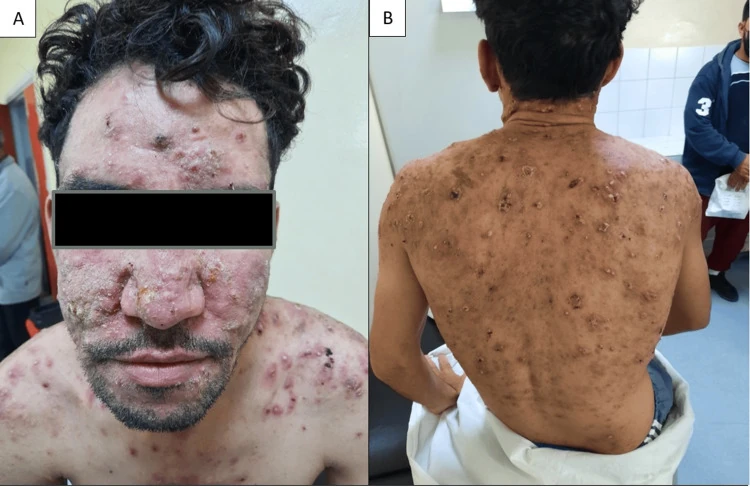
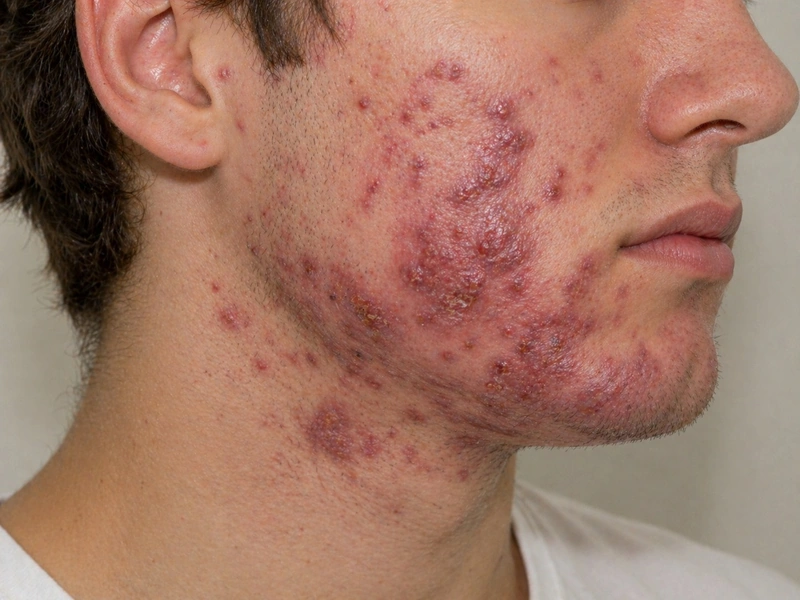 AI illustration
Definition
Acne fulminans is the most severe, rare form of acne: painful, inflammatory, ulcerating nodules with haemorrhagic crusts develop abruptly, mainly on the chest and back, often with fever and systemic symptoms. Forms with and without systemic involvement are distinguished.
Course & target group: Acne fulminans is the most severe variant of acne conglobata with an acute systemic inflammatory course and predominantly affects male adolescents.
Clinical features: ulcerating, necrotizing lesions are present, accompanied by fever + polyarthralgia and hepatosplenomegaly.
Associations: Particularly with SAPHO syndrome; isolated cases in inflammatory bowel disease have been described.
Aetiopathogenesis
It nearly always affects adolescent males. Described triggers include anabolic agents and testosterone (e.g. in bodybuilding) and a genetic predisposition; an exaggerated immune reaction against Cutibacterium acnes is discussed.
Diagnosis
- Clinical picture; laboratory findings with leucocytosis, raised ESR and CRP, sometimes anaemia; clinically hepatosplenomegaly may be present.
- Joint pain (sacroiliac joints in about 20%); X-rays may show osteolytic bone lesions; SAPHO syndrome is a possible complication.
Differential diagnoses

Image credits for the thumbnails
- Erythema nodosum: James Heilman, MD, “ENlegs”, CC BY-SA 3.0, via Wikimedia Commons · CC BY-SA 3.0 · Source
- Pyoderma gangrenosum: Monopol, “Pyoderma gangrenosum 01”, CC BY-SA 3.0, via Wikimedia Commons · CC BY-SA 3.0 · Source
- Staphylococcal scalded skin syndrome (SSSS): Tamborino A, Venturini E, Montagnani C et al. (Ital J Pediatr 2025), CC BY 4.0, via PubMed Central (PMC12406360) · CC BY 4.0 · Source · cropped
Treatment principles
- Acne fulminans requires prompt systemic anti-inflammatory treatment, primarily with systemic glucocorticoids, often on an inpatient basis.
- A systemic retinoid is introduced gradually only once the acute inflammation has subsided, as the disease can itself be triggered by retinoid therapy.
- Wound care and analgesia are provided alongside, and residual scars are treated specifically at a later stage.
Guideline: AWMF guideline register (no. 013-017)
Specific treatment regimens with drugs and doses are covered in the DermaFuchs app.
Keep learning in the app
References (selection)
Cross-references
Mentioned in
Keep learning: test yourself
Two questions from the DermaFuchs app on Acne fulminans – tap an answer.
Question 1 of 2
What type of lesions are characteristic of acne fulminans, accompanied by fever and polyarthralgia?
Answer
Correct: ulcerating, necrotizing lesions. Ulcerating, necrotizing lesions are a hallmark of acne fulminans, indicating severe inflammation.
Question 2 of 2
What systemic symptoms are associated with acne fulminans?
Answer
Correct: Fever + arthralgias + CRP↑. Acne fulminans is associated with systemic symptoms such as fever, arthralgias, and elevated CRP levels.
More questions like these – with explanations and spaced repetition – in the app.
Note: This page is intended for medical education and does not replace diagnosis or treatment decisions in individual cases.