Atopic dermatitis (atopic eczema)
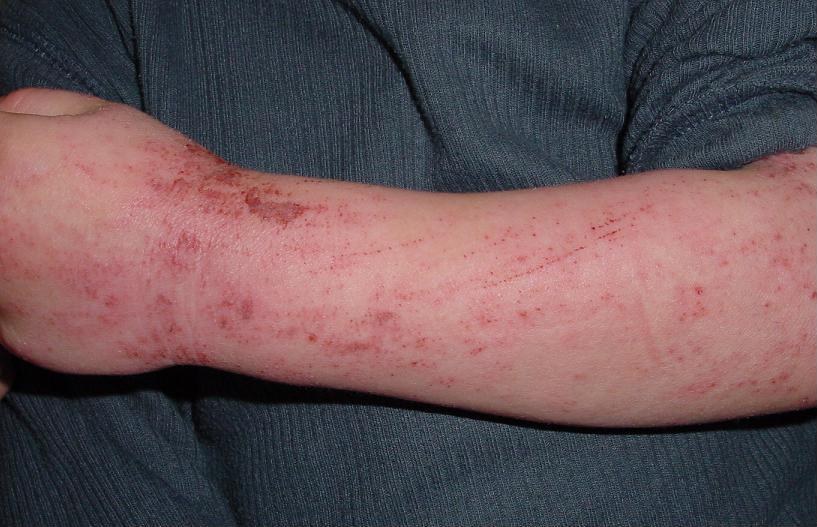
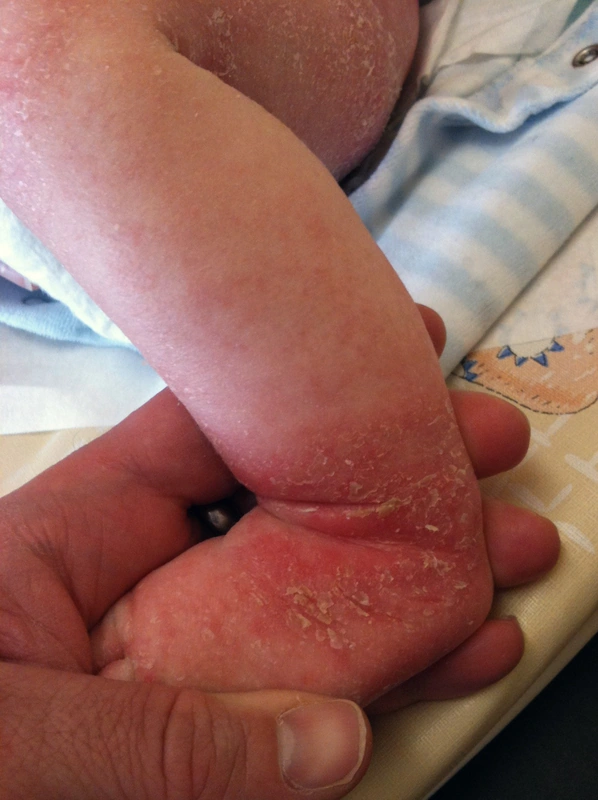
Definition
Chronic-recurrent, non-contagious inflammatory dermatosis due to barrier defect and dysregulation of the innate and adaptive immune system with Th2 dominance.
Atopy & Atopic March
Hypersensitivity to physical and chemical stimuli as well as IgE-mediated allergens; part of the atopic triad (Atopic dermatitis, Bronchial asthma, allergic rhinoconjunctivitis). Atopic March: Infantile eczema → later Asthma or Rhinitis.
Prevalence & Risk
Children 15–20 %, Adults 1.5–5 %. No parent affected: 15 %; both parents affected: 60–80 %.
Genetics / Barrier
Filaggrin mutation → ↓ NMF (Natural Moisturizing Factor), ↑ pH of the skin surface, ↑ TEWL (Transepidermal Water Loss). Additionally ↓ Claudin-1/3, ↓ Ceramides, SPINK5 mutation, changes in IL-4, IL-13, IL-4R and FcεRI → barrier defect and allergen penetration.
Diagnostic Criteria (Hanifin-Rajka 1980, modified according to DDG 2024)
Major Criteria (≥ 3 of 4 required)
- Major triad is chronic-recurrent with pruritus + history of atopy and age-dependent localization.
Minor Criteria / Atopic Stigmata (≥ 3 additional for diagnostic confirmation)
- Stigmata are facial pallor + palmar hyperlinearity with pulpitis sicca + nipple eczema and ear rhagades + pityriasis alba.
- Further classic stigmata:
- Dirty Neck (livid-brownish discoloration on neck/décolleté)
- Keratoconus (cone-shaped corneal deformation)
- Fur cap-like hairline (especially fronto-temporal)
- Cradle cap (infants — yellowish-crusted plaques on cheek/forehead)
- Keratosis follicularis (chicken skin) on extensor surfaces of upper arms/thighs
- Angular cheilitis (cheilitis sicca)
- Xerosis cutis (generalized dryness)
- Periorbital darkening ("Haloed eyes")
- Dennie-Morgan fold with double lower eyelid fold.
- White dermographism (skin streak turns white instead of red, in contrast to urticaria)
- Hertoghe's sign with thinned lateral eyebrows.
Common Provoking Factors (Trigger Factors)
- Allergic: House dust mites, animal dander, pollen, food allergens (cow's milk, chicken egg, soy, wheat, peanut in children; nuts, fish in adults).
- Irritant: Wool, sweating, surfactants / soaps, dry heated air, swimming pool chlorine.
- Microbial: Staphylococcus aureus (superantigen), Pityrosporum (head-neck form), HSV (Eczema herpeticatum).
- Stress, Hormonal fluctuations, Sleep deprivation.
Clinical Presentation by Age Phase
| Phase | Typical Localization |
|---|---|
| Infants (3rd month – 2nd year) | Cheeks, extensor surfaces of extremities, scalp, trunk; NOT diaper area (DD!) |
| Children (3rd–12th year) | Flexures (elbow creases, popliteal fossae), neck, wrists/ankles |
| Adolescence / Adulthood | Flexures continue, eyelid eczema, hand eczema, nape / neck / décolleté ("Head-Neck variant"), Atopic Hand Eczema |
| Seniors | generalized, lichenified, often erythroderma |
- Terminology: the pattern of childhood and adolescence is called eczema flexurarum (flexural eczema); in infancy one speaks of eczema infantum with crusta lactea (cradle cap), and in adulthood eyelid, hand and head-and-neck involvement is added.
Severity Scores (DDG-S3 Guideline)
- EASI (Eczema Area and Severity Index) — Quantification of erythema + infiltration + excoriation + lichenification × area.
- SCORAD (Scoring Atopic Dermatitis) — combines area + clinical signs + subjective symptoms.
- DLQI (Dermatology Life Quality Index) — Patient-Reported Outcome (10 questions).
- POEM (Patient-Oriented Eczema Measure) — Symptom score over 7 days.
Complications
- Eczema herpeticatum (HSV infection) — extensive umbilicated vesicles, emergency.
- Eczema molluscatum (HPV molluscum dissemination).
- Bacterial superinfection (S. aureus, "honey-colored crusts").
- Erythroderma in generalized course.
- Ocular involvement: Keratoconus, cataract (cup-shaped), conjunctivitis.
Differential diagnoses
- Allergic contact dermatitis
- Psoriasis vulgaris (plaque psoriasis)
- Seborrhoeic dermatitis
- Urticaria
- Mycosis fungoides
- Dyshidrotic hand eczema (pompholyx)
- Scabies
- Nummular eczema
Practise Atopic dermatitis (atopic eczema) in the app
Flashcards with spaced repetition, exam questions and spot-the-diagnosis on this topic – in DermaFuchs, free of charge.
In the DermaFuchs app: 25 flashcards · 12 clinical images
Open in browser Download on the App StoreSources (selection)
More allergies and eczemas
Note: This page is intended for medical education and does not replace diagnosis or treatment decisions in individual cases. Treatment and follow-up content is available in the app.