EASI calculator (Eczema Area and Severity Index)
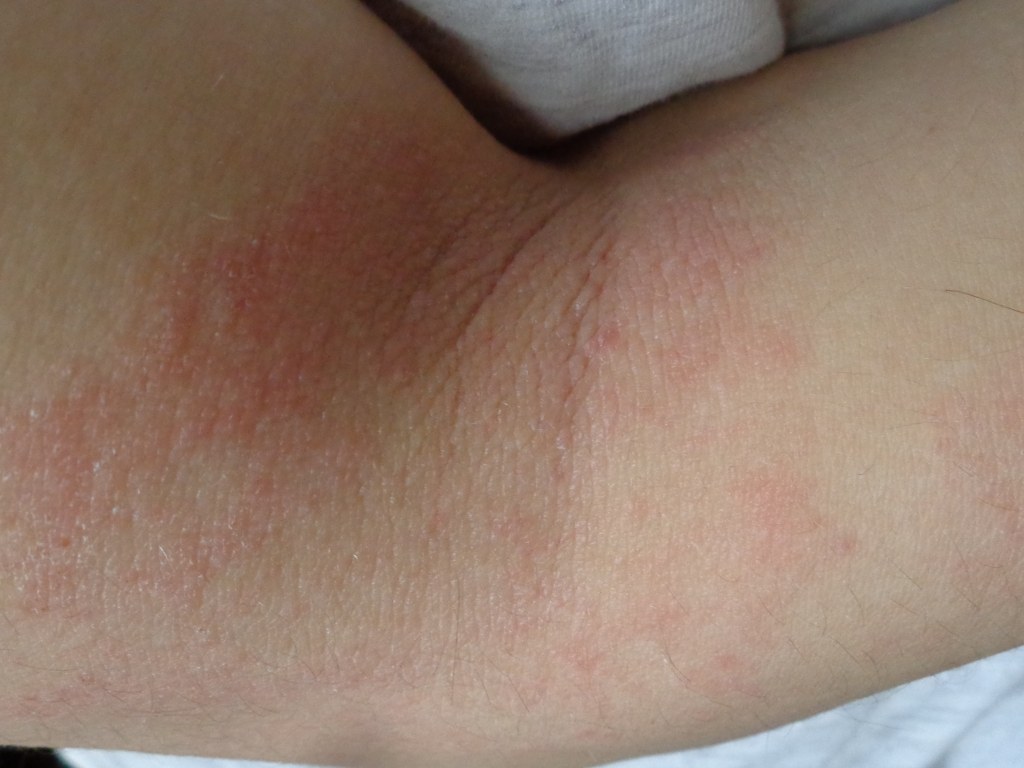
The EASI measures atopic dermatitis severity from 0 to 72. Rate erythema, oedema/papulation, excoriation and lichenification (0–3, half steps allowed) and the affected area per region.
⚠︎ Learning tool for medical education – not for use in patients or for treatment decisions.
Classification (original publication)
| Score | Classification (original publication) |
|---|---|
| 0 | Clear |
| 0.1–1.0 | Almost clear |
| 1.1–7.0 | Mild |
| 7.1–21.0 | Moderate |
| 21.1–50.0 | Severe |
| 50.1–72 | Very severe |
Calculation
Per region: (erythema + oedema/papulation + excoriation + lichenification) × area score × regional weight. Weights from age 8: head/neck 0.1 · upper limbs 0.2 · trunk 0.3 · lower limbs 0.4. Children aged 0–7: 0.2 · 0.2 · 0.3 · 0.3.
The severity bands come from the interpretability study by Leshem et al. (2015), which linked EASI values to the investigator global assessment. Trials report response as EASI 50/75/90.
EASI in trials
The EASI contains only clinician-rated signs and no subjective symptoms. The HOME initiative (Harmonising Outcome Measures for Eczema) chose it as the core instrument for clinical signs in trials.
FAQ
Which EASI indicates moderate atopic dermatitis?▾
According to Leshem et al. (2015), an EASI of 7.1–21.0 corresponds to moderate and 21.1–50.0 to severe disease.
Why are children weighted differently?▾
In young children the head accounts for a larger and the legs for a smaller share of body surface area. Hence the weights 0.2/0.2/0.3/0.3 up to age 7.
How is the EASI calculated? A worked example▾
Adult, only the legs affected: erythema 2 + oedema/papulation 1 + excoriation 1 + lichenification 1 = 5. The area is 30–49%, so area score 3. Regional weight of the legs from age 8: 0.4. Result: 5 × 3 × 0.4 = 6.0 – mild (1.1–7.0) according to Leshem et al. (2015).
What does EASI 75 mean?▾
EASI 75 means that the EASI has fallen by at least 75% from baseline. EASI 50 and EASI 90 accordingly stand for an improvement of at least 50% and 90%. These response rates are common endpoints in atopic dermatitis trials.
How does the EASI differ from SCORAD?▾
The EASI rates only clinician-assessed signs, separately for four body regions. SCORAD estimates extent using the rule of nines, rates six intensity items (additionally oozing/crusting and dryness) and includes the subjective symptoms itch and sleeplessness.
References
- Hanifin JM et al. The eczema area and severity index (EASI): assessment of reliability in atopic dermatitis. Exp Dermatol 2001;10:11–8. · PubMed
- Leshem YA et al. What the Eczema Area and Severity Index score tells us about the severity of atopic dermatitis: an interpretability study. Br J Dermatol 2015;172:1353–7. · PubMed
More Dermatology calculators
Keep learning
Keep learning with flashcards, exam questions and spot diagnoses in the KLINIKFUCHS app – free, in your browser or as an app.
Related pages: PASI calculator · Modified Rodnan skin score (mRSS) · BSA calculator (affected body surface area)
All calculators in the app
In DermaFuchs you practise PASI, EASI, mRSS, IHS4, UAS7 and more – and learn dermatology with flashcards, spot diagnoses and a dermoscopy course.
Open in browser Download on the App StoreIntended purpose: learning tool for medical education only. Not intended for use in patients or for diagnostic or treatment decisions; not a medical device. Calculations follow the cited original publications; no guarantee of completeness or correctness. Last updated: 11/2026 · Dr. Pascal Bafteh