Papular urticaria
- Synonyms
- Strophulus, Strophulus infantum, papulöse Urtikaria, Urtikaria papulosa, persistierende Insektenstichreaktion, insect bite-induced hypersensitivity, persistent insect bite reaction
- Specialty
- Dermatology · Allergies
- Images
- Clinical 1
- Last updated
- 10/2026 · Dr. Pascal Bafteh
Contents
Images (1)
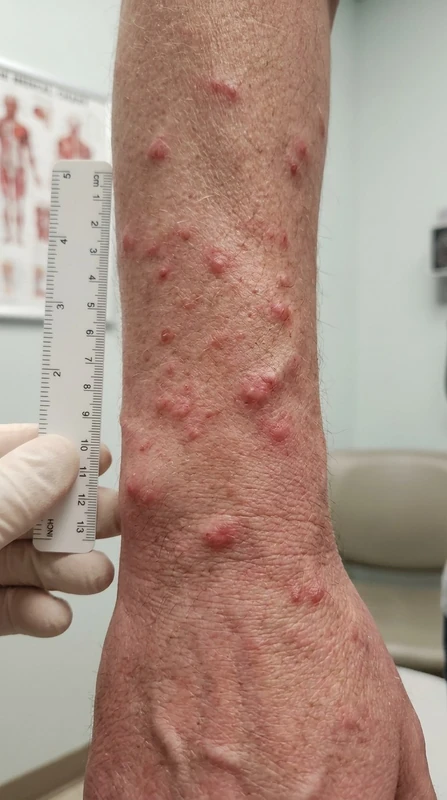 AI illustration
Definition
Papular urticaria is a hypersensitivity reaction to the bites of insects and arachnids, with chronic or recurrent itchy papules, mainly in children. It is also called persistent insect bite reaction; "insect bite-induced hypersensitivity" has been proposed as a more precise term.
Occurrence & epidemiology
Children are affected most often because they have not yet become desensitised to insect bites. In adults it occurs mainly in travellers to new environments. Flares cluster in the warmer months.
Aetiopathogenesis
An immunological reaction to bites; the initial bite is rarely noticed. Fleas and mites from cats and dogs are most often responsible; mosquitoes, bed bugs, bird mites, carpet beetles and caterpillars have also been reported. As desensitisation develops, the reaction settles over months to years.
Clinical features
- Clusters of itchy red papules (0.2–2 cm) without systemic symptoms, each with a central punctum; the papule may surround a wheal, and crops of vesicles can occur.
- Mainly on the legs and other uncovered areas (forearms, face), sometimes in small groups all over the body.
- New lesions appear every few days as older ones fade; a new bite can reactivate old lesions.
- The papules last days to weeks and can leave postinflammatory pigmentation or hypopigmented scars, particularly after deep scratching; scratching can lead to secondary bacterial infection (impetiginisation).
Histology
Mild dermal oedema, extravasated erythrocytes, interstitial eosinophils and exocytosis of lymphocytes; vasculitic features may be present.
Diagnosis
- Usually a clinical diagnosis; asking about pets, travel and season is helpful.
- A biopsy can support the diagnosis, as insect bites have a characteristic microscopic appearance.
- Affected children are often misdiagnosed and subjected to extensive, sometimes invasive investigations; clinical features (the SCRATCH principles) are intended to aid early diagnosis.
Differential diagnoses
Keep learning in the app
References (selection)
Cross-references
Mentioned in
- Mastocytosis (urticaria pigmentosa)
- Pediculosis capitis
- Caterpillar dermatitis caused by oak processionary moth (Thaumetopoea processionea)
- Urticaria
- Prurigo nodularis
- Nummular eczema (discoid eczema)
- Urticarial vasculitis (normocomplementaemic and hypocomplementaemic)
- Insect bite and sting reaction (local and large local reaction)
Note: This page is intended for medical education and does not replace diagnosis or treatment decisions in individual cases.