Intertrigo
- Synonyms
- skin fold rash
- Specialty
- Dermatology · Fungal infections
- Images
- Clinical 2
- In the app
- 6 flashcards
- Last updated
- 10/2026 · Dr. Pascal Bafteh
Contents
Images (2)
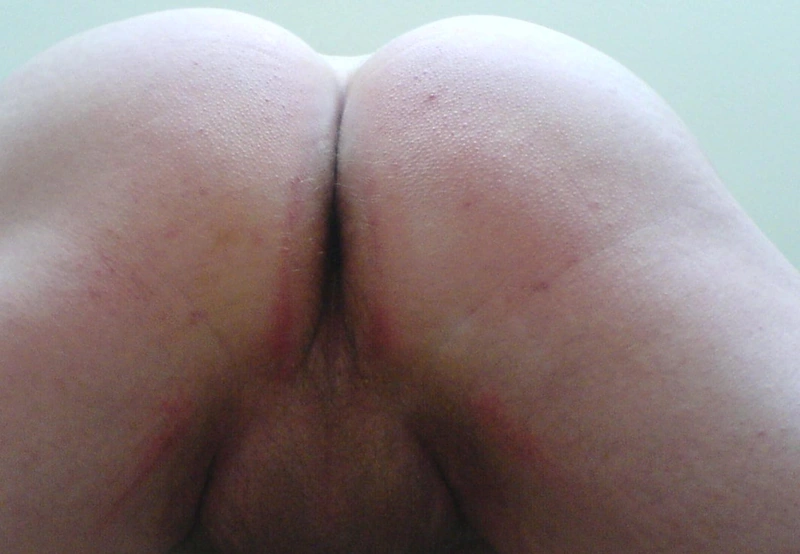
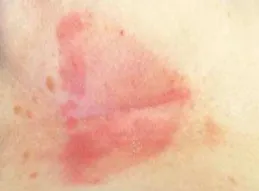
Definition
Intertrigo is an inflammatory condition of skin folds where skin rests on skin. Friction, warmth, moisture and maceration damage the skin barrier; secondary colonisation with Candida, bacteria or dermatophytes is common.
- General presentation: redness, maceration, burning, moist
- Candida albicans: bright red, sharply demarcated, satellite papules or pustules, burning
- Bacterial intertrigo: strongly weeping, painful, yellowish crusts, foul odor
- Erythrasma (Corynebacterium): brownish-red, dry, minimally inflamed; Wood's light coral red
- Intertrigo simplex: uniformly red, moist, macerated, no satellites
Occurrence & epidemiology
Predisposing factors are obesity, diabetes mellitus, hyperhidrosis, smoking, alcohol, older age, genetic predisposition, skin contact with sweat or urine, tight-fitting shoes (toe webs) and a warm humid climate. Typical sites are submammary, axillary, inguinal, the intergluteal cleft, abdominal folds and toe webs; in infants neck and nappy folds.
Diagnosis
- Clinical diagnosis; potassium hydroxide (KOH) microscopy and fungal culture to detect Candida or dermatophytes.
- Wood's light (coral-red fluorescence in erythrasma), bacterial swab with oozing and crusts.
- Distinction from inverse psoriasis, seborrhoeic dermatitis, contact dermatitis and Hailey-Hailey disease.
Differential diagnoses


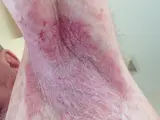
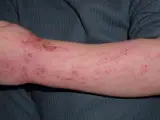
Image credits for the thumbnails
- Erythrasma: unknown (Commons user), “Erythrasma”, CC BY-SA 4.0, via Wikimedia Commons · CC BY-SA 4.0 · Source
- Seborrhoeic dermatitis: Roymishali, “Seborrhoeic dermatitis highres”, CC BY-SA 3.0, via Wikimedia Commons · CC BY-SA 3.0 · Source
- Hailey-Hailey disease: Squeakycatta, “Before Magnesium Chloride”, CC BY-SA 4.0, via Wikimedia Commons · CC BY-SA 4.0 · Source
- Atopic dermatitis (atopic eczema): Eisfelder, “Atopic dermatitis child”, CC BY-SA 3.0, via Wikimedia Commons · CC BY-SA 3.0 · Source
Treatment principles
- The basic principle is to reduce moisture, warmth and friction in the skin folds, for example by keeping them dry, inserting absorbent textiles and weight reduction in obesity.
- Acutely inflamed areas are treated briefly with low-potency topical glucocorticoids and antiseptics.
- Secondary infections are treated according to the pathogen, with topical antimycotics for Candida and antiseptics or antibiotics for bacterial infection; predisposing conditions such as diabetes mellitus should also be treated.
Specific treatment regimens with drugs and doses are covered in the DermaFuchs app.
Keep learning in the app
References (selection)
Cross-references
Mentioned in
Keep learning: test yourself
Two questions from the DermaFuchs app on Intertrigo – tap an answer.
Question 1 of 2
What are the typical clinical characteristics of a bacterial intertrigo?
Answer
Correct: strongly weeping, painful, yellowish crusts, foul odor. Bacterial superinfections in skin folds typically present with marked exudation, pain, yellowish crusting, and a foul smell due to bacterial metabolism.
Question 2 of 2
What clinical feature helps differentiate irritant diaper dermatitis from Candida intertrigo?
Answer
Correct: Sparing of folds. Irritant diaper dermatitis primarily affects convex surfaces in direct contact with the diaper, sparing the deeper skin folds.
More questions like these – with explanations and spaced repetition – in the app.
Note: This page is intended for medical education and does not replace diagnosis or treatment decisions in individual cases.