Hailey-Hailey disease
Exam relevance: in 4 of more than 50 board exam reports · rank 33
- Synonyms
- familial benign pemphigus
- Specialty
- Dermatology · Hereditary skin diseases
- Images
- Clinical 2
- In the app
- 8 flashcards
- Last updated
- 10/2026 · Dr. Pascal Bafteh
Contents
Images (2)
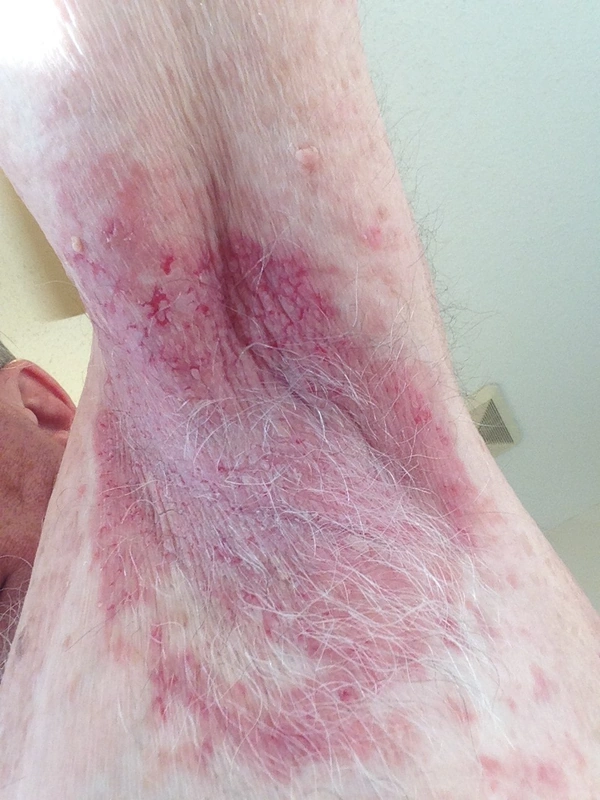
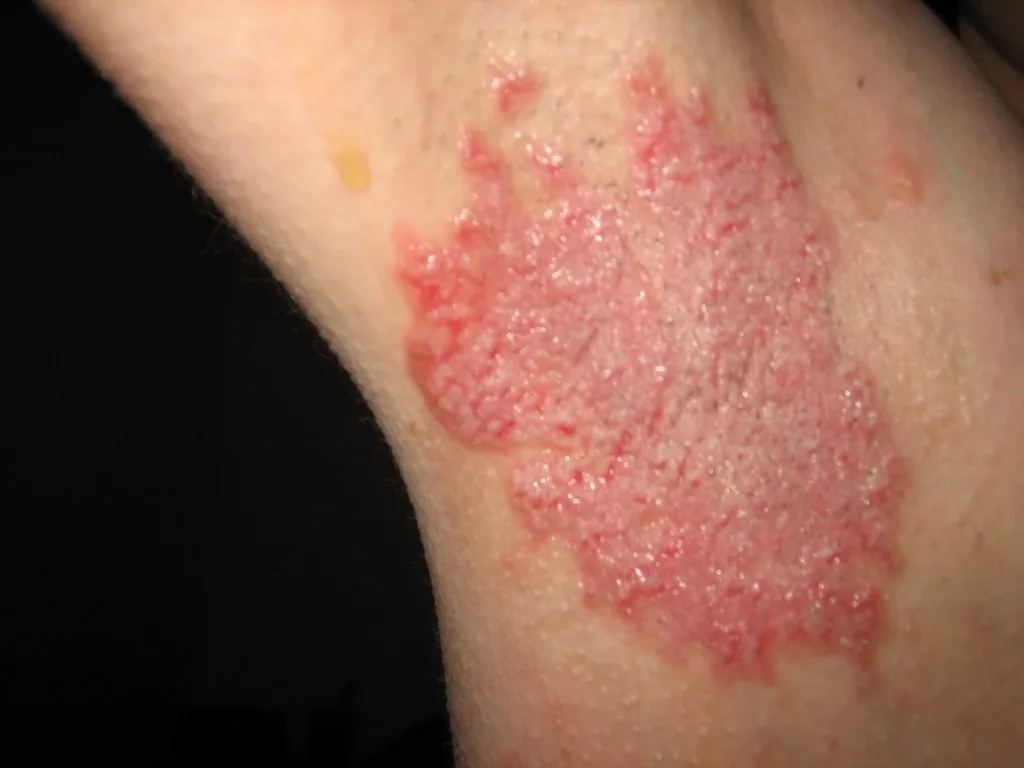
Definition
Definition & Pathogenesis
- Hailey-Hailey disease (Familial benign chronic pemphigus, M. Hailey-Hailey) = autosomal-dominant genodermatosis with acantholytic dermatosis of intertriginous areas.
- Gene / inheritance: Causative gene is ATP2C1 (encodes SPCA1 = secretory Golgi pathway Ca²⁺-ATPase 1) on chromosome 3q21, autosomal-dominant.
- Pathomechanism: Mechanism is disturbed Ca²⁺/Mn²⁺ transport into Golgi → defective desmosome assembly → suprabasal acantholysis ("dilapidated brick wall").
- Penetrance high, expressivity variable; segmental mosaic form type 1/2 possible.
- Localization: intertriginous (axillae + groins) — Axillae, inframammary, neck.
- Triggers: Heat, sweating, mechanical stress.
Clinical features
Clinical Presentation
- Age of onset: Typical first manifestation period is 2nd–4th decade of life (10–40 yrs).
- Location: Characteristic distribution is intertriginous (axillae, groin, genitoanal, submammary, neck-nape).
- Morphology: Efflorescences are macerated erythemas + erosions + rhagades / fissures ("brain furrow" aspect) + vegetations + malodorous.
- Triggers: Frequent triggers are heat + sweat + friction + UV + bacterial/viral superinfections.
- Course: chronic-relapsing, summer worsening; often milder with age.
- Not typical: mucosal involvement very rare, no V-notch nails (DD Darier!), longitudinal white nail streaks may occur.
Diagnosis
Diagnostics
- Clinical + family history (autosomal-dominant).
- Histology: Characteristic are extensive suprabasal acantholysis ("dilapidated brick wall").
- DIF: negative (DD to pemphigus vulgaris / pemphigus vegetans).
- Serology: anti-Dsg1/3 negative.
Differential diagnoses
 Atopic dermatitis (atopic eczema)
 Pyoderma gangrenosum
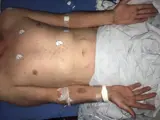 Secondary syphilis (lues II)
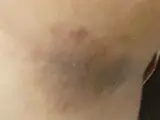 Erythrasma
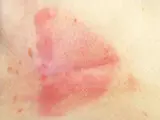 Intertrigo
Image credits for the thumbnails
- Atopic dermatitis (atopic eczema): Eisfelder, “Atopic dermatitis child”, CC BY-SA 3.0, via Wikimedia Commons · CC BY-SA 3.0 · Source
- Pyoderma gangrenosum: Monopol, “Pyoderma gangrenosum 01”, CC BY-SA 3.0, via Wikimedia Commons · CC BY-SA 3.0 · Source
- Secondary syphilis (lues II): Ehlers S, Sergent S, Ashurst J (Clin Pract Cases Emerg Med 2020), CC BY 4.0, via PubMed Central (PMC7676796) · CC BY 4.0 · Source
- Erythrasma: unknown (Commons user), “Erythrasma”, CC BY-SA 4.0, via Wikimedia Commons · CC BY-SA 4.0 · Source
- Intertrigo: Pera F, Suman C, Cosma M, Mazza S, Brunani A, Cancello R (J Cosmet Dermatol 2025), CC BY 4.0, via PubMed Central (PMC12042251) – panel B “before” (cropped) · CC BY 4.0 · Source
Treatment principles
- There is no causal treatment; the basis is reducing friction and sweating (breathable clothing, cooling, weight reduction) and early treatment of superinfections.
- Topical glucocorticoids, calcineurin inhibitors and antiseptics or antibiotics are used; sweat-reducing procedures can help prevent flares.
- Refractory disease may be treated with systemic therapies (e.g. antibiotics, retinoids) or ablative procedures such as laser, dermabrasion and excision with skin grafting.
Specific treatment regimens with drugs and doses are covered in the DermaFuchs app.
Keep learning in the app
References (selection)
Cross-references
Mentioned in
Keep learning
Keep learning with flashcards, exam questions and spot diagnoses in the DermaFuchs app – free, in your browser or as an app.
Related pages: Grover's disease (transient acantholytic dermatosis) · Candida intertrigo · Psoriasis inversa
Note: This page is intended for medical education and does not replace diagnosis or treatment decisions in individual cases.