Herpes simplex (cold sores)
Exam relevance: in 3 of more than 50 board exam reports · rank 45
- Synonyms
- Lippenherpes, Fieberbläschen, Herpes labialis, HSV-1, Gingivostomatitis herpetica, cold sores, fever blisters, oral herpes, HSV
- Specialty
- Dermatology · Viral infections
- Images
- Clinical 1
- In the app
- 8 flashcards
- Last updated
- 10/2026 · Dr. Pascal Bafteh
Contents
Images (1)
Definition
Herpes simplex refers to infections with herpes simplex virus type 1 or type 2 (HSV-1, HSV-2), double-stranded DNA viruses of the herpesvirus family. After primary infection the virus remains latent for life in sensory ganglia and can be reactivated repeatedly.
Occurrence & epidemiology
HSV-1 is very widespread worldwide: according to WHO estimates 64% of people under 50 are infected with HSV-1, the main cause of oral herpes. An estimated 13% of people aged 15–49 are infected with HSV-2, the main cause of genital herpes. Transmission occurs through direct contact with lesions, saliva or mucosal secretions, including during asymptomatic viral shedding.
Clinical features
- Primary infection: often unnoticed; in young children it presents as herpetic gingivostomatitis with fever, painful oral erosions and lymphadenopathy.
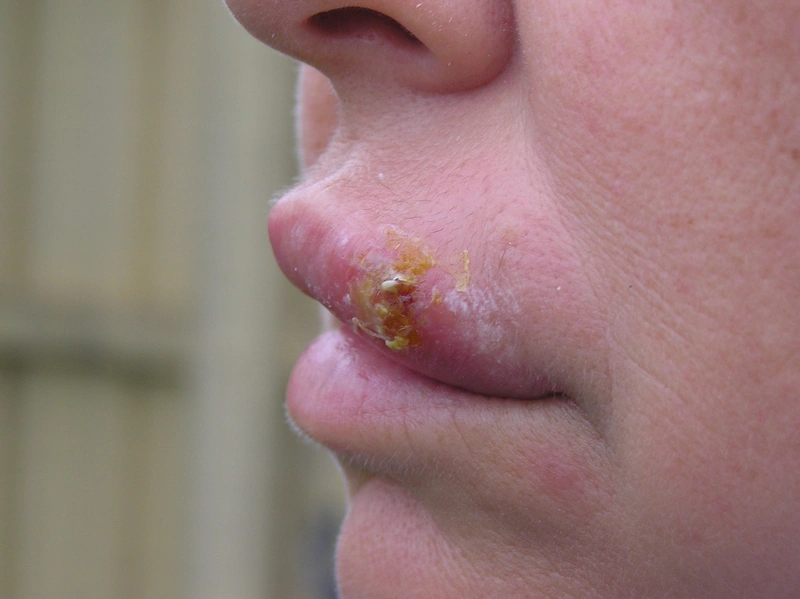
- Recurrence (herpes labialis): prodrome of burning, tingling or tightness, then grouped vesicles on an erythematous base at the vermilion border or perioral skin, which turn into erosions and crusts and usually heal within 7–10 days without scarring. Triggers include UV light, fever, menstruation, stress and immunosuppression.
- Special forms: herpes gladiatorum (contact sports), herpetic whitlow, eczema herpeticum, neonatal herpes and herpetic keratitis.
- HSV is the most common trigger of erythema multiforme.
Histology
Intraepidermal blister with acantholysis and swollen keratinocytes; typical nuclear changes are margination of chromatin, multinucleation and nuclear inclusions (Cowdry type A); mixed infiltrate of lymphocytes and neutrophils. Histologically identical to varicella and herpes zoster – they are distinguished by immunohistochemistry, PCR or culture.
Diagnosis
- The diagnosis is usually clinical when the picture is typical.
- If in clinical doubt, confirmation by PCR or viral culture of a swab from fresh vesicles.
- Serology is not very informative, because most people are positive and it says nothing about the current lesion.
Differential diagnoses
 Herpes zoster
 Impetigo (impetigo contagiosa)
 Hand, foot and mouth disease
 Varicella (chickenpox)
 Dyshidrotic eczema (pompholyx)
 Hand eczema
 Eczema herpeticum
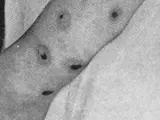 Ecthyma
Image credits for the thumbnails
- Herpes zoster: Asvmdrn, “Herpes zoster, elbow”, CC BY-SA 3.0, via Wikimedia Commons · CC BY-SA 3.0 · Source
- Impetigo (impetigo contagiosa): Littlekidsdoc, “Bullous impetigo”, CC BY-SA 4.0, via Wikimedia Commons · CC BY-SA 4.0 · Source
- Hand, foot and mouth disease: Kessalia19, CC BY-SA 4.0, via Wikimedia Commons · CC BY-SA 4.0 · Source
- Varicella (chickenpox): Jonnymccullagh, “Chickenpox 5yearold”, CC BY-SA 3.0, via Wikimedia Commons · CC BY-SA 3.0 · Source
- Dyshidrotic eczema (pompholyx): Inwe (Wikimedia Commons), “Dyshidrosis”, CC BY-SA 3.0, via Wikimedia Commons · CC BY-SA 3.0 · Source
- Hand eczema: JIP, “Eczema on knuckle”, CC BY-SA 4.0, via Wikimedia Commons · CC BY-SA 4.0 · Source
- Eczema herpeticum: Mohammad2018, CC BY-SA 4.0, via Wikimedia Commons, cropped · CC BY-SA 4.0 · Source
- Ecthyma: Norman Purvis Walker, An Introduction to Dermatology (3rd ed., 1905), public domain, via Wikimedia Commons – cropped · Public domain · Source
Treatment principles
- Recurrent herpes labialis usually resolves spontaneously; topical antivirals started early may shorten the course slightly.
- Systemic antivirals are used for pronounced episodes, severe primary infections such as herpetic gingivostomatitis, or in immunosuppression.
- Suppressive therapy is an option for very frequent recurrences; general measures include avoiding known triggers, for example through UV protection of the lips.
Specific treatment regimens with drugs and doses are covered in the DermaFuchs app.
Keep learning in the app
References (selection)
Cross-references
Mentioned in
Keep learning
Keep learning with flashcards, exam questions and spot diagnoses in the DermaFuchs app – free, in your browser or as an app.
Related pages: Herpes zoster · Impetigo (impetigo contagiosa) · Hand, foot and mouth disease
Note: This page is intended for medical education and does not replace diagnosis or treatment decisions in individual cases.