Fixed drug eruption (FDE)
- Synonyms
- FDE, fixed drug eruption
- Specialty
- Dermatology · Drug reactions
- Images
- Clinical 1
- In the app
- 2 flashcards
- Last updated
- 10/2026 · Dr. Pascal Bafteh
Contents
Images (1)
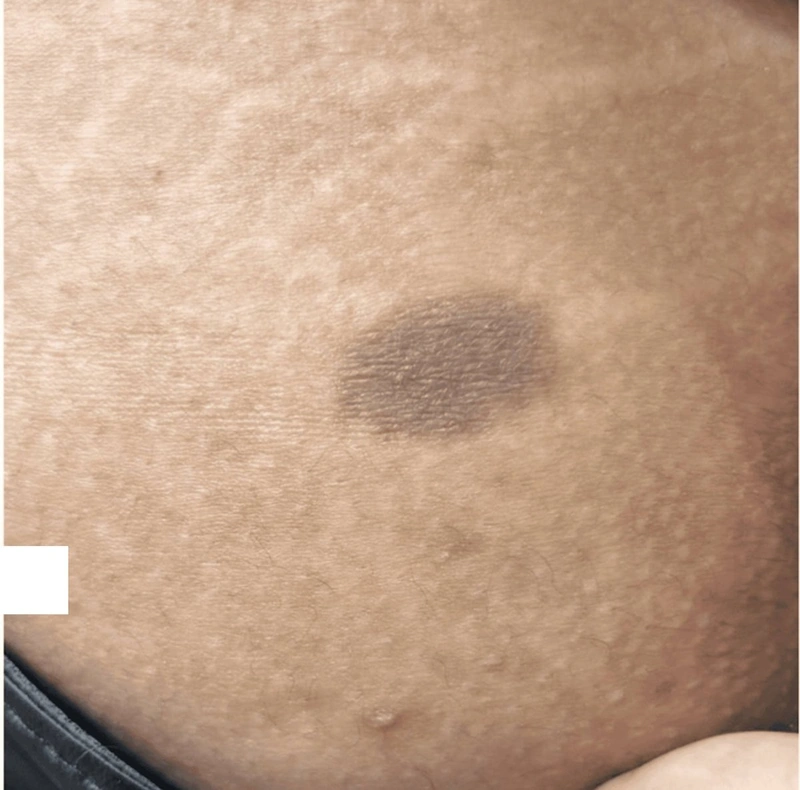
Definition
Fixed drug eruption is a drug reaction that recurs at exactly the same skin sites each time the same culprit is taken again. It is caused by memory T cells (CD8+) residing in the skin that are reactivated locally on re-exposure.
- Frequency: one of the more common cutaneous drug reactions; figures vary widely by region.
- Latency: weeks to years after starting (minutes to hours upon re-exposure).
- Common triggers (2): co-trimoxazole & barbiturates.
- Clinical presentation: Sharply demarcated, erythematous-livid plaques/bullae often acral/mucosal.
- Special feature: recurrence at exactly the same site on re-exposure (in situ memory T cells).
Clinical features
- One or a few round, sharply demarcated, red to violaceous patches or plaques, sometimes blistering or eroded, that leave a brown post-inflammatory hyperpigmentation on resolution (darker with each recurrence).
- Preferred sites are hands and feet, eyelids, the anogenital area (e.g. glans penis) and lips; the first episode follows weeks to years of regular intake, later episodes begin within minutes to hours of renewed intake.
- It is frequently caused by co-trimoxazole and other sulfonamides, tetracyclines, NSAID painkillers and paracetamol; a generalised bullous form resembles SJS/TEN.
Differential diagnoses


Image credits for the thumbnails
- Urticaria: Gzzz, “Urticaria child”, CC BY-SA 4.0, via Wikimedia Commons · CC BY-SA 4.0 · Source
- Phototoxic dermatitis: Dragan Marjanovic, “Phytophotodermatitis-Severe-Case”, CC BY-SA 3.0, via Wikimedia Commons · CC BY-SA 3.0 · Source
- Erythema multiforme: kilbad (talk), “Target lesion 2”, CC BY-SA 3.0, via Wikimedia Commons · CC BY-SA 3.0 · Source
- Herpes simplex (cold sores): unknown (Commons user), “Cold sore”, Public Domain, via Wikimedia Commons · Public Domain · Source
Treatment principles
- Withdrawal and permanent avoidance of the causative drug are crucial, as re-exposure provokes lesions again at the same sites.
- Topical glucocorticoids and, for pruritus, oral antihistamines are used symptomatically; residual hyperpigmentation usually fades only slowly.
- The generalised bullous form is managed like a severe cutaneous adverse drug reaction, and the culprit drug is documented in an allergy passport.
Specific treatment regimens with drugs and doses are covered in the DermaFuchs app.
Keep learning in the app
References (selection)
Cross-references
Mentioned in
Keep learning: test yourself
One question from the DermaFuchs app on Fixed drug eruption (FDE) – tap an answer.
Question 1 of 1
What is the typical latency period for a fixed drug eruption upon first exposure versus re-exposure?
Answer
Correct: 1–2 weeks post-exposure (minutes to hours upon re-exposure). Initial sensitization takes 1-2 weeks, but re-exposure to the offending drug triggers a reaction within minutes to hours.
More questions like these – with explanations and spaced repetition – in the app.
Note: This page is intended for medical education and does not replace diagnosis or treatment decisions in individual cases.