Rubella (German measles)
- Synonyms
- Rubella, Rötelnvirus, Rötelnexanthem, konnatale Röteln, konnatales Rötelnsyndrom, Rötelnembryopathie, German measles, rubella rash, congenital rubella syndrome
- Specialty
- Dermatology · Viral infections
- Images
- Clinical 1
- In the app
- 1 flashcards
- Last updated
- 10/2026 · Dr. Pascal Bafteh
Contents
Images (1)
Definition
Rubella is a usually mild infectious disease caused by the rubella virus (family Togaviridae, genus Rubivirus), with a fine macular rash and lymph node swelling. Its main significance lies in infection during pregnancy, which can lead to congenital rubella syndrome (CRS).
Occurrence & epidemiology
Humans are the only natural host. Transmission is usually by droplets; the incubation period is 14–21 days. Patients are infectious from 7 days before to 7 days after the onset of the rash. Up to 50% of infections are asymptomatic. In Germany rubella has been considered eliminated since December 2020 and now occurs only very rarely.
Clinical features
- Prodrome (more common in adults): headache, low-grade fever, conjunctivitis, upper respiratory catarrh.
- Lymph node swelling, especially nuchal and retroauricular.
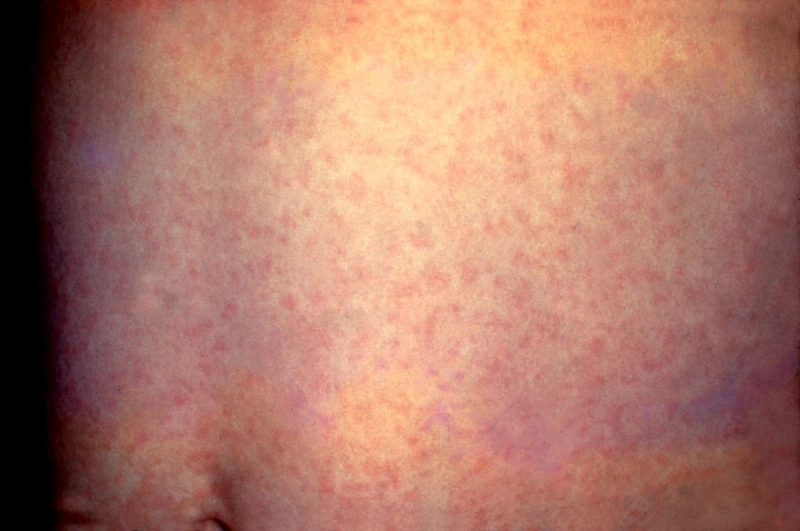
- Rash: fine, macular to maculopapular, pink to light red (spots about 2–3 mm); starts on the face, spreads over the trunk and limbs and fades after 1–3 days.
- Forchheimer sign: petechiae on the soft palate and uvula during the prodrome.
- Arthralgia and arthritis mainly in adult women; rarely thrombocytopenia with purpura or encephalitis.
- Congenital rubella syndrome: infection in the first 12 weeks of pregnancy damages up to 90% of fetuses; classic Gregg triad of heart defect, cataract and sensorineural deafness; the skin may show a "blueberry muffin" pattern.
Diagnosis
- A purely clinical diagnosis is unreliable (similar rashes occur in measles, erythema infectiosum and scarlet fever, among others); every suspected case is confirmed in the laboratory.
- RT-PCR from throat swab and urine, as soon as possible after the rash appears.
- Serology: IgM antibodies (positive in over 90% from about day 5 after symptom onset; false-positive results possible) or a marked (more than 4-fold) rise in IgG in two samples taken 10–14 days apart.
- Notifiable by name in Germany (suspicion, illness, death, pathogen detection).
Differential diagnoses
- Measles
- Erythema infectiosum (fifth disease)
- Roseola infantum (exanthem subitum)
- Scarlet fever
- Amoxicillin rash in infectious mononucleosis
- Acanthosis nigricans maligna
Keep learning in the app
References (selection)
Cross-references
Note: This page is intended for medical education and does not replace diagnosis or treatment decisions in individual cases.