Erythema infectiosum (fifth disease)
Exam relevance: in 2 of more than 50 board exam reports · rank 69
- Synonyms
- fifth disease, slapped cheek, erythema infectiosum
- Specialty
- Dermatology · Viral infections
- Images
- Clinical 2
- In the app
- 2 flashcards
- Last updated
- 10/2026 · Dr. Pascal Bafteh
Contents
Images (2)
Definition
- Rubella (Rubella): The causative agent is the rubella virus.
- Symptoms: flu-like prodrome · nuchal/retroauricular lymphadenopathy.
- Exanthem: consists of pinhead-sized papules.
- Spread: craniocaudally (face → trunk → extremities).
- Infection during pregnancy: Gregg's triad (malformation).
- Erythema infectiosum (Erythema infectiosum): The causative agent is Parvo B19.
- Typical: cheek erythema with perioral pallor (slapped cheeks).
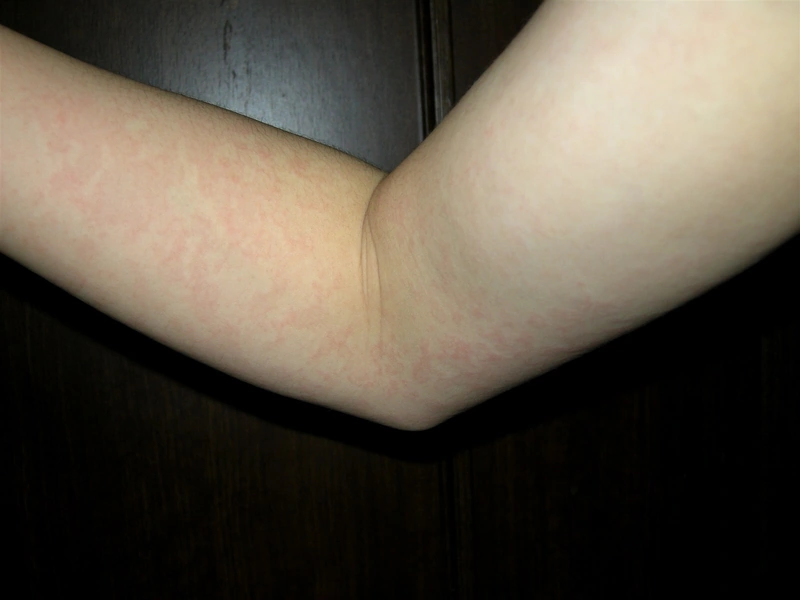
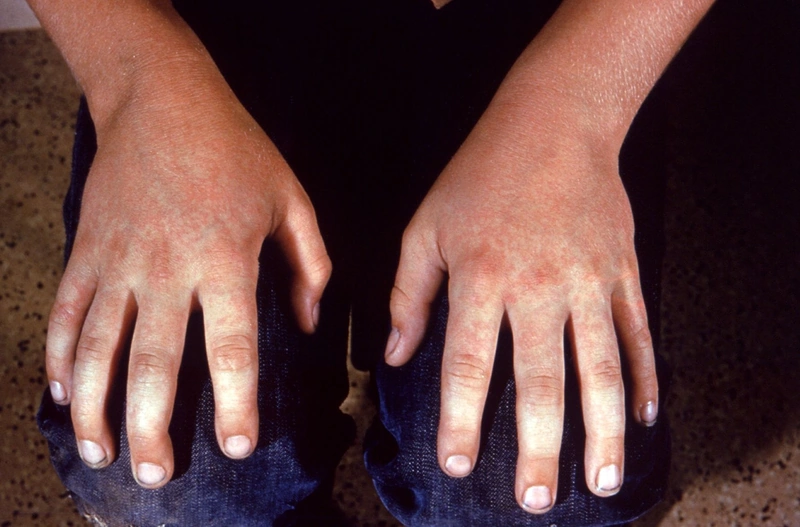
- Exanthem: garland-shaped, lace-like exanthem on the limbs and sometimes the trunk.
- Complication: aplastic crisis.
- During pregnancy: risk of hydrops.
- Also: glove-and-sock syndrome possible · lymphadenopathy usually absent.
- Roseola infantum (Exanthema subitum): The causative agent is HHV-6 (HHV-7 only a rare trigger).
- Exanthem: transiently pink.
- Spread: centrifugally (trunk → extremities).
- Usually spared: the face.
- Lymphadenopathy: rare/subtle.
Differential diagnoses
 Rubella (German measles)
 Roseola infantum (exanthem subitum)
 Atopic dermatitis (atopic eczema)
 Urticaria
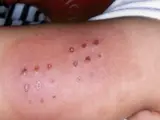 Kawasaki disease (mucocutaneous lymph node syndrome)
 Measles
Image credits for the thumbnails
- Rubella (German measles): CDC, “Rubella”, Public domain, via Wikimedia Commons · Public domain · Source · CDC PHIL #4514
- Roseola infantum (exanthem subitum): Emiliano Burzagli, Public domain, via Wikimedia Commons · Public domain · Source
- Atopic dermatitis (atopic eczema): Eisfelder, “Atopic dermatitis child”, CC BY-SA 3.0, via Wikimedia Commons · CC BY-SA 3.0 · Source
- Urticaria: Gzzz, “Urticaria child”, CC BY-SA 4.0, via Wikimedia Commons · CC BY-SA 4.0 · Source
- Kawasaki disease (mucocutaneous lymph node syndrome): Dong Soo Kim, CC BY-SA 4.0, via Wikimedia Commons · CC BY-SA 4.0 · Source
- Measles: CDC/Dr. Heinz F. Eichenwald, “Morbillivirus measles infection”, Public Domain, via Wikimedia Commons · Public Domain · Source · CDC PHIL #3168
Treatment principles
- In healthy individuals, erythema infectiosum resolves spontaneously; treatment is symptomatic.
- Pregnant women, patients with haemolytic anaemia and immunocompromised patients are at risk: in pregnancy, the fetus is closely monitored for anaemia and hydrops, and intrauterine transfusion may be required.
- Aplastic crises require transfusion, and chronic infection in immunosuppression requires immunoglobulins.
Specific treatment regimens with drugs and doses are covered in the DermaFuchs app.
Keep learning in the app
References (selection)
Cross-references
Keep learning: test yourself
One question from the DermaFuchs app on Erythema infectiosum (fifth disease) – tap an answer.
Question 1 of 1
What is the typical shape of the generalized exanthem in erythema infectiosum?
Answer
Correct: garland-shaped. The rash of erythema infectiosum typically has a reticular or garland-shaped appearance.
More questions like these – with explanations and spaced repetition – in the app.
Note: This page is intended for medical education and does not replace diagnosis or treatment decisions in individual cases.