Measles
For patients: easy-to-read leaflets in English (page in German) →
Exam relevance: in 1 of more than 50 board exam reports · rank 93
- Synonyms
- rubeola, morbilli
- Specialty
- Dermatology · Viral infections
- Images
- Clinical 2
- In the app
- 3 flashcards
- Last updated
- 10/2026 · Dr. Pascal Bafteh
Contents
Images (2)
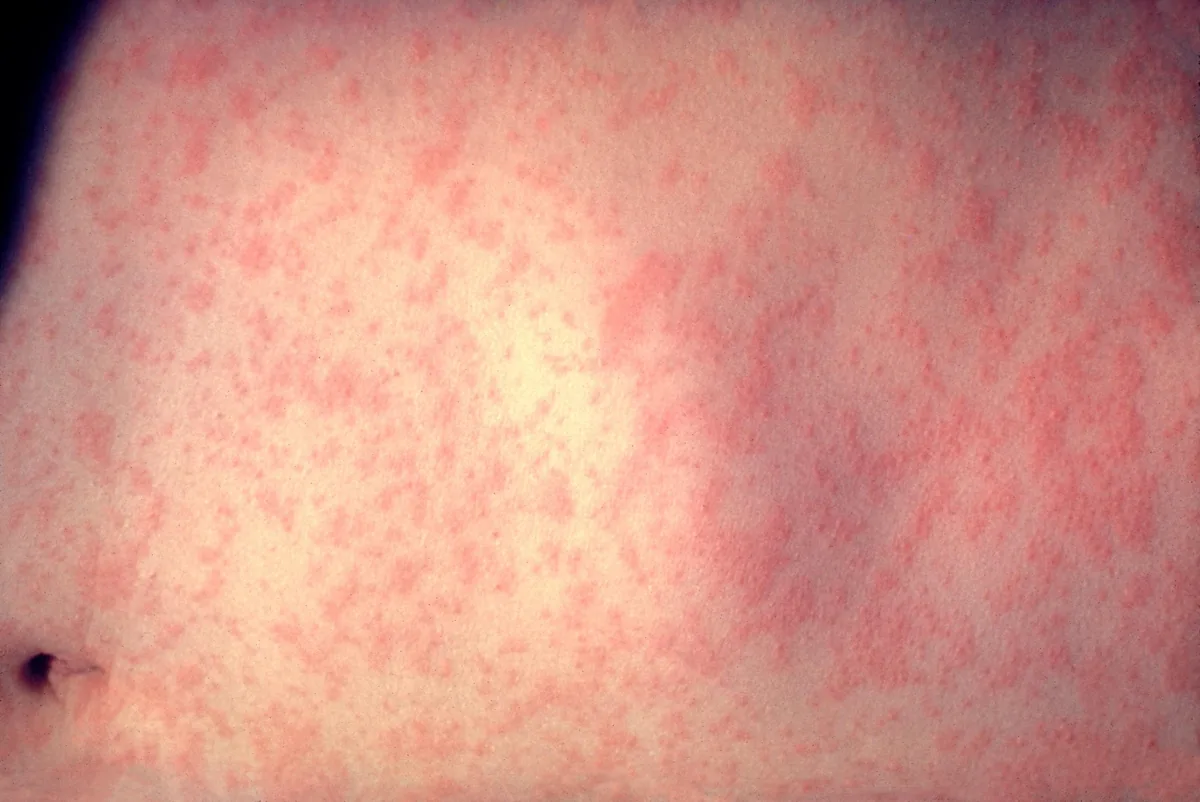
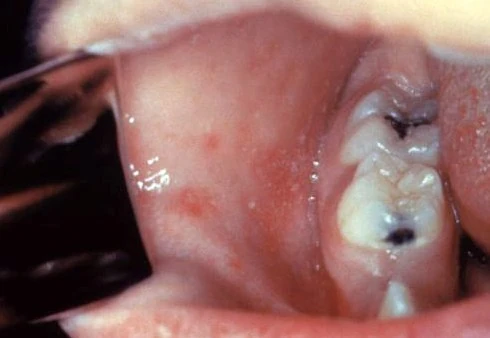
Definition
Measles is a highly contagious systemic viral infection caused by measles virus (Paramyxoviridae, genus Morbillivirus) with a typical biphasic course of a prodromal and an exanthematous stage.
- Pathogen: Measles virus (Paramyxoviridae). Incubation: 10–14 days until the prodrome (14–17 days until the rash). Prodrome: Fever, cough & coryza, Conjunctivitis & photophobia.
- Mucous membrane: On day 2-3, Koplik spots (white spots) appear; the correlate is the migration of viruses into the oral mucosa with consecutive focal necrosis/exudation.
- Exanthem: On day 2–4 after onset of the prodrome, a morbilliform/confluent exanthem follows with brownish-pink, confluent spots, starting on the face and behind the ears.
Occurrence & epidemiology
Transmission is airborne via droplets and aerosols; almost every susceptible contact becomes ill. People are contagious from about four days before to four days after the onset of the rash. In Germany suspected cases, illness and death are notifiable. Feared complications are otitis media, pneumonia, acute encephalitis and – years later – subacute sclerosing panencephalitis (SSPE).
Diagnosis
- Clinical picture with prodrome (fever, cough, coryza, conjunctivitis), Koplik spots and a craniocaudally spreading rash.
- Laboratory confirmation: measles-specific IgM in serum and/or viral RNA (PCR) from a throat swab or urine.
- Distinction from other exanthematous diseases such as rubella, erythema infectiosum, scarlet fever and drug eruptions; in sporadic suspected cases the clinical diagnosis is unreliable, so laboratory confirmation is always needed.
Differential diagnoses
 Kawasaki disease (mucocutaneous lymph node syndrome)
 Scarlet fever
 Roseola infantum (exanthem subitum)
 Rubella (German measles)
 Erythema infectiosum (fifth disease)
 Infectious mononucleosis (glandular fever) – skin and mucosal signs
- Acanthosis nigricans maligna
- Measles
Image credits for the thumbnails
- Kawasaki disease (mucocutaneous lymph node syndrome): Dong Soo Kim, CC BY-SA 4.0, via Wikimedia Commons · CC BY-SA 4.0 · Source
- Scarlet fever: Whispyhistory, “Scarlet fever rash”, CC BY-SA 4.0, via Wikimedia Commons · CC BY-SA 4.0 · Source
- Roseola infantum (exanthem subitum): Emiliano Burzagli, Public domain, via Wikimedia Commons · Public domain · Source
- Rubella (German measles): CDC, “Rubella”, Public domain, via Wikimedia Commons · Public domain · Source · CDC PHIL #4514
- Erythema infectiosum (fifth disease): Etorofu island, “Erythema infectiosum (右腕)”, CC BY-SA 3.0, via Wikimedia Commons · CC BY-SA 3.0 · Source
- Infectious mononucleosis (glandular fever) – skin and mucosal signs: Sgamer1770, CC BY-SA 4.0, via Wikimedia Commons · CC BY-SA 4.0 · Source
Treatment principles
- There is no specific antiviral therapy; treatment is symptomatic, and bacterial complications such as otitis media or pneumonia are treated with antibiotics.
- Patients are isolated; measles is a notifiable disease.
- Unprotected contacts can receive early post-exposure vaccination or, if contraindicated, passive immunisation; the most effective measure is prevention by vaccination.
Specific treatment regimens with drugs and doses are covered in the DermaFuchs app.
Keep learning in the app
References (selection)
Cross-references
Mentioned in
Keep learning: test yourself
One question from the DermaFuchs app on Measles – tap an answer.
Question 1 of 1
What is the consequence of a measles infection during pregnancy?
Answer
Correct: premature birth without malformation. Measles infection during pregnancy increases the risk of premature birth, but unlike rubella, it does not typically cause fetal malformations.
More questions like these – with explanations and spaced repetition – in the app.
Note: This page is intended for medical education and does not replace diagnosis or treatment decisions in individual cases.