Eczema herpeticum
Exam relevance: in 2 of more than 50 board exam reports · rank 69
- Synonyms
- Kaposi-varizelliforme Eruption, Ekzema herpeticatum, disseminierter Herpes bei Neurodermitis, Kaposi varicelliform eruption
- Specialty
- Dermatology · Viral infections
- Images
- Clinical 2
- In the app
- 10 flashcards
- Last updated
- 10/2026 · Dr. Pascal Bafteh
Contents
Images (2)
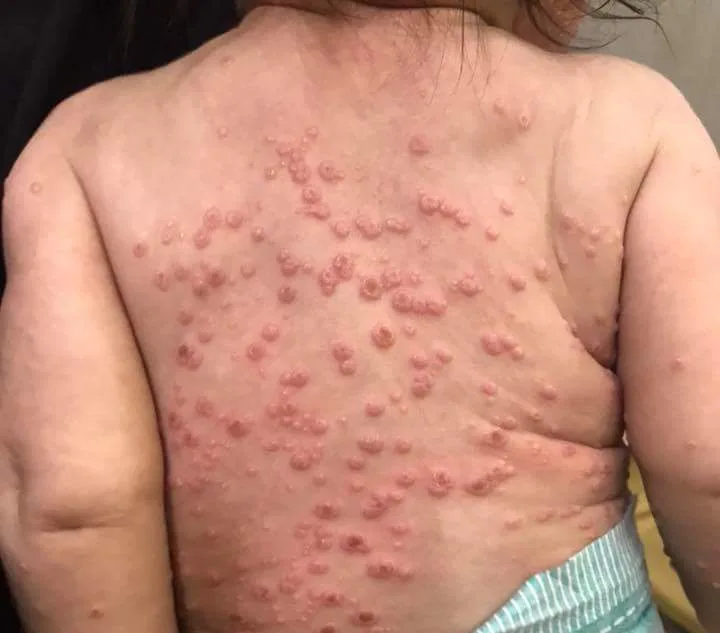
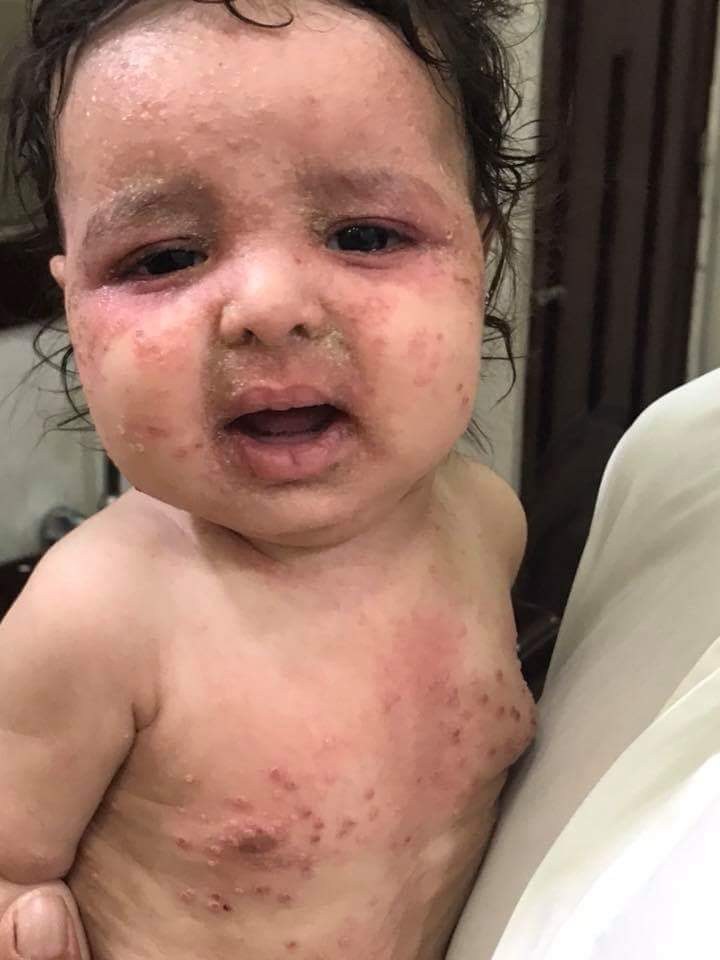
Definition
Eczema herpeticum (Kaposi varicelliform eruption) is a disseminated herpes simplex infection (HSV-1 or HSV-2) on previously damaged skin, usually as a complication of atopic dermatitis. Severe courses with organ involvement are possible, rarely fatal.
Occurrence & epidemiology
All ages can be affected, most often infants and children with atopic dermatitis; the underlying eczema can be mild or severe, active or inactive. It usually arises during a primary HSV infection, 5–12 days after contact. Less often it arises on other damaged skin (then better called Kaposi varicelliform eruption), for example in Darier disease, Hailey-Hailey disease, pemphigus vulgaris, cutaneous T-cell lymphoma, ichthyoses or burns.
Clinical features
- Rapidly appearing, monomorphic, grouped vesicles and pustules that turn into punched-out, haemorrhagic crusted erosions and may coalesce.
- Any site possible, most often the face and neck, on normal or (previously) affected skin; the blisters are itchy and painful, and new patches spread over 7–10 days.
- Fever, malaise and lymphadenopathy are common.
- Complications: bacterial superinfection, keratoconjunctivitis, haematogenous spread with hepatitis, pneumonitis or encephalitis.
Diagnosis
- Clinical picture: monomorphic punched-out erosions on eczematous skin with an acutely worsening, painful eczema.
- HSV PCR from the vesicle base or an erosion; additionally Tzanck smear or direct immunofluorescence.
- Bacterial swab, as the picture may resemble impetigo and secondary bacterial infection may occur.
Differential diagnoses
 Herpes simplex (cold sores)
 Atopic dermatitis (atopic eczema)
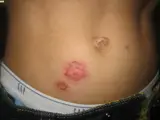 Impetigo (impetigo contagiosa)
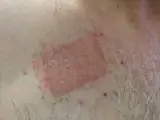 Contact dermatitis (contact eczema)
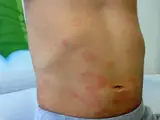 Urticaria
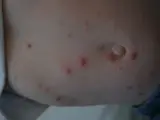 Varicella (chickenpox)
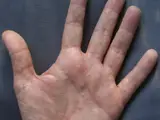 Dyshidrotic eczema (pompholyx)
Image credits for the thumbnails
- Herpes simplex (cold sores): unknown (Commons user), “Cold sore”, Public Domain, via Wikimedia Commons · Public Domain · Source
- Atopic dermatitis (atopic eczema): Eisfelder, “Atopic dermatitis child”, CC BY-SA 3.0, via Wikimedia Commons · CC BY-SA 3.0 · Source
- Impetigo (impetigo contagiosa): Littlekidsdoc, “Bullous impetigo”, CC BY-SA 4.0, via Wikimedia Commons · CC BY-SA 4.0 · Source
- Contact dermatitis (contact eczema): Dr.khatmando, “Severe contact dermatitis buprenorphine transdermal patch”, CC BY-SA 4.0, via Wikimedia Commons · CC BY-SA 4.0 · Source
- Urticaria: Gzzz, “Urticaria child”, CC BY-SA 4.0, via Wikimedia Commons · CC BY-SA 4.0 · Source
- Varicella (chickenpox): Jonnymccullagh, “Chickenpox 5yearold”, CC BY-SA 3.0, via Wikimedia Commons · CC BY-SA 3.0 · Source
- Dyshidrotic eczema (pompholyx): Inwe (Wikimedia Commons), “Dyshidrosis”, CC BY-SA 3.0, via Wikimedia Commons · CC BY-SA 3.0 · Source
Treatment principles
- Eczema herpeticum is a dermatological emergency requiring immediate systemic antiviral therapy, given intravenously on an inpatient basis in extensive disease or when the patient is systemically unwell.
- Bacterial superinfection is treated with antibiotics, and periocular involvement requires ophthalmological assessment.
- After healing, treatment of the underlying skin disease is optimised.
Specific treatment regimens with drugs and doses are covered in the DermaFuchs app.
Keep learning in the app
References (selection)
Cross-references
Mentioned in
Keep learning
Keep learning with flashcards, exam questions and spot diagnoses in the DermaFuchs app – free, in your browser or as an app.
Related pages: Herpes simplex (cold sores) · Atopic dermatitis (atopic eczema) · Impetigo (impetigo contagiosa)
Note: This page is intended for medical education and does not replace diagnosis or treatment decisions in individual cases.