Mpox
- Synonyms
- monkeypox
- Specialty
- Dermatology · Viral infections
- Images
- Clinical 3
- In the app
- 2 flashcards
- Last updated
- 10/2026 · Dr. Pascal Bafteh
Contents
Images (3)
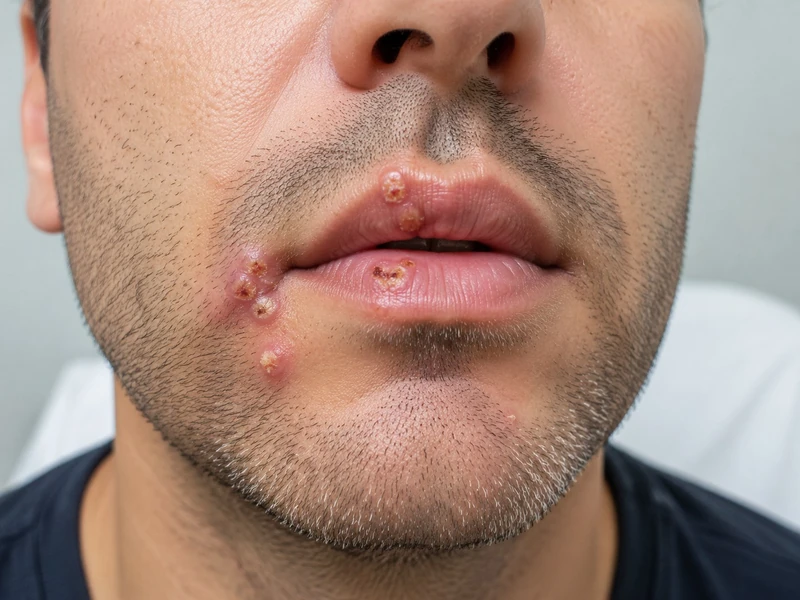
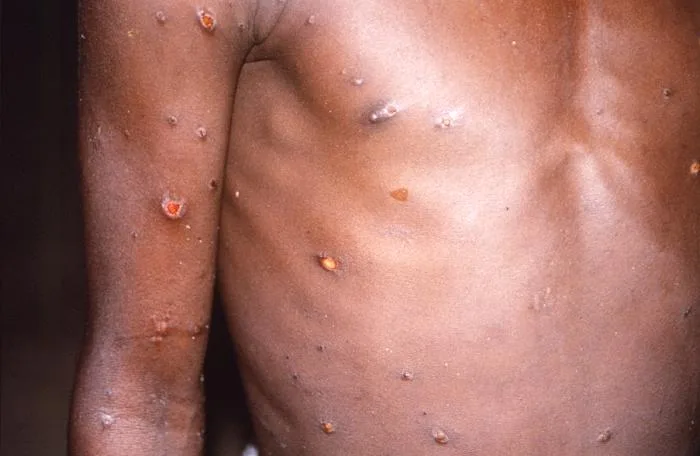
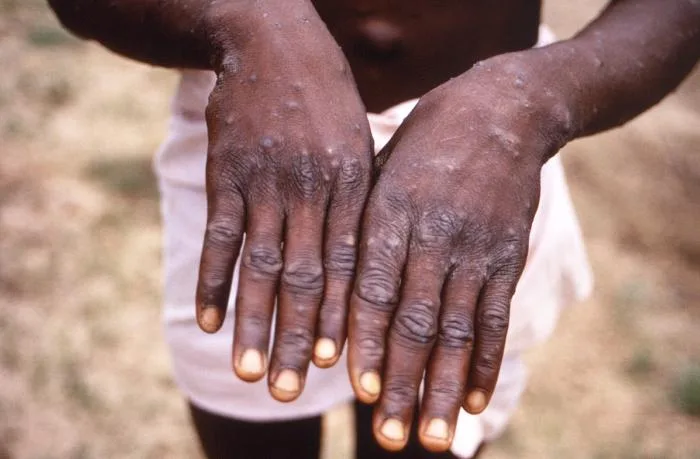
Definition
Definition & Pathogen
Mpox (formerly monkeypox) is caused by the Mpox virus (Orthopoxvirus, double-stranded DNA virus, family Poxviridae). Two clades:
- Clade I (Central Africa, DRC): higher mortality of around 3–6 %; new sub-clade Ib spreading since 2024.
- Clade II (West Africa): sub-clade IIb caused the global 2022–2024 outbreak with overall lethality <1 %.
Transmission
- Direct skin contact with lesions (most important)
- Sexual transmission — in the 2022–2024 outbreak predominantly MSM clusters
- Droplets/aerosols during close contact
- Fomite transmission (clothing, bedding)
- Vertical: transplacental; perinatal
Clinical features
Clinical presentation
- Incubation: 5–21 days (median 7–10 d)
- Prodrome: fever, marked lymphadenopathy (typical — absent in classical smallpox!), myalgia, headache
- Skin lesions: macule → papule → vesicle → pustule with central umbilication → crust. synchronous stages of skin lesions (classically; key DD criterion versus varicella, but asynchronous lesions have also been seen since the 2022 outbreak), deep-seated, firm, painful
- Distribution 2022/2024 outbreak: anogenital, perianal, perioral; single lesions rather than the classical centrifugal pattern
- Proctitis common after sexual transmission; also tonsillitis/pharyngitis
- Course: 2–4 weeks; scarring possible
Diagnosis
Diagnostics
- Gold standard: PCR from pustule swab (roof/base or crust; also genital, throat, anal swabs)
- Histology: ballooning degeneration, intracytoplasmic eosinophilic inclusion bodies (Guarnieri bodies)
Differential diagnoses
 Herpes simplex (cold sores)
 Secondary syphilis (lues II)
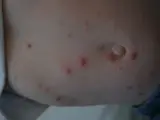 Varicella (chickenpox)
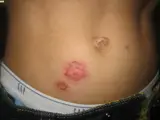 Impetigo (impetigo contagiosa)
 Scabies
 Urticaria
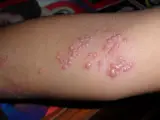 Herpes zoster
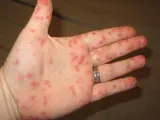 Hand, foot and mouth disease
Image credits for the thumbnails
- Herpes simplex (cold sores): unknown (Commons user), “Cold sore”, Public Domain, via Wikimedia Commons · Public Domain · Source
- Secondary syphilis (lues II): Ehlers S, Sergent S, Ashurst J (Clin Pract Cases Emerg Med 2020), CC BY 4.0, via PubMed Central (PMC7676796) · CC BY 4.0 · Source
- Varicella (chickenpox): Jonnymccullagh, “Chickenpox 5yearold”, CC BY-SA 3.0, via Wikimedia Commons · CC BY-SA 3.0 · Source
- Impetigo (impetigo contagiosa): Littlekidsdoc, “Bullous impetigo”, CC BY-SA 4.0, via Wikimedia Commons · CC BY-SA 4.0 · Source
- Scabies: Gzzz, “Scabies hand and fingers 1”, CC BY-SA 4.0, via Wikimedia Commons · CC BY-SA 4.0 · Source
- Urticaria: Gzzz, “Urticaria child”, CC BY-SA 4.0, via Wikimedia Commons · CC BY-SA 4.0 · Source
- Herpes zoster: Asvmdrn, “Herpes zoster, elbow”, CC BY-SA 3.0, via Wikimedia Commons · CC BY-SA 3.0 · Source
- Hand, foot and mouth disease: Kessalia19, CC BY-SA 4.0, via Wikimedia Commons · CC BY-SA 4.0 · Source
Treatment principles
- In immunocompetent patients, mpox is usually self-limiting and treated symptomatically (analgesia, skin care, treatment of secondary infections).
- Antivirals may be considered for severe disease, immunosuppression or ocular involvement.
- Isolation until the lesions have healed, contact management and notification requirements must be observed; vaccination can be offered to contacts and at-risk groups, and screening for other sexually transmitted infections including HIV is advisable.
Specific treatment regimens with drugs and doses are covered in the DermaFuchs app.
Keep learning in the app
References (selection)
- Monkeypox Virus Infection in Humans across 16 Countries - April-June 2022
- Clinical presentation and virological assessment of confirmed human monkeypox virus cases in Spain: a prospective observational cohort study
- Clinical features and management of human monkeypox: a retrospective observational study in the UK
Cross-references
Mentioned in
Keep learning: test yourself
One question from the DermaFuchs app on Mpox – tap an answer.
Question 1 of 1
Which prominent clinical finding in the prodromal phase of Mpox helps distinguish it from classical smallpox?
Answer
Correct: lymphadenopathy. Marked lymphadenopathy is a characteristic feature of Mpox that is typically absent in classical smallpox.
More questions like these – with explanations and spaced repetition – in the app.
Note: This page is intended for medical education and does not replace diagnosis or treatment decisions in individual cases.