Erythema ab igne
Exam relevance: in 1 of more than 50 board exam reports · rank 93
- Synonyms
- toasted skin syndrome
- Specialty
- Dermatology · Environmental & photodermatoses
- Images
- Clinical 2
- In the app
- 1 flashcard
- Last updated
- 10/2026 · Dr. Pascal Bafteh
Contents
Images (2)
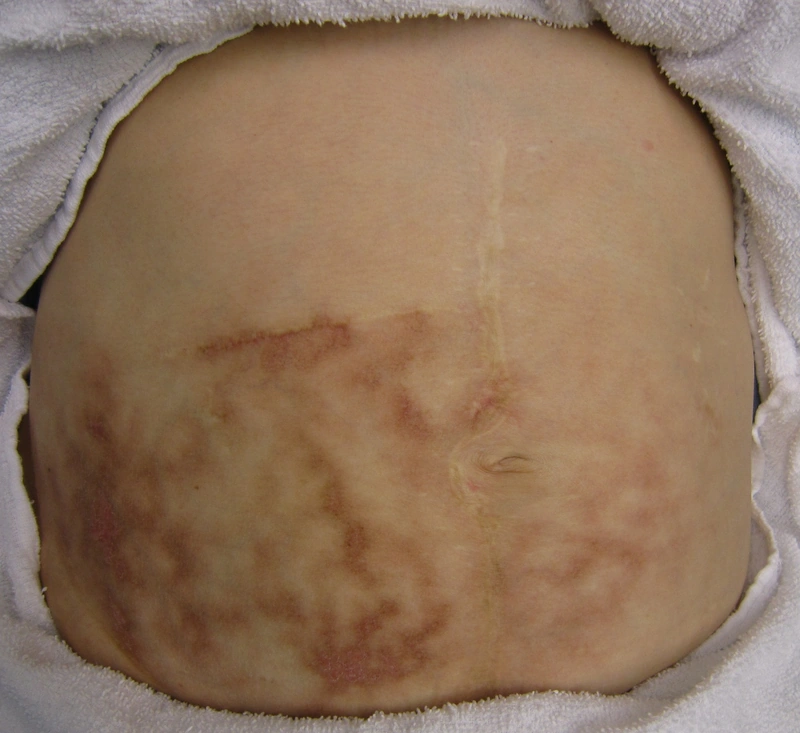
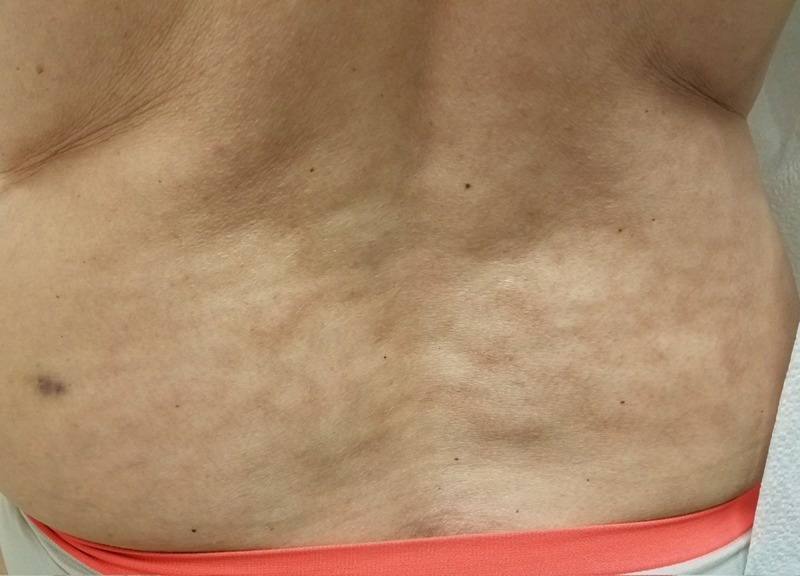
Definition
Definition & Pathogenesis
- Erythema ab igne (EAI) — chronically persistent net-like, livid, reticular hyperpigmentation pattern due to repeated prolonged sub-burning heat exposure (>43 °C, below the burn threshold); synonym Buschke heat melanosis.
- Pathogenesis: repetitive heat damages the superficial vascular network and leads to vascular ectasia + dermal melanophages / melanin pigmentation predominant, often with additional hemosiderin deposits. End result = persistent reticular pigmentation (melanophage dermatosis) along the cutaneous vascular pattern; histologically also dermal elastosis.
Aetiopathogenesis
Triggers
- Hot water bottle, heating pad, heated car seats (chronic back pain → lumbar/hip pigmentation).
- Fireplace or stove heat (classically anterior lower legs/thighs in older patients).
- Occupational exposure: bakers, blacksmiths, glassblowers.
Clinical features
Clinical Presentation
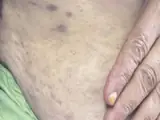
- Reticular, net-like branched erythematous → brown-hyperpigmented streaks corresponding to the superficial cutaneous vascular network.
- Location correlates with heat source: anterior thighs (laptop), lumbar region (hot water bottle, heating pad), anterior lower legs (fireplace), abdomen.
- Subjective: initially asymptomatic or mild burning; chronically persistent.
Complications
- Malignant transformation rare, but relevant: chronic EAI can be a precursor for Squamous cell carcinoma or Merkel cell carcinoma in the pigmented plaque. → Biopsy suspicious nodules/ulcerations.
Differential diagnoses
- Livedo reticularis
- Erythema perstans faciei
Image credits for the thumbnails
- Lupus erythematosus: Meriam Hajji, CC BY 4.0, via Wikimedia Commons · CC BY 4.0 · Source
- Urticaria: Gzzz, “Urticaria child”, CC BY-SA 4.0, via Wikimedia Commons · CC BY-SA 4.0 · Source
- Ashy dermatosis (= Erythema dyschromicum perstans): Golani S, Khan S, Saeed Z et al. (Cureus 2025), CC BY 4.0, via PubMed Central (PMC12168861) · CC BY 4.0 · Source
Treatment principles
- The most important step is avoidance of the heat source; early changes then often regress slowly, whereas marked hyperpigmentation may persist.
- If cosmetically distressing, depigmenting topical agents or laser therapy are options.
- Because squamous cell carcinoma can rarely develop in long-standing lesions, growing or ulcerated areas are biopsied.
Specific treatment regimens with drugs and doses are covered in the DermaFuchs app.
Keep learning in the app
References (selection)
Cross-references
Mentioned in
Keep learning
Keep learning with flashcards, exam questions and spot diagnoses in the DermaFuchs app – free, in your browser or as an app.
Related pages: Livedo reticularis · Lupus erythematosus · Urticaria
Note: This page is intended for medical education and does not replace diagnosis or treatment decisions in individual cases.