Miliaria (heat rash, prickly heat)
- Synonyms
- heat rash, prickly heat, sweat rash
- Specialty
- Dermatology · Environmental & photodermatoses
- Images
- Clinical 4
- In the app
- 2 flashcards
- Last updated
- 10/2026 · Dr. Pascal Bafteh
Contents
Images (4)
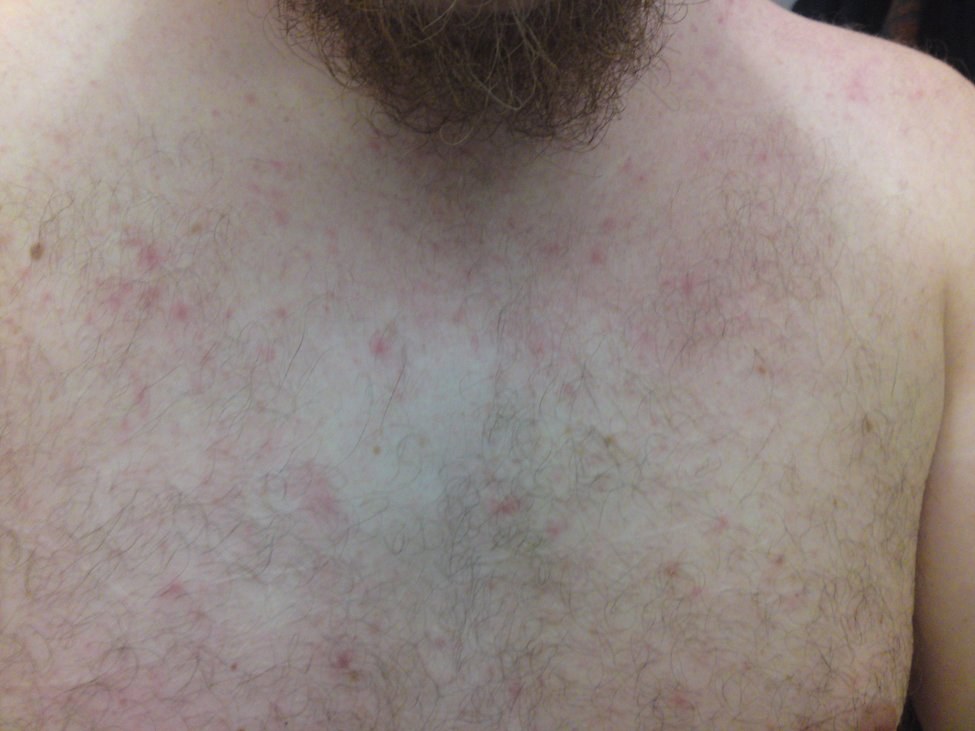
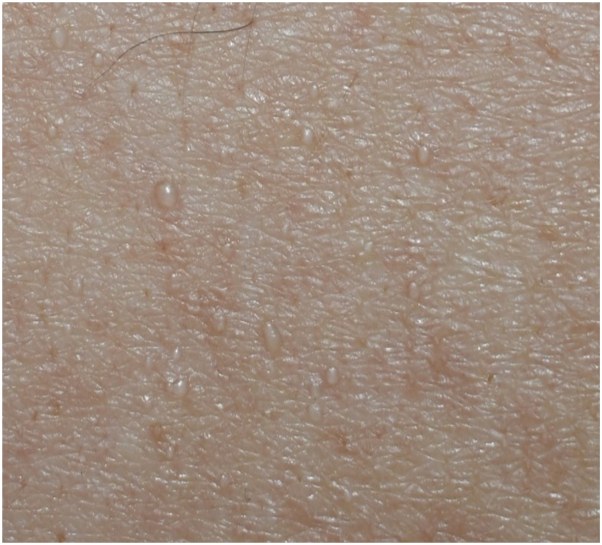
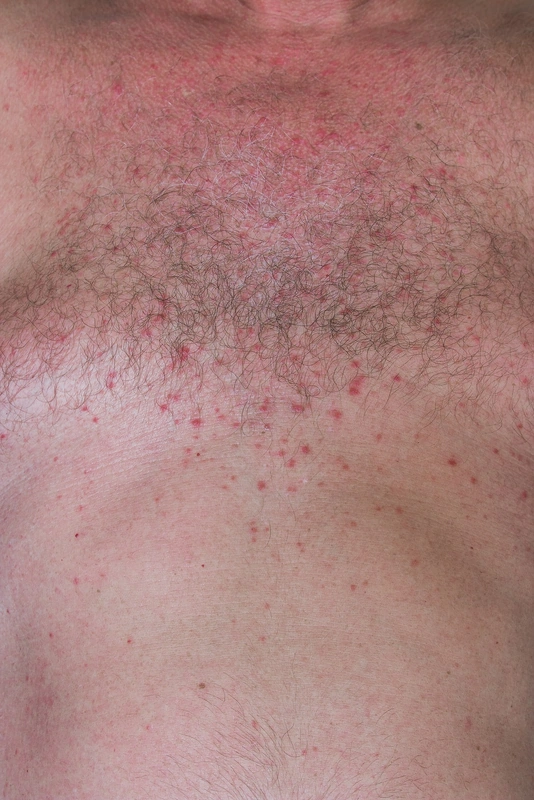
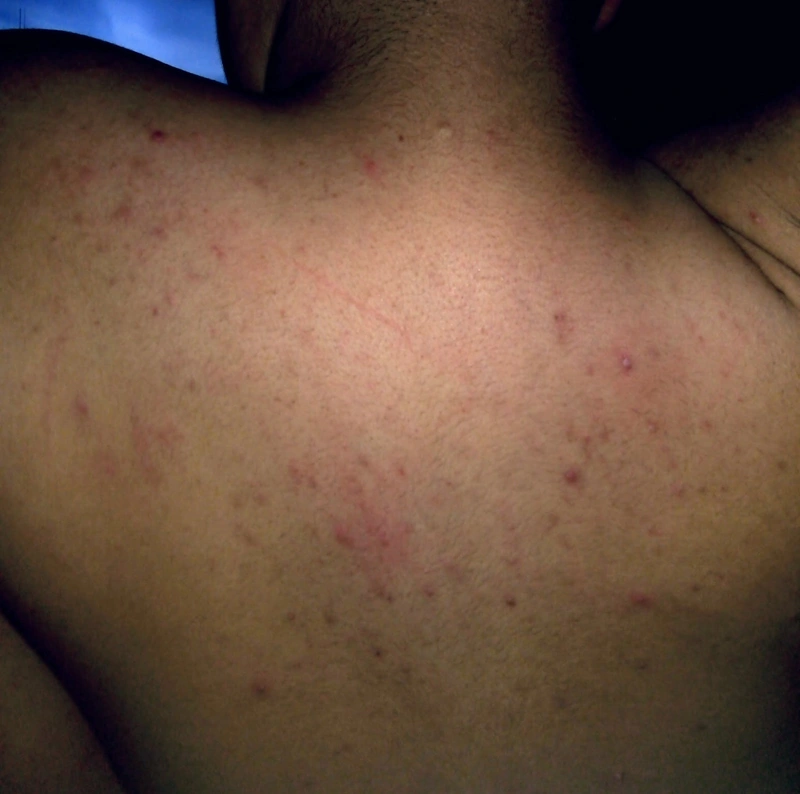
Definition
Miliaria (from Latin milium, millet seed) is the umbrella term for skin changes that arise when the duct of eccrine sweat glands is blocked. Sweat that continues to be produced cannot reach the skin surface, is retained and leaks into the surrounding tissue. In everyday language it is called heat rash or prickly heat. Miliaria is common, almost always harmless and regresses as soon as heat and occlusion end.
Classification by level of blockage
Which form develops depends on the level at which the sweat duct is blocked.
| Form | Level of blockage | Typical finding | Symptoms |
|---|---|---|---|
| Miliaria crystallina (sudamina) | in or just below the stratum corneum | 1–2 mm clear vesicles without redness, "like dew drops"; burst on light touch | none |
| Miliaria rubra | intraepidermal duct segment (acrosyringium) | densely set red papules and papulovesicles, not follicle-bound | itch, stinging, prickling |
| Miliaria pustulosa | as in miliaria rubra | additional superficial, sterile pustules | itch |
| Miliaria profunda | dermoepidermal junction, uppermost dermis | skin-coloured, firm papules without redness | little itch, but reduced sweating |
Rule of thumb: the deeper the blockage, the less visible the vesicles and the more sweating in the area is impaired. The two clinically most important forms have their own pages: miliaria rubra and miliaria profunda.
Occurrence
- Newborns and infants: common in the first weeks of life, favoured by immature sweat ducts, warm clothing, incubators and febrile infections. Miliaria crystallina appears particularly early.
- Hot, humid climate: travellers, soldiers and workers in the tropics or during heatwaves, especially in the first weeks before acclimatisation.
- Occlusion: tight, poorly breathable clothing, dressings, plasters, protective clothing, lying on the back for long periods.
- Fever and heavy sweating: miliaria crystallina typically follows febrile episodes, also in seriously ill adults.
Aetiopathogenesis
The eccrine sweat gland consists of a coil in the deep dermis, a straight dermal duct and a terminal segment spiralling through the epidermis, the acrosyringium. In miliaria, this pathway is interrupted at one point.
- Swelling of the stratum corneum: persistent sweating under occlusion softens the stratum corneum and narrows the duct at its opening.
- Bacterial plug: under occlusion, resident cocci multiply. Experimentally, miliaria could only be induced with strains of Staphylococcus epidermidis that produce an extracellular polysaccharide substance (EPS); this PAS-positive material blocks the duct (Mowad 1995). Such strains are common in the normal skin flora.
- Consequence of retention: sweat leaks from the duct into the epidermis or dermis and – except in the most superficial form – triggers inflammation.
- Duration of the disturbance: the blockage persists until the epidermis has renewed itself; experimentally, the plug was shed after about three weeks (Hölzle and Kligman 1978). This is why sweating can remain reduced for some time after the skin changes have faded (postmiliarial hypohidrosis).
- Infants: in newborns, delayed maturation of the sweat ducts is considered a key factor.
Clinical features and course
- Distribution: covered, warm and occluded skin – trunk, neck, axillae, groin and other flexures; in infants also the nape, scalp, forehead and nappy area, in bedridden people the back. Palms and soles are usually spared.
- Morphology: uniform, small lesions not bound to hair follicles, densely scattered; depending on the form, clear vesicles, red papules, pustules or skin-coloured papules (see table).
- Course: once the triggering heat or occlusion ends, the changes usually fade within days; miliaria crystallina often shows fine scaling as it resolves. With ongoing exposure, repeated flares are common.
- Complications: bacterial superinfection (impetiginisation), in infants up to periporitis staphylogenes and multiple sweat gland abscesses; in extensive miliaria, reduced sweating with heat intolerance, in extreme cases heat exhaustion or heatstroke. Infants and older or frail people are particularly at risk.
Diagnosis
The diagnosis almost always follows from the history (heat, fever, occlusion, age) and the findings.
- Morphology and distribution: monomorphic, non-follicular lesions on occluded body sites.
- Course: regression within a few days after heat exposure ends supports the diagnosis.
- Swab: for pustules, to distinguish bacterial folliculitis, impetigo or Candida infection.
- Biopsy: only if the picture is atypical. Depending on the form, it shows subcorneal vesicles, spongiosis around the acrosyringium or an infiltrate around the duct at the dermoepidermal junction.
- Sweat test (Minor starch–iodine test): reveals areas without sweating in miliaria profunda.
How to tell it apart
- Newborns: erythema toxicum neonatorum (yellowish-white papules and pustules on an erythematous halo, rich in eosinophils), transient neonatal pustular melanosis (pustules leaving brownish macules with a collarette of scale), neonatal cephalic pustulosis (face) and candidiasis with satellite pustules in the nappy area.
- Children and adults: folliculitis (follicle-bound pustules, often with a central hair), Grover's disease (itchy papules on the trunk, often after heat and sweating, histologically acantholysis), varicella (vesicles at different stages, also on the scalp and mucosa), drug eruption, insect bites and cholinergic urticaria (fleeting, pinhead-sized wheals on sweating).
- Apocrine counterpart: Fox–Fordyce disease is also called "apocrine miliaria" – intensely itchy, skin-coloured follicular papules in the axillae, on the areolae and in the anogenital region, almost exclusively in women from puberty onwards; it is caused by a keratin plug that blocks the opening of the apocrine duct into the follicle.
Exam essentials
- The level of blockage determines the form: crystallina (stratum corneum), rubra (intraepidermal, acrosyringium), profunda (dermoepidermal junction).
- Miliaria crystallina: clear vesicles without inflammation – typical in newborns and after fever.
- Pathogenesis: EPS-producing strains of Staphylococcus epidermidis create the PAS-positive plug in the sweat duct.
- After miliaria, sweating can remain reduced for weeks (postmiliarial hypohidrosis).
- Fox–Fordyce disease is regarded as "apocrine miliaria".
Treatment principles
- The key step is ending heat exposure and occlusion: a cool environment, light, breathable clothing and removal of occlusive dressings; miliaria then usually resolves spontaneously.
- Cooling and drying lotions or shake lotions are used locally, and for very itchy miliaria rubra short-term low-potency topical glucocorticoids; in miliaria rubra, occlusive greasy ointments should be avoided.
- Secondary infections are treated with antiseptics or topical antibiotics, and with systemic antibiotics in extensive disease.
Specific treatment regimens with drugs and doses are covered in the DermaFuchs app.
Keep learning in the app
References (selection)
- Wenzel FG, Horn TD. Nonneoplastic disorders of the eccrine glands. J Am Acad Dermatol. 1998;38(1):1-17. PMID 9448199
- Mowad CM, McGinley KJ, Foglia A, Leyden JJ. The role of extracellular polysaccharide substance produced by Staphylococcus epidermidis in miliaria. J Am Acad Dermatol. 1995;33(5 Pt 1):729-33. PMID 7593770
- Hölzle E, Kligman AM. The pathogenesis of miliaria rubra. Role of the resident microflora. Br J Dermatol. 1978;99(2):117-37. PMID 698101
- Haas N, Martens F, Henz BM. Miliaria crystallina in an intensive care setting. Clin Exp Dermatol. 2004;29(1):32-4. PMID 14723716
- Heckmann M. Erkrankungen der Schweißdrüsen. In: Plewig G, Ruzicka T, Kaufmann R, Hertl M (Hrsg.). Braun-Falco's Dermatologie, Venerologie und Allergologie. 7. Aufl. Berlin: Springer; 2018. S. 1337-49
Cross-references
Keep learning
Keep learning with flashcards, exam questions and spot diagnoses in the DermaFuchs app – free, in your browser or as an app.
Related pages: Miliaria Profunda · Miliaria rubra (heat rash) · Favre-Racouchot disease
Note: This page is intended for medical education and does not replace diagnosis or treatment decisions in individual cases.