Miliaria rubra (heat rash)
- Synonyms
- prickly heat, heat rash
- Specialty
- Dermatology · Environmental & photodermatoses
- Images
- Clinical 2
- In the app
- 2 flashcards
- Last updated
- 10/2026 · Dr. Pascal Bafteh
Contents
Images (2)
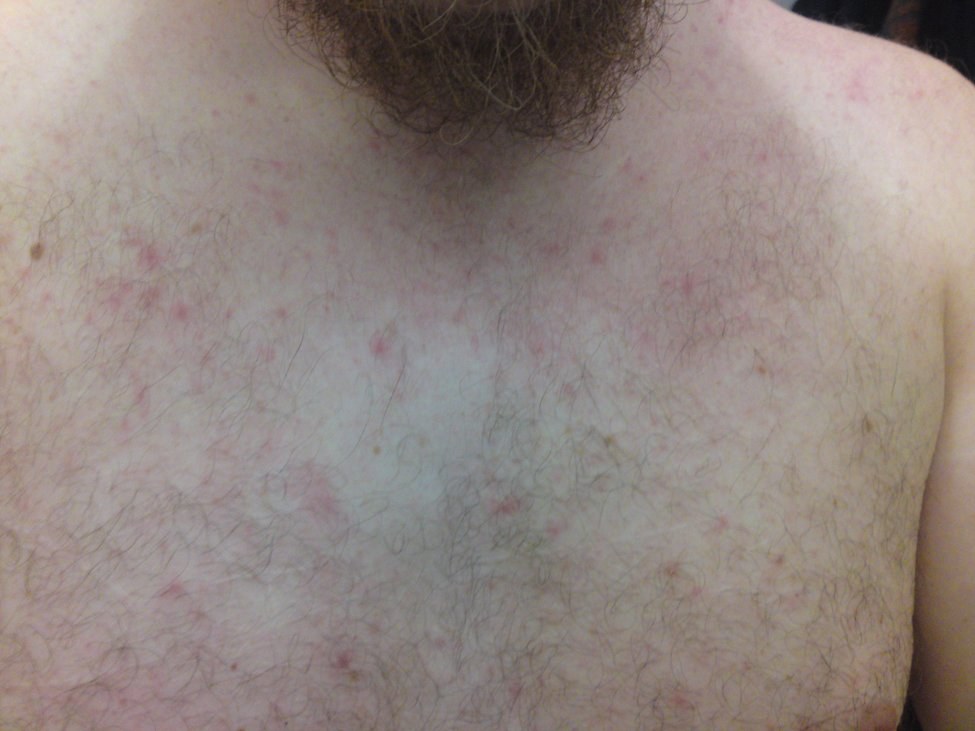
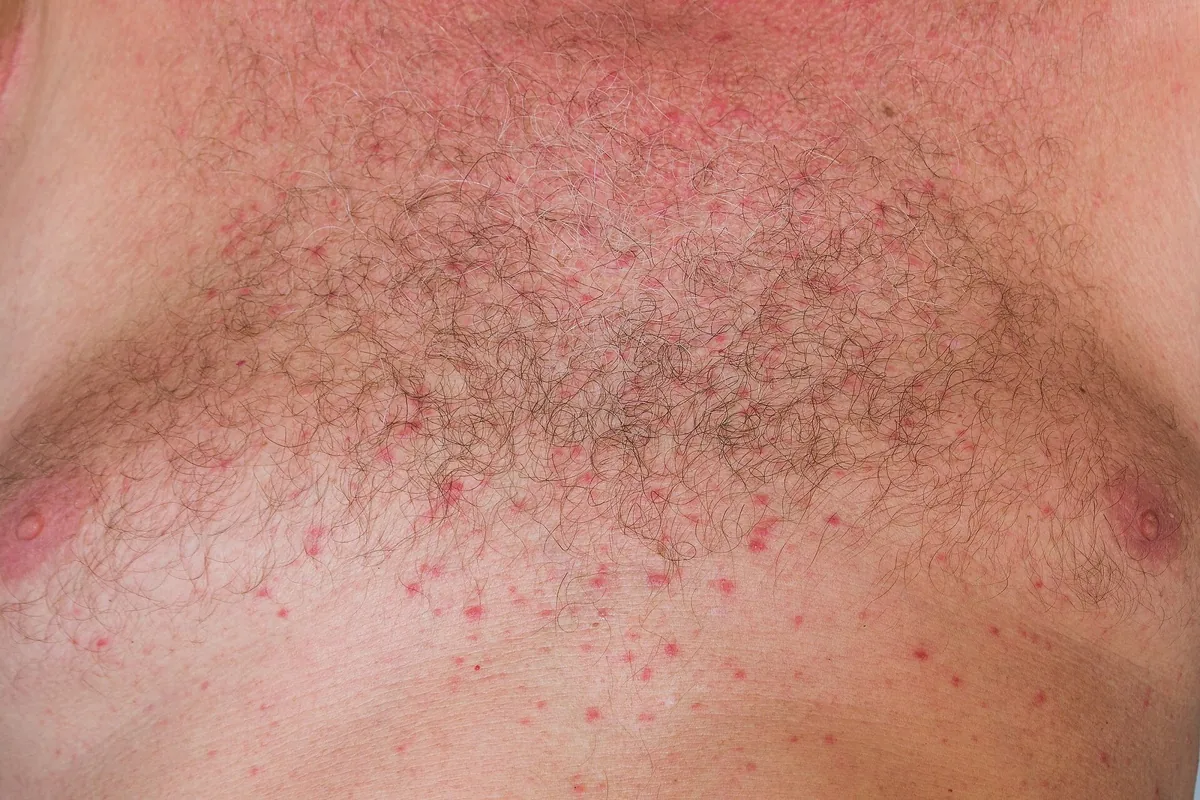
Definition
Miliaria rubra is the most common form of miliaria. The duct of the eccrine sweat gland is blocked in its intraepidermal segment, the acrosyringium – usually at the level of the stratum spinosum. Sweat leaks into the surrounding epidermis and causes inflammation there, hence the name (Latin ruber, red). Common terms are heat rash and prickly heat; in tropical medicine it is also known as lichen tropicus. A variant with additional pustules is called miliaria pustulosa.
Occurrence
- Infants: especially when dressed too warmly, in incubators or with fever; preferentially on the neck, nape, axillae and nappy area.
- Hot, humid climate: non-acclimatised travellers, soldiers and people working in heat are often affected in the first weeks after arrival.
- Occlusion in adults: tight or synthetic clothing, dressings and protective equipment, lying supine when bedridden.
- Heavy sweating: during physical exertion, fever and in overweight.
Aetiopathogenesis
The basis is the interplay of occlusion, sweat and the resident skin flora.
- Experimental induction: under an impermeable plastic film, the degree of sweat suppression and miliaria was directly proportional to the increase in resident aerobic bacteria, notably cocci. When expansion of the skin flora was suppressed, no anhidrosis developed (Hölzle and Kligman 1978).
- Events in the duct: after two days of occlusion, a PAS-positive, diastase-resistant amorphous mass appeared deep within the acrosyringium, with a periductal leukocyte infiltrate; after another two days, the duct was clogged by degenerating leukocytes. Bacterial colonies were not found within the duct itself.
- Role of Staphylococcus epidermidis: only strains producing an extracellular polysaccharide substance (EPS) induced miliaria experimentally; other coagulase-negative staphylococci did not (Mowad 1995). EPS is considered the PAS-positive material that blocks the duct.
- Inflammation: the retained sweat passes into the epidermis and leads to spongiosis and inflammation. Itch and stinging increase with every new bout of sweating.
- Long after-effect: the plug is only shed as the epidermis renews itself, experimentally after about three weeks. This explains the postmiliarial hypohidrosis described by Sulzberger and Griffin after induced miliaria.
Clinical features
- Lesions: densely set, 1–4 mm red papules and papulovesicles on reddened skin, not bound to hair follicles. In miliaria pustulosa, superficial sterile pustules are added; it often develops on skin already damaged by another dermatitis.
- Symptoms: itch, stinging and prickling, typically worse with warmth and renewed sweating.
- Distribution: trunk, neck, flexures and areas where clothing rubs; palms and soles are usually spared.
- Infants: the papules are often located on the neck, nape and upper trunk. Restlessness, rubbing and scratching may be the only sign of itch. The most common trigger is heat build-up from overly thick clothing or bedding, often together with a febrile infection.
- Course: once heat or occlusion ends, the papules usually regress within a few days. With ongoing exposure, miliaria rubra becomes recurrent or chronic.
- Complications: excoriations and bacterial superinfection (impetiginisation, in infants periporitis staphylogenes), postmiliarial hypohidrosis and, after repeated episodes, progression to miliaria profunda. With very extensive involvement, heat loss is impaired and heat intolerance can develop.
Histology
- Spongiosis and spongiotic vesicles around the intraepidermal sweat duct, usually in the stratum spinosum.
- Predominantly lymphocytic infiltrate around the duct in the epidermis and upper dermis; in miliaria pustulosa, collections of neutrophils within the vesicles.
- PAS-positive, diastase-resistant material may be detectable in the duct lumen.
- No relationship to the hair follicle – an important difference from folliculitis.
Diagnosis
The diagnosis is clinical. The typical constellation is itchy red papules on occluded skin after heat or heavy sweating, regressing once the exposure ends.
- History: climate, clothing, fever, physical exertion, dressings; in infants, clothing and room temperature.
- Inspection with a magnifier or dermatoscope: checks whether the lesions are follicle-bound – in miliaria rubra they are not.
- Swab: for pustules or crusts (staphylococci, Candida).
- Biopsy: only for an atypical or unusually prolonged course.
How to tell it apart
- Miliaria crystallina: no redness, no symptoms, clear vesicles within the stratum corneum.
- Miliaria profunda: skin-coloured, firm papules, little itch, marked hypohidrosis; often develops from repeated miliaria rubra.
- Folliculitis: follicle-bound papules and pustules, often with a central hair; pathogen detectable on swab.
- Candidiasis of the skin folds: bright red, moist area with a collarette of scale and satellite pustules.
- Atopic dermatitis: chronic and relapsing, typical flexural distribution, dry skin; sweating also aggravates the itch here.
- Contact dermatitis: confined to the area of contact, matching history.
- Grover's disease: itchy papules on the trunk, mostly in older men, likewise favoured by heat and sweating; histologically acantholysis.
- Cholinergic urticaria: pinhead-sized wheals on a rise in body temperature (exertion, heat, emotion) that usually disappear within an hour.
- In newborns: erythema toxicum neonatorum with eosinophil-rich pustules on an erythematous halo.
Exam essentials
- Level of blockage: intraepidermal sweat duct (acrosyringium); leading symptoms itch and prickling ("prickly heat").
- Not follicle-bound – this distinguishes miliaria rubra from folliculitis.
- Pathogenesis: occlusion plus EPS-producing strains of Staphylococcus epidermidis, PAS-positive plug in the duct.
- Complications: superinfection, postmiliarial hypohidrosis, progression to miliaria profunda.
- The variant with pustules is called miliaria pustulosa.
Differential diagnoses
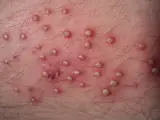
Image credits for the thumbnails
- Atopic dermatitis (atopic eczema): Eisfelder, “Atopic dermatitis child”, CC BY-SA 3.0, via Wikimedia Commons · CC BY-SA 3.0 · Source
- Urticaria: Gzzz, “Urticaria child”, CC BY-SA 4.0, via Wikimedia Commons · CC BY-SA 4.0 · Source
- Contact dermatitis (contact eczema): Dr.khatmando, “Severe contact dermatitis buprenorphine transdermal patch”, CC BY-SA 4.0, via Wikimedia Commons · CC BY-SA 4.0 · Source
- Folliculitis: Da pacem Domine, “Folliculitis2”, CC0, via Wikimedia Commons · CC0 · Source
Treatment principles
- The priority is ending heat exposure and occlusion: a cool, well-ventilated environment and loose, breathable clothing; the papules then usually regress within a few days.
- For itch and inflammation, cooling non-occlusive preparations and short courses of low-potency topical glucocorticoids may be considered; greasy, occlusive bases aggravate sweat retention.
- Pustules or crusts suggest secondary infection, which is treated with antiseptics and, if needed, antibiotics; in infants, adjusting their clothing is part of the approach.
Specific treatment regimens with drugs and doses are covered in the DermaFuchs app.
Keep learning in the app
References (selection)
- Hölzle E, Kligman AM. The pathogenesis of miliaria rubra. Role of the resident microflora. Br J Dermatol. 1978;99(2):117-37. PMID 698101
- Mowad CM, McGinley KJ, Foglia A, Leyden JJ. The role of extracellular polysaccharide substance produced by Staphylococcus epidermidis in miliaria. J Am Acad Dermatol. 1995;33(5 Pt 1):729-33. PMID 7593770
- Sulzberger MB, Griffin TB. Induced miliaria, postmiliarial hypohidrosis, and some potential sequelae. Arch Dermatol. 1969;99(2):145-51. PMID 4884045
- Wenzel FG, Horn TD. Nonneoplastic disorders of the eccrine glands. J Am Acad Dermatol. 1998;38(1):1-17. PMID 9448199
- Heckmann M. Erkrankungen der Schweißdrüsen. In: Plewig G, Ruzicka T, Kaufmann R, Hertl M (Hrsg.). Braun-Falco's Dermatologie, Venerologie und Allergologie. 7. Aufl. Berlin: Springer; 2018. S. 1337-49
Cross-references
Keep learning
Keep learning with flashcards, exam questions and spot diagnoses in the DermaFuchs app – free, in your browser or as an app.
Related pages: Atopic dermatitis (atopic eczema) · Urticaria · Contact dermatitis (contact eczema)
Note: This page is intended for medical education and does not replace diagnosis or treatment decisions in individual cases.