Miliaria profunda
- Synonyms
- deep miliaria
- Specialty
- Dermatology · Environmental & photodermatoses
- Images
- Illustration 1
- In the app
- 1 flashcard
- Last updated
- 10/2026 · Dr. Pascal Bafteh
Contents
Images (1)
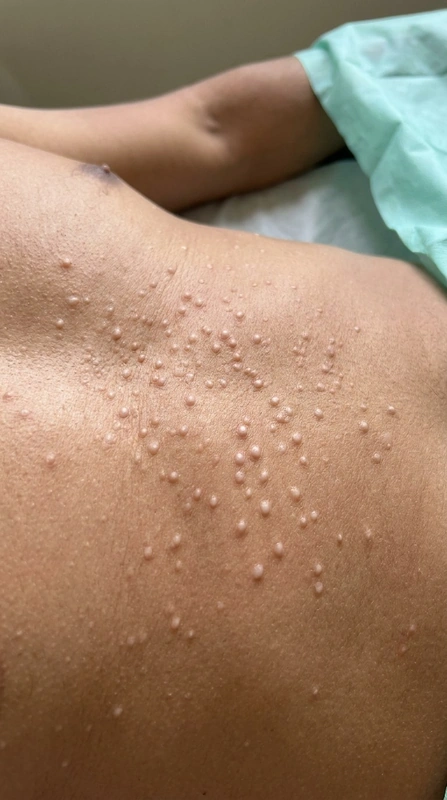 AI illustration
Definition
Miliaria profunda is the deepest and rarest form of miliaria. The sweat duct is blocked at the dermoepidermal junction or in its uppermost dermal segment, so that sweat leaks into the upper dermis. Clinically, skin-coloured papules develop without appreciable redness. More important than the skin findings, however, is the reduced or absent sweating in the affected areas. Miliaria profunda typically develops after repeated episodes of miliaria rubra in hot climates. The term "profunda" (Latin for "deep") refers to the level of the blockage, not to the size of the papules, which remain small.
Occurrence
- Almost exclusively in adults with prolonged or repeated heat exposure: stays in tropical or subtropical climates, work in heat, military deployments; rare in infants. Historically, the condition was described mainly in soldiers serving in tropical regions.
- In temperate climates, miliaria profunda is a rarity; the literature here consists mainly of single case reports.
Aetiopathogenesis
- Repeated damage to the duct: the starting point is usually repeated flares of miliaria rubra. After repeated flares, the duct is also damaged at the dermoepidermal junction and can rupture there.
- Leakage into the dermis: sweat leaks into the papillary dermis, causing oedema and periductal inflammation. Because the overlying epidermis remains largely intact, the papules are skin-coloured and firm instead of red and vesicular.
- Fluctuating visibility: the papules become more prominent with sweating and usually flatten again quickly afterwards.
- Anhidrosis: sweating fails in the affected areas. If large areas are involved, such as the whole trunk, the body can no longer lose enough heat. Unaffected regions such as the face and axillae may then sweat more as compensation.
- Tropical anhidrotic asthenia: the name given to the full picture – heat intolerance, weakness, fatigue, headache, palpitations and a rise in body temperature under heat stress.
- Postmiliarial hypohidrosis: Sulzberger and Griffin had already shown that sweating can remain reduced for weeks after induced miliaria; in miliaria profunda this disturbance is particularly marked.
Clinical features
- Lesions: numerous, densely set, 1–3 mm skin-coloured to whitish firm papules, not follicle-bound; mainly on the trunk and proximal limbs.
- Few signs of inflammation: no or only slight erythema; itch is usually absent or mild – a clear contrast to miliaria rubra.
- Dependence on warmth: clearly visible in heat and during sweating, often hardly recognisable in cool surroundings. The papules are therefore easily overlooked when the patient is examined in a cool room.
- Hypohidrosis to anhidrosis: patients often notice that the skin of the trunk stays dry despite the heat, while the face and axillae sweat heavily.
- Systemic risk: with extensive involvement, heat exhaustion and heatstroke can occur under heat stress – an emergency.
- Course: after heat exposure ends, sweat function usually recovers over a period of weeks. Until then, the risk on renewed heat exposure remains increased.
Histology
- Changes around the sweat duct at the dermoepidermal junction and in the papillary dermis: periductal, predominantly lymphocytic infiltrate and oedema, occasionally spongiosis of the lowest intraepidermal duct segment.
- PAS-positive material may be present in the duct lumen.
- The overlying epidermis is largely unremarkable; subcorneal or intraepidermal vesicles as in the more superficial forms are absent.
- No relationship to the hair follicle.
Diagnosis
- History: stays in the tropics or years of work in heat, previous episodes of miliaria rubra, heat intolerance and the observation of no longer sweating on the trunk.
- Provocation: warmth or physical exertion makes the papules more prominent and easier to assess.
- Sweat test (Minor starch–iodine test): sweating skin turns dark, while areas without sweating remain unstained. The test shows the extent and distribution of anhidrosis.
- Biopsy: if the findings are atypical or to distinguish other papular dermatoses; ideally taken from an area where the papules are currently visible.
- Heat intolerance: consider incipient heat illness and record body temperature, pulse and blood pressure.
- Without a history of heat exposure: consider other causes of hypohidrosis or anhidrosis (see "How to tell it apart").
How to tell it apart
- Miliaria rubra: red, itchy papulovesicles from a more superficial blockage; miliaria profunda often follows miliaria rubra.
- Miliaria crystallina: clear vesicles within the stratum corneum without inflammation; sweating hardly impaired.
- Cholinergic urticaria: small, itchy wheals with an erythematous halo on a rise in body temperature that disappear quickly; sweating is usually preserved, but one subtype is associated with hypohidrosis or anhidrosis (Fukunaga 2018).
- Keratosis pilaris: follicle-bound, rough keratotic papules on the upper arms and thighs, independent of warmth.
- Lichen nitidus: tiny, shiny, skin-coloured papules, often arranged along scratch lines; not dependent on warmth.
- Other causes of hypohidrosis or anhidrosis: autonomic neuropathy (for example in diabetes mellitus), Ross syndrome, Fabry disease and hypohidrotic ectodermal dysplasia. Here the typical papules and the link to previous miliaria are missing.
Exam essentials
- Deepest blockage, at the dermoepidermal junction: skin-coloured papules without erythema, little itch.
- Usually develops after repeated miliaria rubra with prolonged tropical or heat exposure.
- The key problem is anhidrosis, with a risk of heat exhaustion and heatstroke (tropical anhidrotic asthenia).
- The papules become more prominent with sweating; anhidrosis can be demonstrated with the Minor starch–iodine test.
- Distinction from cholinergic urticaria: fleeting itchy wheals rather than firm skin-coloured papules.
Differential diagnoses



Image credits for the thumbnails
- Miliaria rubra (heat rash): Sentient Planet, “Miliaria rubra mild”, CC BY-SA 3.0, via Wikimedia Commons · CC BY-SA 3.0 · Source
- Keratosis pilaris: Feedmecereal~commonswiki, Public domain, via Wikimedia Commons, cropped · Public domain · Source
- Lichen nitidus: Belda W, Criado PR, Di Chiacchio NG (An Bras Dermatol 2021), CC BY 4.0, via PubMed Central (PMC8178568) · CC BY 4.0 · Source
Treatment principles
- The key step is ending heat exposure and occlusion through a cool environment, light clothing and removal of occlusive dressings.
- Because impaired sweating in extensive disease compromises thermoregulation, affected patients must be protected from overheating.
- Topical measures are of limited value in miliaria profunda; unlike in miliaria rubra, an anhydrous greasy base, combined with systemic treatment, has been used successfully in a case report. Secondary infections are treated with antiseptics or antibiotics.
Specific treatment regimens with drugs and doses are covered in the DermaFuchs app.
Keep learning in the app
References (selection)
- Kirk JF, Wilson BB, Chun W, Cooper PH. Miliaria profunda. J Am Acad Dermatol. 1996;35(5 Pt 2):854-6. PMID 8912605
- Sulzberger MB, Griffin TB. Induced miliaria, postmiliarial hypohidrosis, and some potential sequelae. Arch Dermatol. 1969;99(2):145-51. PMID 4884045
- Wenzel FG, Horn TD. Nonneoplastic disorders of the eccrine glands. J Am Acad Dermatol. 1998;38(1):1-17. PMID 9448199
- Fukunaga A et al. Cholinergic urticaria: epidemiology, physiopathology, new categorization, and management. Clin Auton Res. 2018;28(1):103-13. PMID 28382552
- Heckmann M. Erkrankungen der Schweißdrüsen. In: Plewig G, Ruzicka T, Kaufmann R, Hertl M (Hrsg.). Braun-Falco's Dermatologie, Venerologie und Allergologie. 7. Aufl. Berlin: Springer; 2018. S. 1337-49
Cross-references
Keep learning
Keep learning with flashcards, exam questions and spot diagnoses in the DermaFuchs app – free, in your browser or as an app.
Related pages: Miliaria rubra (heat rash) · Keratosis pilaris · Urticaria
Note: This page is intended for medical education and does not replace diagnosis or treatment decisions in individual cases.