Insect bite and sting reaction (local and large local reaction)
- Synonyms
- Insektenstich, Mückenstich, Wespenstich, gesteigerte Lokalreaktion, Insect bite reaction, Insect sting, Large local reaction
- Specialty
- Dermatology · Environmental & photodermatoses
- Images
- Clinical 1 · Histology 1
- In the app
- 1 flashcards
- Last updated
- 10/2026 · Dr. Pascal Bafteh
Contents
Images (2)
 Histology
Definition
A skin reaction to the sting or bite of an insect. Hymenoptera (bees, wasps, hornets) deliver venom in self-defence; blood-feeding insects such as mosquitoes, fleas and bed bugs pierce the skin to feed. This page focuses on local reactions; systemic reactions belong to insect venom allergy.
Classification
- Normal local reaction (bee, wasp): immediate sharp pain, then redness, swelling, itch; usually resolves within 24 hours.
- Large local reaction: swelling over 10 cm, peaking at around 48 hours, lasting up to a week, sometimes involving a whole limb. Swelling alone is not a sign of systemic allergy.
- Systemic reaction, for distinction: urticaria, angioedema, bronchospasm, hypotension.
Clinical features
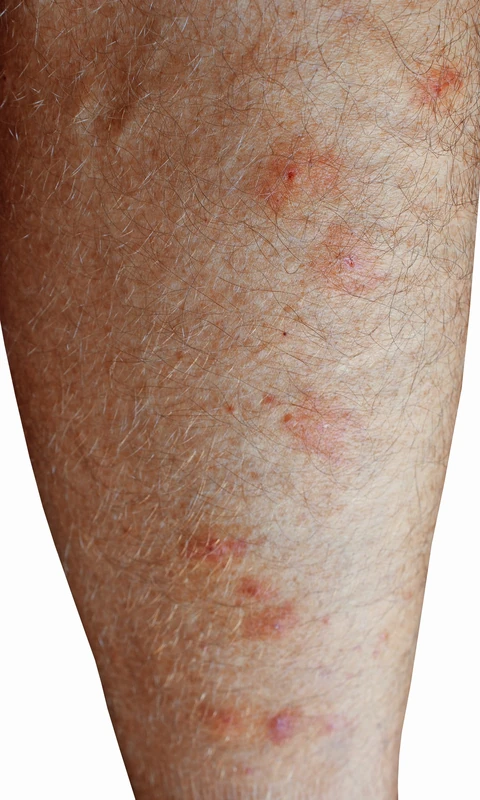
- Bites of blood-feeding insects: intensely itchy, often grouped papules on exposed sites, sometimes with a central clear or haemorrhagic blister.
- Scratching leads to open sores; secondary bacterial infection (impetigo, cellulitis) is possible.
- Papular urticaria: mostly in young children after flea or mosquito bites, symmetrical itchy papules; new bites reactivate old lesions.
- Persistent bite reaction: urticarial, bullous, vasculitic or granulomatous for weeks to months.
Histology
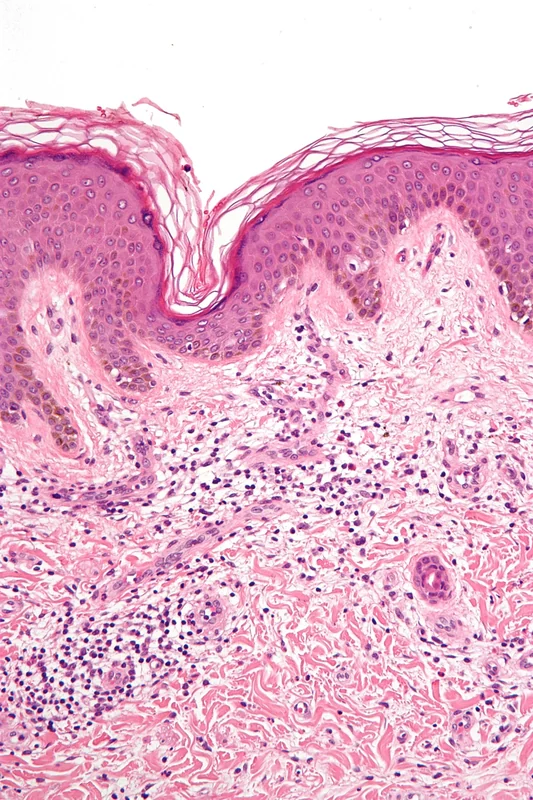
Rarely needed; suggestive features are a central punctum, eosinophilic spongiosis and a wedge-shaped mixed infiltrate around the sweat ducts.
Diagnosis
- Usually clinical from history and appearance; after bee stings the stinger may remain in the skin.
- Redness and swelling beginning only after one or two days, significant pain or fever point rather to secondary infection.
- Allergy work-up (prick/intradermal tests, specific IgE) after a systemic reaction; to be considered after a large local reaction.
Differential diagnoses
Keep learning in the app
References (selection)
Cross-references
Note: This page is intended for medical education and does not replace diagnosis or treatment decisions in individual cases.