Folliculitis decalvans
- Synonyms
- tufted hair folliculitis
- Specialty
- Dermatology · Skin appendages
- Images
- Clinical 1
- In the app
- 4 flashcards
- Last updated
- 10/2026 · Dr. Pascal Bafteh
Contents
Images (1)
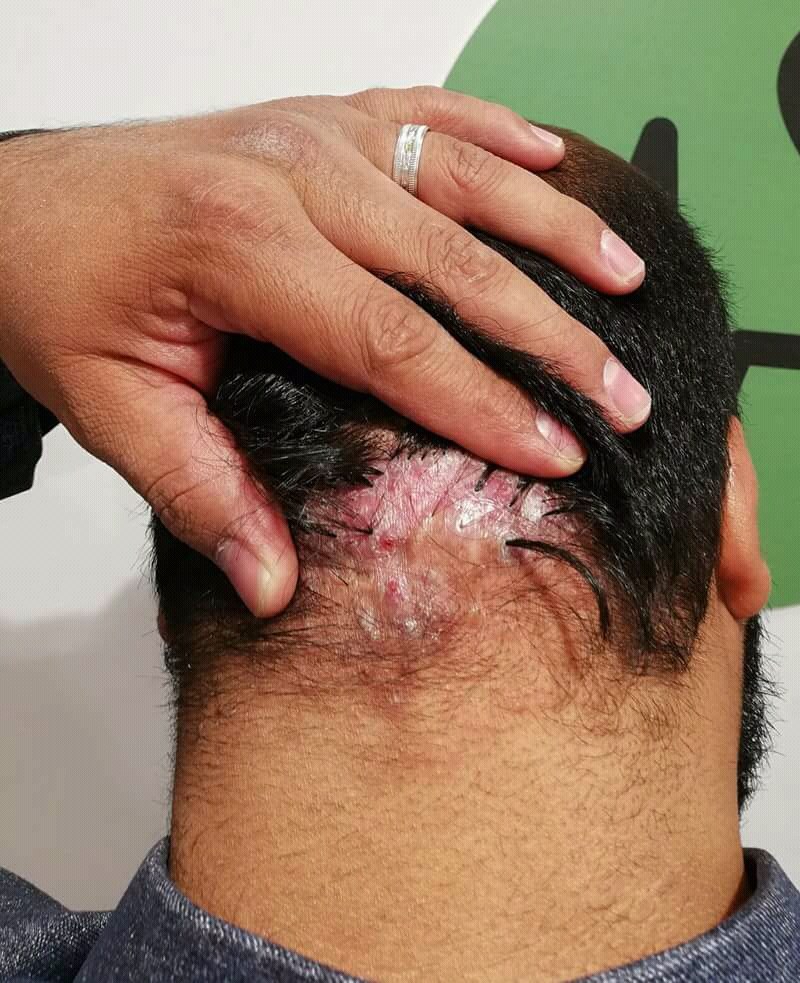
Definition
Folliculitis decalvans is a primary neutrophilic scarring alopecia. It usually begins in the fourth or fifth decade, with a male predominance; children are only very rarely affected. The scalp is typically involved, often around the crown, less often the beard area, axillae, limbs or pubic hair. An abnormal immune response to Staphylococcus aureus is assumed but not proven.
- Pathogenesis: Folliculitis decalvans is presumably a Staph. aureus-triggered neutrophilic folliculitis with perifollicular pustule formation.
- Clinical features: Tufted Hairs (= tufts of multiple hairs emerging from a single follicular ostium), perifollicular pustules + crusts, atrophic plaques slowly expand.
Diagnosis
- Trichoscopy: tufted hairs (polytrichia), white dots, perifollicular erythema and scale, scattered follicular pustules; clinically atrophic white scarred patches with pustules and crusts at the periphery.
- Bacteriology and mycology; histology: early a neutrophilic infiltrate dilating the infundibulum, later follicular rupture with perifollicular scarring and a mixed infiltrate with foreign-body giant cells.
- Distinction from lichen planopilaris, tinea capitis (fungal culture) and dissecting cellulitis of the scalp.
Differential diagnoses
 Folliculitis
 Frontal fibrosing alopecia
 Psoriasis vulgaris (plaque psoriasis)
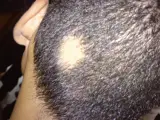 Alopecia areata
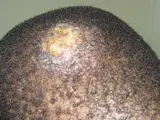 Tinea capitis (scalp ringworm)
 Hidradenitis suppurativa (acne inversa)
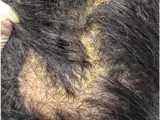 Lichen planopilaris
Image credits for the thumbnails
- Folliculitis: Da pacem Domine, “Folliculitis2”, CC0, via Wikimedia Commons · CC0 · Source
- Frontal fibrosing alopecia: Tziotzios, C., Petridis, C., Dand, N. et al., CC BY 4.0, via Wikimedia Commons, cropped · CC BY 4.0 · Source
- Psoriasis vulgaris (plaque psoriasis): MediaJet, “An Arm Covered With Plaque Type Psoriasis”, CC BY-SA 3.0, via Wikimedia Commons · CC BY-SA 3.0 · Source
- Alopecia areata: Abbassyma at English Wikipedia, “Allopecia areata”, Public Domain, via Wikimedia Commons · Public domain · Source
- Tinea capitis (scalp ringworm): Grook da oger, “Kérion 01”, CC BY-SA 4.0, via Wikimedia Commons · CC BY-SA 4.0 · Source
- Hidradenitis suppurativa (acne inversa): Dr. Thomas Brinkmeier, “Acne inversa, Hurley-Stadium II, ©WIKIDERM”, CC BY 4.0, via Wikimedia Commons · CC BY 4.0 · Source
- Lichen planopilaris: Shahbar ST, Maaddawi HA, Aljefri YE et al. (JAAD Case Rep 2026), CC BY 4.0, via PubMed Central (PMC12996700) · CC BY 4.0 · Source
Treatment principles
- The aim is to halt progression of the inflammation, as established scarring alopecia is irreversible.
- Systemic antibiotics are used, often as combination therapy against Staphylococcus aureus, supplemented by topical antiseptics or antibiotics and intralesional glucocorticoids.
- In refractory cases, systemic anti-inflammatory treatments such as retinoids may be considered; relapses after stopping treatment are common.
Specific treatment regimens with drugs and doses are covered in the DermaFuchs app.
Keep learning in the app
References (selection)
Cross-references
Mentioned in
More diseases of the skin appendages
Keep learning
Keep learning with flashcards, exam questions and spot diagnoses in the DermaFuchs app – free, in your browser or as an app.
Related pages: Folliculitis · Frontal fibrosing alopecia · Psoriasis vulgaris (plaque psoriasis)
Note: This page is intended for medical education and does not replace diagnosis or treatment decisions in individual cases.