Hidrocystoma (eccrine and apocrine)
- Synonyms
- Hidrocystom, Hydrozystom, Schweißdrüsenzyste, Moll-Zyste, apokrines Zystadenom, hidrocystoma, hydrocystoma, apocrine cystadenoma, Moll gland cyst, sudoriferous cyst
- Specialty
- Dermatology · Skin appendages
- Images
- Clinical 1
- In the app
- 1 flashcards
- Last updated
- 10/2026 · Dr. Pascal Bafteh
Contents
Images (1)
Definition
Hidrocystomas are benign cystic lesions of the sweat glands. A distinction is made between apocrine and eccrine hidrocystomas; their origin (retention cyst or adenomatous lesion, apocrine or eccrine) is viewed differently in the literature.
Classification
- Apocrine hidrocystoma (apocrine cystadenoma): usually a solitary translucent cyst, typically on the eyelid.
- Eccrine hidrocystoma: often multiple, for example on the lower eyelid or the face.
Occurrence & epidemiology
Mainly adults are affected; in two case series (107 and 20 patients) the mean age was 56 years. In a series of 22 hidrocystomas, 73% were located on the eyelids. Multiple apocrine hidrocystomas of the eyelids occur in Schöpf-Schulz-Passarge syndrome, a rare autosomal recessive genodermatosis with palmoplantar keratoderma, hypodontia, hypotrichosis and nail dystrophy.
Clinical features
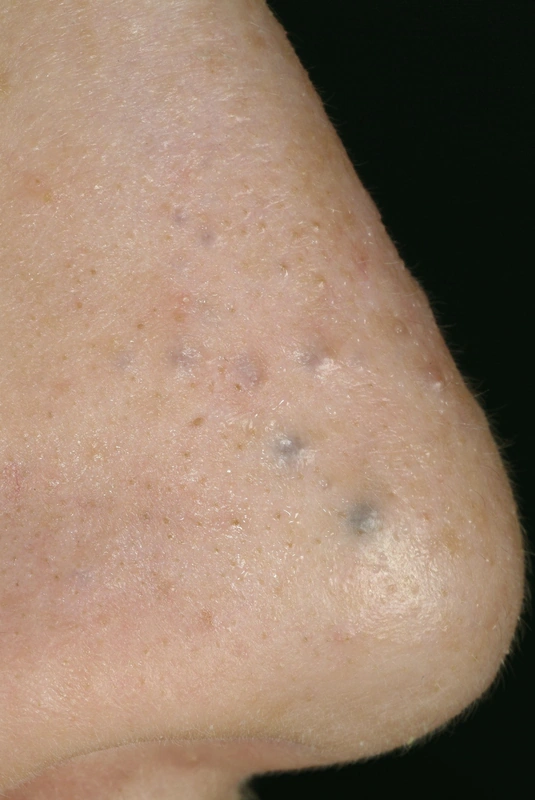
- Usually a solitary translucent, skin-coloured to bluish nodule or papule with jelly-like contents, mainly on the head and neck.
- The bluish colour results from light scattering (Tyndall effect).
- Eccrine hidrocystomas often present as several small papules, some skin-coloured, some dark.
Histology
Unilocular or multilocular cyst in the dermis. Apocrine: bilaminar epithelium with inner columnar eosinophilic cells and decapitation secretion ("apocrine snouts"). Eccrine: thin epithelium of one to two layers without decapitation secretion.
Diagnosis
- Clinical (translucent bluish cyst, typical site).
- Dermoscopy in eccrine hidrocystoma: homogeneous bluish-purplish centre with a pale halo.
- Histology confirms the diagnosis and distinguishes it from basal cell carcinoma, among others.
Differential diagnoses
Keep learning in the app
References (selection)
- DermNet: Sweat gland lesions (Hidrocystoma)
- DermNet: Apocrine hidrocystoma pathology
- DermNet: Eccrine hidrocystoma pathology
- PubMed: Cutaneous lesions of the nose (PMID 20525327; Volltext über Europe PMC gelesen)
- PubMed: Apocrine and eccrine hidrocystomas: a clinicopathological study (PMID 34169699)
- PubMed: Bi-institutional retrospective study on the demographics and basic clinical presentation of hidrocystomas (PMID 28722532)
- PubMed: Hidrocystomas--a brief review (PMID 17406184)
- PubMed: Pale halo surrounding a homogeneous bluish-purplish central area: dermoscopic clue for eccrine hidrocystoma (PMID 26693090)
Cross-references
Note: This page is intended for medical education and does not replace diagnosis or treatment decisions in individual cases.