PAPASH syndrome
- Specialty
- Dermatology · Inflammatory skin diseases
- Images
- Clinical 2
- In the app
- 3 flashcards
- Last updated
- 10/2026 · Dr. Pascal Bafteh
Contents
Images (2)
Definition
PAPASH syndrome is a very rare autoinflammatory syndrome. Its name sums up its four hallmark findings: Pyogenic (sterile) Arthritis, Pyoderma gangrenosum, Acne and Suppurative Hidradenitis (hidradenitis suppurativa, acne inversa). The condition thus combines the complete triad of PAPA syndrome with hidradenitis suppurativa – or, seen from the other side, PASH syndrome with additional joint inflammation.
It was first described in 2013 by Marzano and colleagues, together with a previously unknown variant of the PSTPIP1 gene. Since then, only single cases and small case series have been published. Reliable figures on frequency, sex distribution or typical age at onset are therefore not available.
Nosologically, PAPASH syndrome belongs to the PAPA spectrum disorders and thus to the autoinflammatory syndromes with neutrophilic dermatosis. What they share is inflammation that occurs without pathogens, without circulating autoantibodies and without autoreactive T cells, and is driven mainly by neutrophils.
Aetiopathogenesis and genetics
Autoinflammatory diseases result from dysregulation of the innate immune system. As in the related syndromes, PAPASH syndrome is thought to involve overactivation of inflammasomes, leading to increased production of interleukin-1β. TNF-α and interleukin-17 are considered further contributing cytokines. The result is sterile, neutrophil-rich inflammation of the skin and joints.
Role of PSTPIP1
- PSTPIP1 (formerly CD2BP1) is an adaptor protein that binds, among others, the tyrosine phosphatase PTP-PEST and pyrin, the protein affected in familial Mediterranean fever.
- In classic PAPA syndrome, mutations disrupt binding to PTP-PEST. PSTPIP1 then becomes hyperphosphorylated and binds pyrin more strongly – a mechanism behind the excessive release of interleukin-1β.
- The first description of PAPASH syndrome reported a novel PSTPIP1 variant. However, no uniform, regularly detectable cause has been established for PAPASH: according to reviews, disease-causing mutations within the PAPA spectrum have so far been confirmed only for PAPA and PAMI syndrome.
Follicular component
Acne and hidradenitis suppurativa originate in the hair follicle. Hyperkeratosis of the follicular infundibulum leads to occlusion, dilatation and eventually rupture of the follicle. Released keratin and bacterial components are a strong inflammatory stimulus. In PAPASH syndrome, this stimulus meets an autoinflammatory, exaggerated immune response – one explanation for the often severe, extensive course of acne and hidradenitis.
Clinical features
The hallmark is the coexistence of four components, which need not appear at the same time. The order is variable; the full picture is often only recognised once the last component appears.
- Pyogenic arthritis: sterile joint inflammation with a purulent-looking aspirate in which no pathogen can be detected. It runs a relapsing course and, as in PAPA syndrome, can leave joint damage.
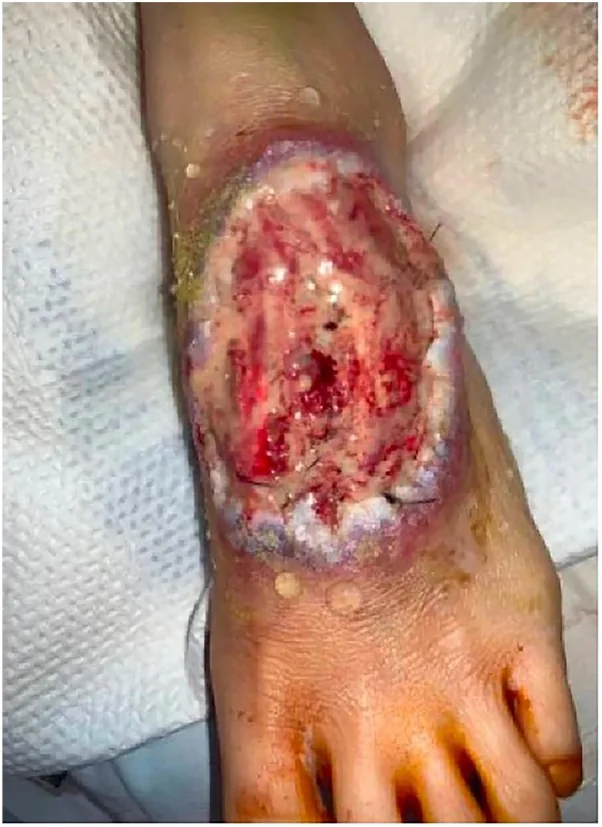
- Pyoderma gangrenosum: painful ulcers with a violaceous, undermined border that develop rapidly from papules or pustules. A pathergy phenomenon – new or worsening lesions after minor trauma, needle punctures or procedures – occurs in some patients; it is neither obligatory nor specific.
- Acne: usually severe inflammatory forms with nodules, cysts and scars, up to acne conglobata, mainly on the face, chest and back.
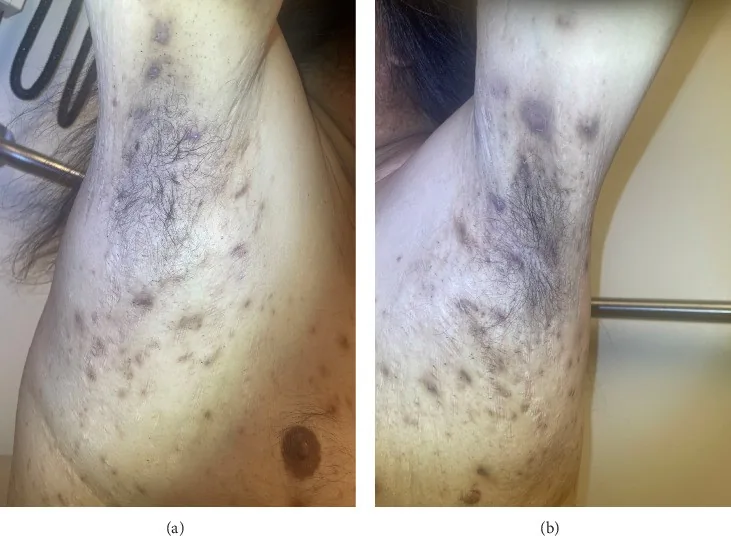
- Suppurative hidradenitis: recurrent inflammatory nodules, abscesses and sinus tracts in the axillae, groin, buttocks and anogenital region with rope-like scars; its extent is described clinically, for example with Hurley stages.
General symptoms such as fatigue and raised inflammatory markers are possible. Chronic pain, scarring and joint involvement usually impair patients' quality of life considerably.
Histology
Histology is not specific for the syndrome, but it helps to classify the individual components and to exclude other causes.
- Pyoderma gangrenosum: dense, predominantly neutrophilic dermal infiltrate, often with abscess formation and ulceration. Primary leukocytoclastic vasculitis is not part of the typical picture, although secondary vascular changes occur. A biopsy from the active border is the most informative.
- Hidradenitis suppurativa: follicular hyperkeratosis and occlusion, perifollicular mixed inflammation, epithelialised sinus tracts and foreign-body giant cells around ruptured follicles.
- Joint aspirate (cytology): markedly increased neutrophil count with sterile cultures.
Diagnosis
The diagnosis is clinical once all four components are present. Because pyoderma gangrenosum is a diagnosis of exclusion and the arthritis resembles septic arthritis, ruling out infection comes first.
- Joint: aspiration with cell count, Gram stain and culture; only a sterile, neutrophil-rich aspirate fits the pyogenic arthritis of the syndrome. Imaging assesses effusion and joint damage.
- Skin: biopsy from the border of an ulcer with histology and tissue cultures (bacteria, mycobacteria, fungi) to distinguish infection, vasculitis and malignancy; swabs from abscesses and sinus tracts.
- Laboratory: CRP, ESR and full blood count reflect systemic inflammation but are non-specific.
- Associated diseases: pyoderma gangrenosum and hidradenitis suppurativa are associated with inflammatory bowel disease. Ask specifically about abdominal pain, diarrhoea and blood in the stool, and arrange gastroenterological work-up if suspected.
- Genetics: molecular testing of PSTPIP1, where appropriate as a panel of further genes of autoinflammatory diseases, can support classification. A normal result does not exclude PAPASH syndrome.
- Criteria: for pyoderma gangrenosum itself, structured diagnostic tools exist: the Delphi consensus criteria for ulcerative pyoderma gangrenosum (Maverakis 2018) and the PARACELSUS score (Jockenhöfer 2019).
How it differs: PAPA, PASH and related syndromes
The syndromes of the PAPA spectrum overlap considerably. Classification depends on which components are present – above all, whether and how the joints are involved.
| Syndrome | Components | Genetics |
|---|---|---|
| PAPA | pyogenic arthritis, pyoderma gangrenosum, acne | autosomal dominant, PSTPIP1 mutation; onset usually in childhood |
| PASH | pyoderma gangrenosum, acne, hidradenitis suppurativa – no arthritis | mostly sporadic; no uniform mutation |
| PAPASH | all four: pyogenic arthritis, pyoderma gangrenosum, acne, hidradenitis suppurativa | first described with a novel PSTPIP1 variant; no uniform mutation |
| PsAPASH | PASH components plus psoriatic arthritis | unknown |
| PASS | pyoderma gangrenosum, acne, axial spondyloarthritis, with or without hidradenitis | unknown |
| PAC | pyoderma gangrenosum, acne, ulcerative colitis | unknown |
| SAPHO (not PAPA spectrum) | synovitis, acne, pustulosis, hyperostosis, osteitis | unknown; focus on bone and anterior chest wall |
- Against PAPA syndrome: the presence of hidradenitis suppurativa in PAPASH; PAPA is also inherited in an autosomal dominant manner (often familial) and usually starts in childhood.
- Against PASH syndrome: joint involvement – PASH is by definition free of arthritis.
- PAMI syndrome: a severe systemic disease caused by specific PSTPIP1 mutations, with markedly raised serum calprotectin and zinc levels, systemic inflammation, hepatosplenomegaly, cytopenias, frequent arthritis, failure to thrive and skin lesions resembling pyoderma gangrenosum (Holzinger 2015).
- Other differentials: isolated pyoderma gangrenosum with inflammatory bowel disease, septic arthritis, acne fulminans (ulcerating acne with fever and joint or bone pain in adolescents), Sweet syndrome and SAPHO syndrome.
Exam essentials
- PAPASH = PAPA syndrome plus hidradenitis suppurativa = PASH syndrome plus pyogenic arthritis; first described in 2013 (Marzano et al.).
- The arthritis is sterile: it only fits the syndrome once septic arthritis has been excluded (negative culture).
- Pyoderma gangrenosum is a diagnosis of exclusion – biopsy from the active border; rule out infection, vasculitis and malignancy.
- Common denominator of all PAPA spectrum syndromes: sterile, neutrophil-rich inflammation with a central role of interleukin-1β.
- A normal PSTPIP1 result does not exclude PAPASH – no uniform mutation has been established.
Differential diagnoses
 Pyoderma gangrenosum
 Acne fulminans
 SAPHO syndrome
 PAPA syndrome
 Generalized pustular psoriasis (von Zumbusch)
 Sweet syndrome (acute febrile neutrophilic dermatosis)
Image credits for the thumbnails
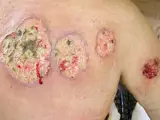
- Pyoderma gangrenosum: Monopol, “Pyoderma gangrenosum 01”, CC BY-SA 3.0, via Wikimedia Commons · CC BY-SA 3.0 · Source
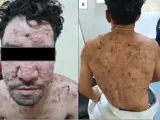
- Acne fulminans: Lahrougui A, Aboudourib M, Bendaoud L, Amal S, Hocar O, Cureus 2025, Figure 1, CC BY 4.0, via PubMed Central (PMC12123476) · CC BY 4.0 · Source
- SAPHO syndrome: Martinelli Salathiel AS, Secamilli EN, Maciel MG et al. (An Bras Dermatol 2026), CC BY 4.0, via PubMed Central (PMC13355544) · CC BY 4.0 · Source
- PAPA syndrome: Alvarez-Payares JC, Ramírez-Urrea S, Correa-Parra L et al. (Cureus 2021), CC BY 4.0, via PubMed Central (PMC8439267) · CC BY 4.0 · Source
- Generalized pustular psoriasis (von Zumbusch): Bourousis E, Kotzamani MT, Maritsi DN., Cureus 2025, Figure 1, CC BY 4.0, via PMC · CC BY 4.0 · Source
- Sweet syndrome (acute febrile neutrophilic dermatosis): Antonelli E et al. (J Clin Med 2021), CC BY 4.0, via PubMed Central (PMC7835974) · CC BY 4.0 · Source
Treatment principles
- PAPASH syndrome is managed through close interdisciplinary collaboration between dermatology, rheumatology and, where needed, gastroenterology; the evidence comes from single case reports.
- Because skin and joints are affected at the same time, systemic approaches are central, above all biologics targeting the cytokines interleukin-1 and TNF-α; systemic glucocorticoids serve mainly to bridge acute flares.
- Procedures on joints and on hidradenitis lesions are weighed carefully because of the pathergy phenomenon of pyoderma gangrenosum and, where possible, planned during phases of low inflammatory activity.
Specific treatment regimens with drugs and doses are covered in the DermaFuchs app.
Keep learning in the app
References (selection)
- Marzano AV et al. Pyogenic arthritis, pyoderma gangrenosum, acne, and hidradenitis suppurativa (PAPASH): a new autoinflammatory syndrome associated with a novel mutation of the PSTPIP1 gene. JAMA Dermatol. 2013;149(6):762-4. PMID 23571383
- Cugno M, Borghi A, Marzano AV. PAPA, PASH and PAPASH syndromes: pathophysiology, presentation and treatment. Am J Clin Dermatol. 2017;18(4):555-62. PMID 28236224
- Genovese G, Moltrasio C, Garcovich S, Marzano AV. PAPA spectrum disorders. G Ital Dermatol Venereol. 2020;155(5):542-50. PMID 32618443
- Shoham NG et al. Pyrin binds the PSTPIP1/CD2BP1 protein, defining familial Mediterranean fever and PAPA syndrome as disorders in the same pathway. Proc Natl Acad Sci USA. 2003;100(23):13501-6. PMID 14595024
- Holzinger D et al. Single amino acid charge switch defines clinically distinct proline-serine-threonine phosphatase-interacting protein 1 (PSTPIP1)-associated inflammatory diseases. J Allergy Clin Immunol. 2015;136(5):1337-45. PMID 26025129
- Maverakis E et al. Diagnostic criteria of ulcerative pyoderma gangrenosum: a Delphi consensus of international experts. JAMA Dermatol. 2018;154(4):461-6. PMID 29450466
- Jockenhöfer F et al. The PARACELSUS score: a novel diagnostic tool for pyoderma gangrenosum. Br J Dermatol. 2019;180(3):615-20. PMID 29388188
Cross-references
Keep learning
Keep learning with flashcards, exam questions and spot diagnoses in the DermaFuchs app – free, in your browser or as an app.
Related pages: Acne conglobata · Pyoderma gangrenosum · Acne fulminans
Note: This page is intended for medical education and does not replace diagnosis or treatment decisions in individual cases.