Androgenetic alopecia
- Synonyms
- male pattern baldness, female pattern hair loss
- Specialty
- Dermatology · Skin appendages
- Images
- Clinical 3
- In the app
- 4 flashcards
- Last updated
- 10/2026 · Dr. Pascal Bafteh
Contents
Images (3)
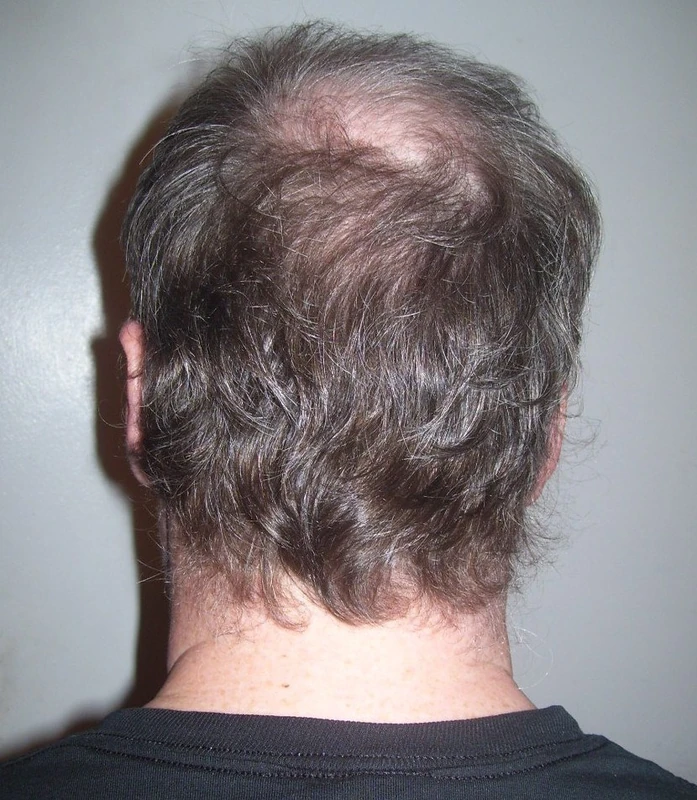
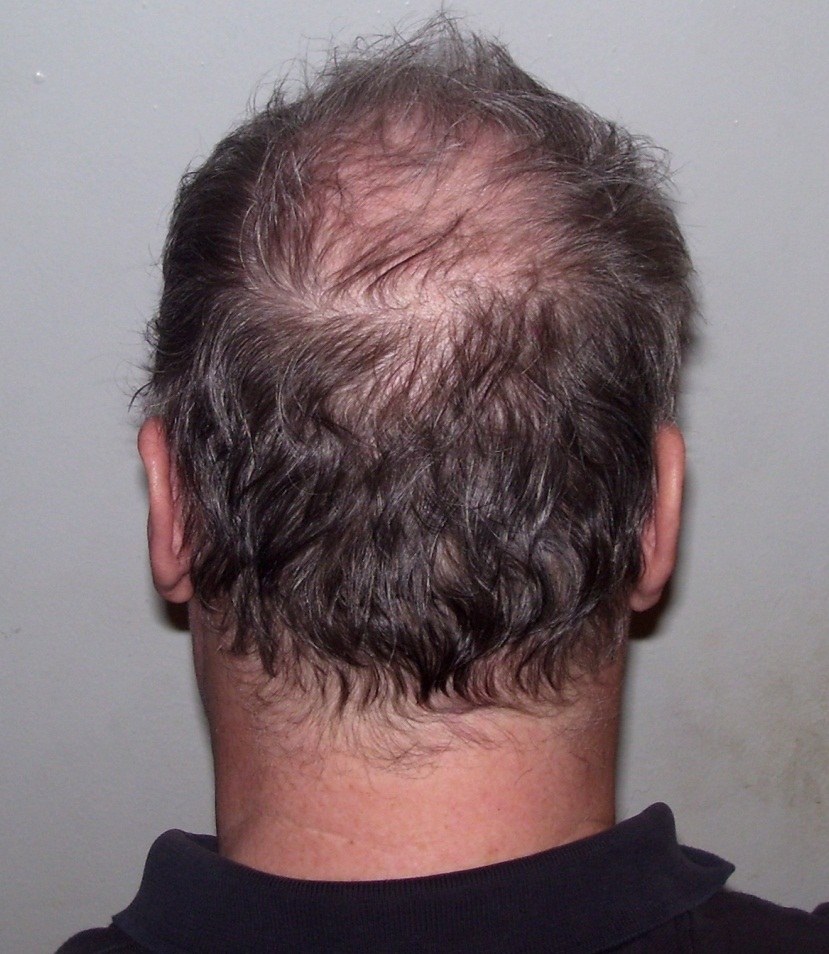
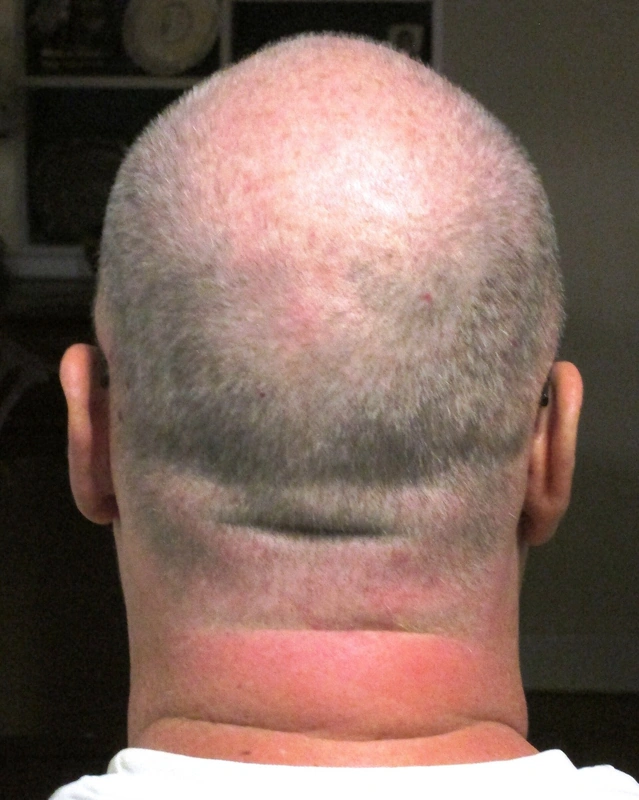
Definition
Definition & Epidemiology
- AGA = androgen-driven non-scarring alopecia with progressive miniaturization of terminal hairs to vellus hairs.
- Incidence: Affects ~50% men / ~40% women by the age of 50 (women primarily postmenopausal).
- Polygenic inheritance (AR gene polymorphism + other loci) — paternal and maternal lines contributing.
Classification
Women (Ludwig Scale / Olsen Classification)
- Stage I–III Ludwig: centrifugal thinning of the mid scalp with preservation of the frontal hairline.
- Olsen complements the frontal accentuation pattern ("Christmas-Tree-Pattern").
Aetiopathogenesis
Pathogenesis
- Key enzyme: Central to the hair follicle is 5α-reductase type II — conversion testosterone → DHT (DHT = dihydrotestosterone).
- DHT effect: Binding to androgen receptor → shortening of anagen phase + miniaturization of the follicle over several hair cycles.
- Genetics: AR polymorphisms + EDA2R + Chr 20p11 etc. — > 60 gene loci identified.
Diagnosis
Men (Hamilton-Norwood Scale)
- Stage I–VII: beginning bitemporally ("receding hairline") + vertex (crown), up to complete baldness with preservation of the occipital zone ("horseshoe pattern").
Diagnostics
- Trichoscopy / Dermoscopy: Typical for AGA are caliber variation ≥ 20%, predominantly in the frontal/crown region (compared with the occiput as reference).
- Trichogram / TrichoScan: Anagen / telogen ratio.
- In women: Iron + ferritin + TSH + androgens (testosterone, DHEA-S, SHBG, free androgen index, possibly 17-OH-progesterone) to rule out endocrine triggers / PCOS.
Differential diagnoses
Image credits for the thumbnails
- Anagen effluvium: Unnikrishnan, Vudayana, Diddi et al. (2026), “Chemotherapy and the Skin: Understanding Dermatologic Side Effects”, CC BY 4.0, via Wikimedia Commons · CC BY 4.0 · Source
- Alopecia areata: Abbassyma at English Wikipedia, “Allopecia areata”, Public Domain, via Wikimedia Commons · Public domain · Source
- Trichotillomania: יעקב הזמר, “Beard hair loss due to trichotillomania”, CC BY-SA 4.0, via Wikimedia Commons · CC BY-SA 4.0 · Source
- Folliculitis decalvans: Mohammad2018, “Foliculitis declavane new photo to avoid wrong diagnosis”, CC BY-SA 4.0, via Wikimedia Commons · CC BY-SA 4.0 · Source
- Telogen effluvium: Mvolz, “Postpartum telogen effluvium (hair loss)”, CC0, via Wikimedia Commons · CC0 · Source · cropped
Treatment principles
- Treatment is symptomatic and works only as long as it is continued; after discontinuation, hair loss progresses again.
- In men, topical hair-growth-promoting agents and systemic 5-alpha-reductase inhibitors are available; in women, mainly topical agents, supplemented by antiandrogens where appropriate.
- Hair transplantation is a surgical option, and platelet-rich plasma is regarded as an adjunctive procedure.
Specific treatment regimens with drugs and doses are covered in the DermaFuchs app.
Keep learning in the app
References (selection)
Cross-references
Mentioned in
Keep learning: test yourself
One question from the DermaFuchs app on Androgenetic alopecia – tap an answer.
Question 1 of 1
What trichoscopic finding is typical for androgenetic alopecia, especially in the vertex region?
Answer
Correct: caliber variation > 20%. Caliber variation greater than 20% is a typical trichoscopic finding in androgenetic alopecia.
More questions like these – with explanations and spaced repetition – in the app.
Note: This page is intended for medical education and does not replace diagnosis or treatment decisions in individual cases.