Anagen effluvium
- Synonyms
- hair loss from chemotherapy drugs
- Specialty
- Dermatology · Skin appendages
- Images
- Clinical 1
- In the app
- 1 flashcard
- Last updated
- 10/2026 · Dr. Pascal Bafteh
Contents
Images (1)
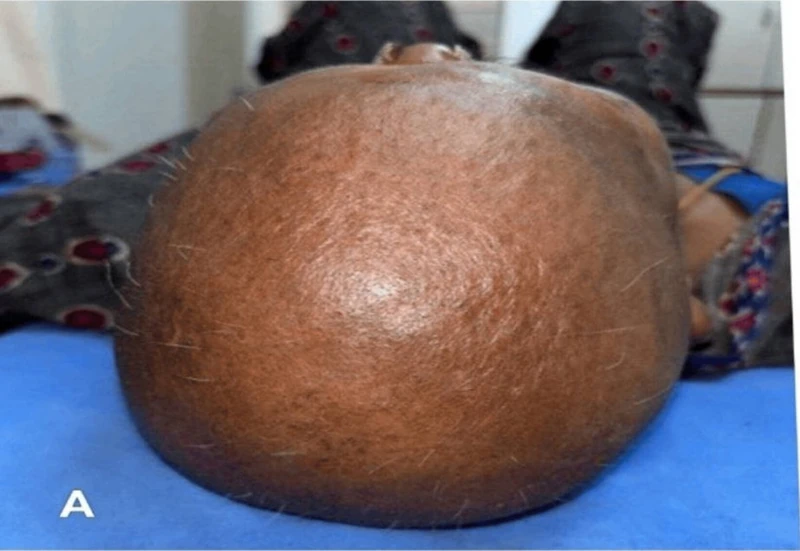
Definition
In anagen effluvium there is a sudden, marked loss of hairs that are in the growth phase (anagen). Mitotic activity of the hair matrix is abruptly interrupted by a damaging insult, and the hairs break at the narrowed point.
- Definition: Sudden diffuse hair loss in the anagen phase after toxic / cytotoxic insult.
- Latency Trigger → Effluvium: Days to 4 weeks — shorter than TE.
Aetiopathogenesis
The most common cause is cytotoxic agents; less often ionising rays, poisoning (e.g. thallium, arsenic) or severe alopecia areata are responsible. Hair loss begins days to a few weeks after the event (within 2–4 weeks of cytotoxic agents) and is usually reversible; after exposure of the scalp to ionising rays, however, regrowth may be incomplete or absent.
Diagnosis
- History with time relationship; trichogram with dystrophic anagen hairs and pointed, broken shafts.
- Distinction from telogen effluvium (shedding only 2–4 months after the trigger, club-shaped telogen hairs); exclusion of other causes of hair loss (iron deficiency, thyroid disease, systemic lupus, infections such as syphilis).
Differential diagnoses
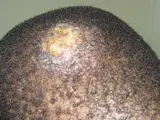
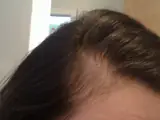
Image credits for the thumbnails
- Alopecia areata: Abbassyma at English Wikipedia, “Allopecia areata”, Public Domain, via Wikimedia Commons · Public domain · Source
- Androgenetic alopecia: Before My Ken, “Back of man's head”, CC BY-SA 3.0, via Wikimedia Commons · CC BY-SA 3.0 · Source
- Trichotillomania: יעקב הזמר, “Beard hair loss due to trichotillomania”, CC BY-SA 4.0, via Wikimedia Commons · CC BY-SA 4.0 · Source
- Tinea capitis (scalp ringworm): Grook da oger, “Kérion 01”, CC BY-SA 4.0, via Wikimedia Commons · CC BY-SA 4.0 · Source
- Telogen effluvium: Mvolz, “Postpartum telogen effluvium (hair loss)”, CC0, via Wikimedia Commons · CC0 · Source · cropped
Treatment principles
- Once the trigger has been removed, usually chemotherapy and less often radiotherapy or intoxication, hair loss is generally reversible, and hair regrows over weeks to months.
- During certain chemotherapy regimens, scalp cooling can reduce hair loss.
- Until regrowth, counselling and the provision of a hairpiece or wig are the main measures.
Specific treatment regimens with drugs and doses are covered in the DermaFuchs app.
Keep learning in the app
References (selection)
Cross-references
Keep learning
Keep learning with flashcards, exam questions and spot diagnoses in the DermaFuchs app – free, in your browser or as an app.
Related pages: Alopecia areata · Androgenetic alopecia · Trichotillomania
Note: This page is intended for medical education and does not replace diagnosis or treatment decisions in individual cases.