Tinea faciei
- Synonyms
- facial ringworm
- Specialty
- Dermatology · Fungal infections
- Images
- Clinical 2
- In the app
- 2 flashcards
- Last updated
- 10/2026 · Dr. Pascal Bafteh
Contents
Images (2)
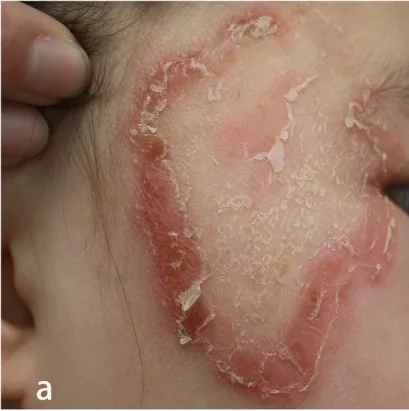
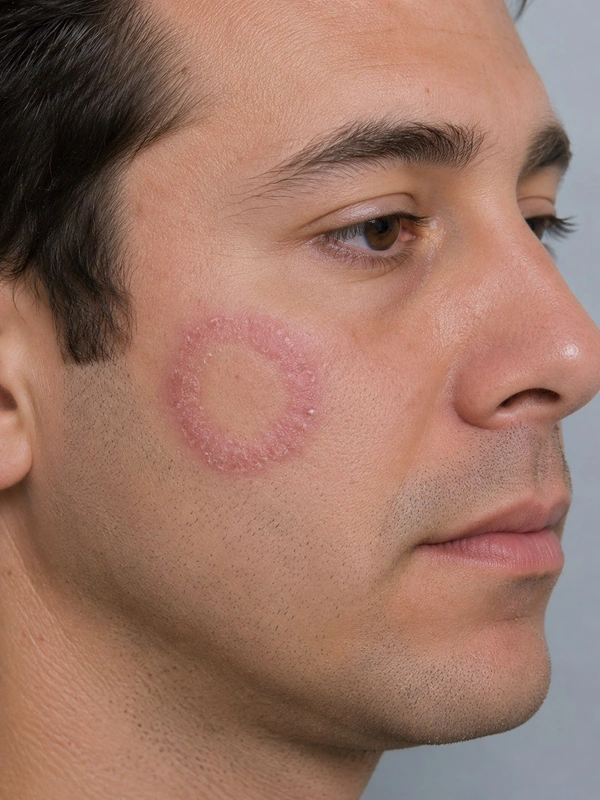 AI illustration
Definition
Tinea faciei is a dermatophyte infection of the glabrous facial skin. It is uncommon. Causes are anthropophilic fungi such as Trichophyton rubrum, often spread from the feet or nails, or zoophilic fungi such as Microsporum canis (cats, dogs) and T. verrucosum (cattle). Because it resembles eczema, rosacea, psoriasis or cutaneous lupus, it is often misdiagnosed.
- Clinical features: annular erythematosquamous plaques with active border on the face, frequently aggravated by sun exposure — often DD vs. lupus / rosacea / seborrheic eczema.
- Pathogens: commonly T. rubrum (from feet/nails), M. canis (cat/dog), T. verrucosum (cattle).
Diagnosis
- KOH microscopy, fungal culture and PCR from the scaly edge.
- An atypical, masked picture ("tinea incognito") is possible; look for tinea of the feet, groins and nails and, if a zoophilic infection is suspected, for the source animal.
Differential diagnoses
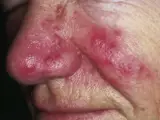 Rosacea
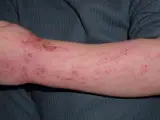 Atopic dermatitis (atopic eczema)
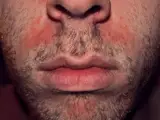 Seborrhoeic dermatitis
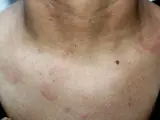 Lupus erythematosus
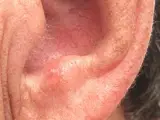 Actinic keratosis
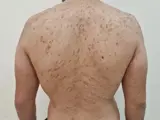 Acne vulgaris
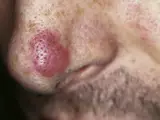 Granuloma faciale
Image credits for the thumbnails
- Rosacea: Michael Sand, Daniel Sand, Christina Thrandorf, Volker Paech, Peter Altmeyer, Falk G Bechara, “Rosacea”, CC BY 2.5, via Wikimedia Commons, cropped · CC BY 2.5 · Source
- Atopic dermatitis (atopic eczema): Eisfelder, “Atopic dermatitis child”, CC BY-SA 3.0, via Wikimedia Commons · CC BY-SA 3.0 · Source
- Seborrhoeic dermatitis: Roymishali, “Seborrhoeic dermatitis highres”, CC BY-SA 3.0, via Wikimedia Commons · CC BY-SA 3.0 · Source
- Lupus erythematosus: Meriam Hajji, CC BY 4.0, via Wikimedia Commons · CC BY 4.0 · Source
- Actinic keratosis: Future FamDoc, “Actinic keratosis on ear”, CC BY-SA 4.0, via Wikimedia Commons · CC BY-SA 4.0 · Source
- Acne vulgaris: Sedef94, “Kürəkdə düyünlü və kistik sızanaqlar (Acne Vulgaris) 08”, CC BY-SA 4.0, via Wikimedia Commons · CC BY-SA 4.0 · Source
- Granuloma faciale: unknown (Commons user), “Facial eosinophilic granuloma 01”, CC BY 2.0, via Wikimedia Commons · CC BY 2.0 · Source
Treatment principles
- After taking material to identify the organism, localised disease is treated with topical antifungals, and extensive or follicular involvement systemically.
- Tinea faciei is often initially mistaken for eczema or rosacea and treated with topical glucocorticoids, which mask the picture (tinea incognito); these are discontinued.
- With zoophilic organisms, the source animal is treated as well.
Guideline: AWMF guideline register (no. 013-002)
Specific treatment regimens with drugs and doses are covered in the DermaFuchs app.
Keep learning in the app
References (selection)
Cross-references
Keep learning
Keep learning with flashcards, exam questions and spot diagnoses in the DermaFuchs app – free, in your browser or as an app.
Related pages: Rosacea · Atopic dermatitis (atopic eczema) · Seborrhoeic dermatitis
Note: This page is intended for medical education and does not replace diagnosis or treatment decisions in individual cases.