Grover's disease (transient acantholytic dermatosis)
- Synonyms
- transitorische akantholytische Dermatose, Grover's disease, transient acantholytic dermatosis
- Specialty
- Dermatology · Inflammatory skin diseases
- Images
- Clinical 1 · Histology 1
- In the app
- 2 flashcards
- Last updated
- 10/2026 · Dr. Pascal Bafteh
Contents
Images (2)
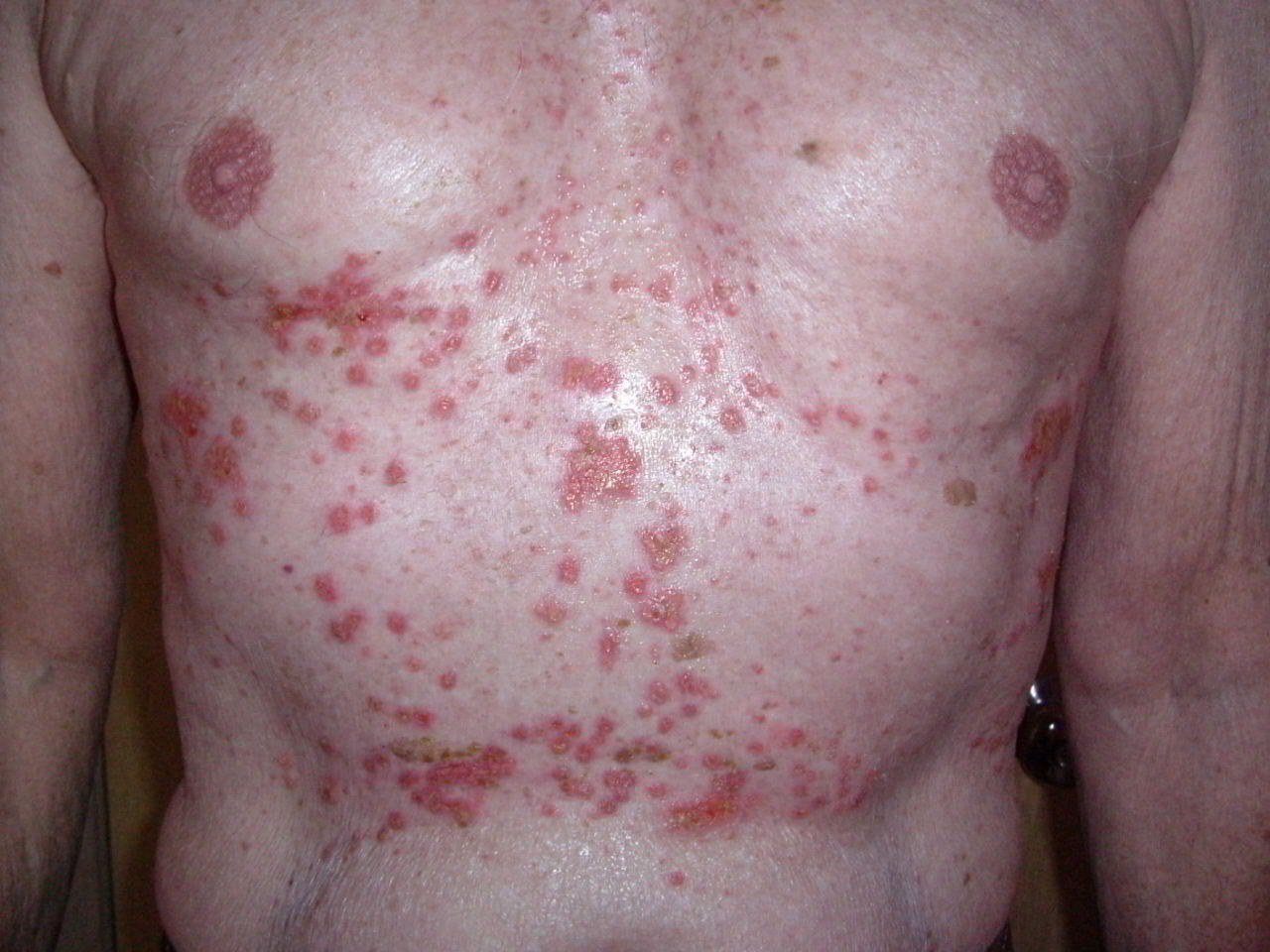
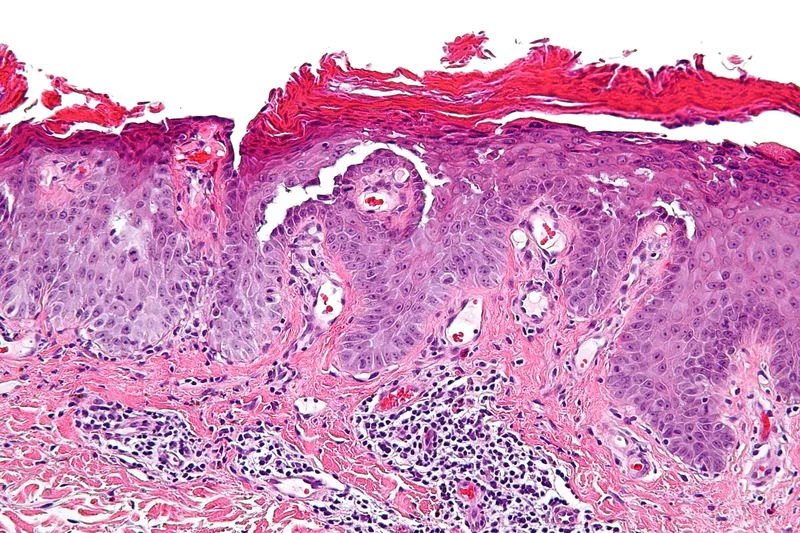 Histology
Definition
Definition & Pathogenesis
- Grover disease (Transient Acantholytic Dermatosis, TAD) = acquired, usually transient acantholytic dermatosis; Grover 1970 first description.
- Pathogenesis: Trigger is focal acantholysis of suprabasal keratinocytes without autoantibodies.
- Middle age / geriatrics: Manifestation typically > 40–50 years, m:f approx. 2–3:1.
- Acquired from 60 years of age, on the trunk, more common in men, pruritus.
Mnemonic: "A2 language level, because French is difficult (= Darier ATP2A2); C1, because English is rather easy (= Hailey-Hailey ATP2C1)."
Clinical features
Clinical Presentation
- Location: Predilection sites are upper trunk (presternal, back) + proximal extremities.
- Morphology: Classic efflorescence is small (1–3 mm) erythematous papulovesicles with crust, densely set, polymorphic.
- Course: classically transient (spontaneous resolution often within weeks), but despite the name often relapsing and sometimes chronic over years.
Diagnosis
Diagnostics
- Clinical + histology for diagnostic confirmation.
- Histology: Characteristic is focal acantholysis with 4 histological patterns (not all show the classic acantholytic picture): Darier-like, Hailey-Hailey-like, pemphigus-like, spongiotic variant.
- DIF: In Grover, direct immunofluorescence is negative (DD to pemphigus / IgA pemphigus / Duhring).
- Serology: Anti-Dsg1/3 negative — important pemphigus exclusion.
Differential diagnoses
 Seborrhoeic dermatitis
 Psoriasis vulgaris (plaque psoriasis)
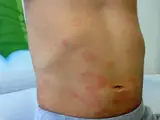 Urticaria
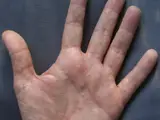 Dyshidrotic eczema (pompholyx)
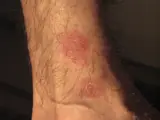 Pityriasis rosea
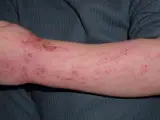 Atopic dermatitis (atopic eczema)
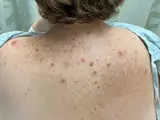 Prurigo nodularis
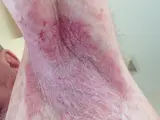 Hailey-Hailey disease
Image credits for the thumbnails
- Seborrhoeic dermatitis: Roymishali, “Seborrhoeic dermatitis highres”, CC BY-SA 3.0, via Wikimedia Commons · CC BY-SA 3.0 · Source
- Psoriasis vulgaris (plaque psoriasis): MediaJet, “An Arm Covered With Plaque Type Psoriasis”, CC BY-SA 3.0, via Wikimedia Commons · CC BY-SA 3.0 · Source
- Urticaria: Gzzz, “Urticaria child”, CC BY-SA 4.0, via Wikimedia Commons · CC BY-SA 4.0 · Source
- Dyshidrotic eczema (pompholyx): Inwe (Wikimedia Commons), “Dyshidrosis”, CC BY-SA 3.0, via Wikimedia Commons · CC BY-SA 3.0 · Source
- Pityriasis rosea: Aceofhearts1968, “Pityriasis rosea-1”, Public Domain, via Wikimedia Commons · Public domain · Source
- Atopic dermatitis (atopic eczema): Eisfelder, “Atopic dermatitis child”, CC BY-SA 3.0, via Wikimedia Commons · CC BY-SA 3.0 · Source
- Prurigo nodularis: Chen R et al. (JAAD Case Rep 2026), Fig 1A, CC BY 4.0, via PubMed Central (PMC12723277) · CC BY 4.0 · Source
- Hailey-Hailey disease: Squeakycatta, “Before Magnesium Chloride”, CC BY-SA 4.0, via Wikimedia Commons · CC BY-SA 4.0 · Source
Treatment principles
- Grover disease is often self-limiting but can persist chronically; the basis is avoiding heat, sweating and UV exposure, together with emollient care.
- Topical glucocorticoids are first line, with antihistamines for itch.
- Refractory cases may be treated with systemic retinoids, phototherapy or short-term systemic glucocorticoids; if induced by immune checkpoint inhibitors, cancer treatment can usually be continued with topical therapy.
Specific treatment regimens with drugs and doses are covered in the DermaFuchs app.
Keep learning in the app
References (selection)
Cross-references
Keep learning
Keep learning with flashcards, exam questions and spot diagnoses in the DermaFuchs app – free, in your browser or as an app.
Related pages: Seborrhoeic dermatitis · Psoriasis vulgaris (plaque psoriasis) · Urticaria
Note: This page is intended for medical education and does not replace diagnosis or treatment decisions in individual cases.