Limited systemic sclerosis (CREST syndrome)
- Synonyms
- CREST-Syndrom, limited systemic sclerosis, CREST syndrome, limited scleroderma
- Specialty
- Dermatology · Connective tissue diseases
- Images
- Clinical 1 · Histology 1
- In the app
- 13 flashcards
- Last updated
- 10/2026 · Dr. Pascal Bafteh
Contents
Images (2)
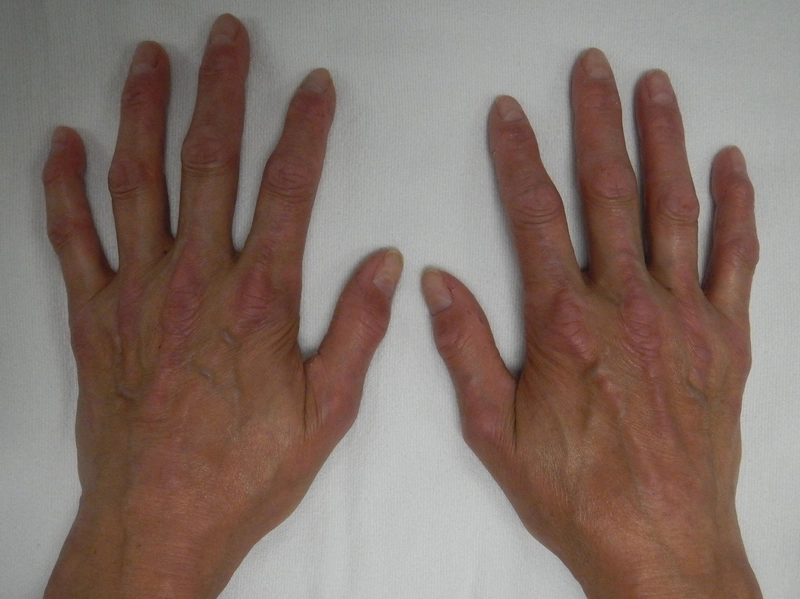
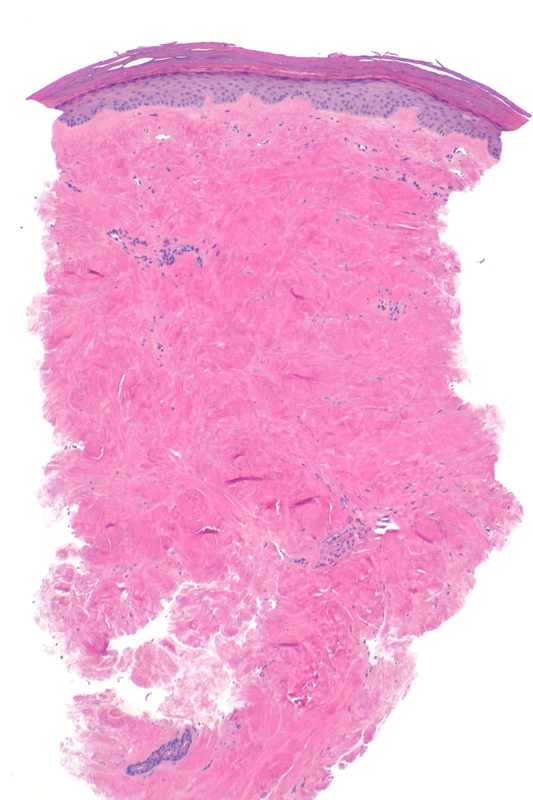 Histology
Definition
Limited cutaneous systemic sclerosis is the more common form of systemic sclerosis in European registries; proportions vary between populations. Skin thickening remains confined to the face, hands, forearms and lower legs (distal to elbows and knees); internal organs are affected later and less often than in the diffuse form. The former term CREST summarises typical features: calcinosis cutis, Raynaud phenomenon, oesophageal dysmotility, sclerodactyly and telangiectasia.
- CREST: Calcinosis, Raynaud, Esophageal dysmotility, Sclerodactyly, Telangiectasia.
- Abs: Anti-Centromere (ACA). Complication: Pulmonary hypertension.
Clinical features
- Raynaud phenomenon often preceding by years; swollen fingers ("puffy fingers"), later sclerodactyly with flexion contractures and digital ulcers.
- Mat-like telangiectasia on the face, lips and hands; calcium deposits at the fingertips.
- A typical late complication is pulmonary arterial hypertension.
Differential diagnoses
 Cutis laxa (generalised elastolysis)
 Morphea
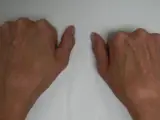 Systemic sclerosis
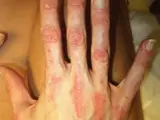 Dermatomyositis
 Ehlers-Danlos syndrome
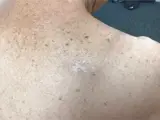 Lichen sclerosus
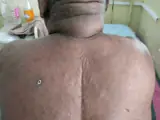 Scleroedema adultorum of Buschke (scleredema)
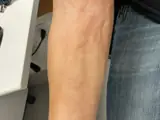 Eosinophilic fasciitis (Shulman)
Image credits for the thumbnails
- Cutis laxa (generalised elastolysis): APSP J Case Rep, CC BY 4.0, via Wikimedia Commons · CC BY 4.0 · Source
- Morphea: Leith C Jones at English Wikipedia, “MercMorphea”, CC BY 3.0, via Wikimedia Commons · CC BY 3.0 · Source
- Systemic sclerosis: James Heilman, “CREST2015.JPG”, CC BY-SA 4.0, via Wikimedia Commons · CC BY-SA 4.0 · Source
- Dermatomyositis: Mohammad2018, CC BY-SA 4.0 · CC BY-SA 4.0 · Source
- Ehlers-Danlos syndrome: Rollcloud, “Skin-hyperelasticity-2”, CC0, via Wikimedia Commons · CC0 · Source
- Lichen sclerosus: Frucht CS, Ragsdale BD, Cureus 2026, Figure 1, CC BY 4.0, via PubMed Central (PMC13614091) · CC BY 4.0 · Source
- Scleroedema adultorum of Buschke (scleredema): Ranabahu M, Karunarathna W, Asanthi J et al. (Cureus 2024), CC BY 4.0, via PubMed Central (PMC11178434) · CC BY 4.0 · Source
- Eosinophilic fasciitis (Shulman): Matthews C, Thomas D, Monteagudo L et al. (Clin Case Rep 2025), CC BY 4.0, via PubMed Central (PMC11926566) · CC BY 4.0 · Source
Treatment principles
- Management is organ-based and interdisciplinary (dermatology, rheumatology, pulmonology, cardiology).
- For Raynaud's phenomenon, protection from cold and smoking cessation come first, supplemented by vasoactive drugs, which are also used to treat and prevent digital ulcers.
- Because of the risk of pulmonary arterial hypertension and interstitial lung disease, regular screening is central; physiotherapy and occupational therapy counteract contractures.
Guideline: AWMF guideline register (no. 060-014)
Specific treatment regimens with drugs and doses are covered in the DermaFuchs app.
Keep learning in the app
References (selection)
Cross-references
Mentioned in
Keep learning
Keep learning with flashcards, exam questions and spot diagnoses in the DermaFuchs app – free, in your browser or as an app.
Related pages: Cutis laxa (generalised elastolysis) · Morphea · Systemic sclerosis
Note: This page is intended for medical education and does not replace diagnosis or treatment decisions in individual cases.