Scleroedema adultorum of Buschke (scleredema)
- Synonyms
- Skleroedem, Skleroedema Buschke, Scleroedema Buschke, Scleroedema diabeticorum, Skleroedema adultorum, scleredema, scleredema adultorum, scleroedema, scleredema diabeticorum
- Specialty
- Dermatology · Connective tissue diseases
- Images
- Clinical 1
- In the app
- 3 flashcards
- Last updated
- 10/2026 · Dr. Pascal Bafteh
Contents
Images (1)
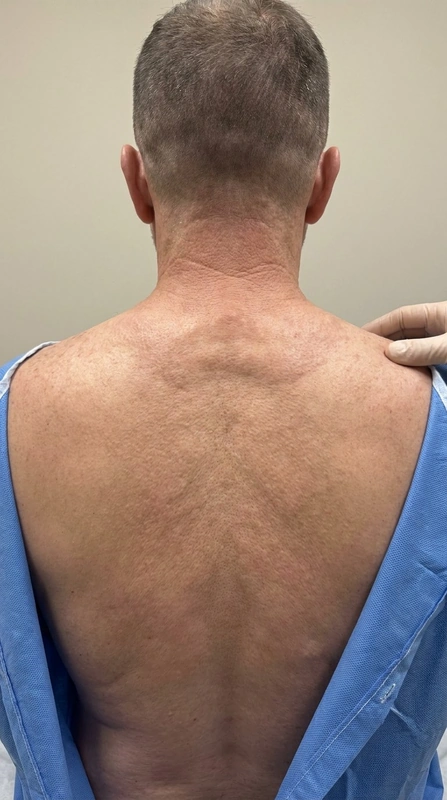 AI illustration
Definition
Scleroedema adultorum of Buschke is a rare scleromucinous disease of unknown cause with symmetrical, woody, non-pitting induration of the skin, typically on the neck and upper trunk. It is distinct from scleroderma, in which the skin becomes fibrotic. The name is used by some for all forms and by others only for the diabetes-associated form.
Classification
- Infection-associated: usually after a streptococcal infection of the upper respiratory tract; mainly middle-aged women and children; rapid spread from the face and neck to the upper trunk and arms; often resolves spontaneously within six months to two years.
- With monoclonal gammopathy: insidious onset, chronic course, sometimes in multiple myeloma.
- Diabetes-associated (scleroedema diabeticorum): the most common form, mainly adult men; the skin of the neck and upper back thickens over months to years and is very persistent.
Occurrence & epidemiology
In a European multicentre study of 44 patients (26 men), the mean age at diagnosis was 53.8 years; 30 patients had diabetes, mostly type 2, and five had a monoclonal gammopathy.
Clinical features
- Symmetrical, hard, woody plaques, sometimes slightly red or brown, often with a peau d'orange appearance; onset on the nape and between the shoulder blades, spreading to the shoulders and upper chest.
- Restricted movement due to the stiff skin; the face may look expressionless and opening the mouth may be difficult.
- Rarely difficulty swallowing and speaking, or involvement of the eyes, tongue, parotid gland, muscles, joints and heart.
Histology
Markedly thickened dermis with mucin deposits between the collagen bundles.
Diagnosis
- Clinical (typical site, non-pitting induration) and skin biopsy for confirmation.
- Search for associated conditions, especially diabetes mellitus, monoclonal gammopathy and a preceding streptococcal infection.
Differential diagnoses
Keep learning in the app
References (selection)
- DermNet: Scleroedema
- PubMed: Scleredema adultorum: Clinical presentation, diagnostic workup, differential diagnosis, treatment option (PMID 30128796)
- PubMed: Differential diagnosis of sclerosing skin diseases: scleredema adultorum of Buschke (PMID 38347238)
- PubMed: Scleredema. A multicentre study of characteristics, comorbidities, course and therapy in 44 patients (PMID 26304054)
Cross-references
Mentioned in
Note: This page is intended for medical education and does not replace diagnosis or treatment decisions in individual cases.