Pseudoxanthoma elasticum (PXE, Grönblad-Strandberg)
Exam relevance: in 1 of more than 50 board exam reports · rank 93
- Synonyms
- PXE, Grönblad-Strandberg, pseudoxanthoma elasticum, PXE
- Specialty
- Dermatology · Hereditary skin diseases
- Images
- Clinical 1
- In the app
- 1 flashcard
- Last updated
- 10/2026 · Dr. Pascal Bafteh
Contents
Images (1)
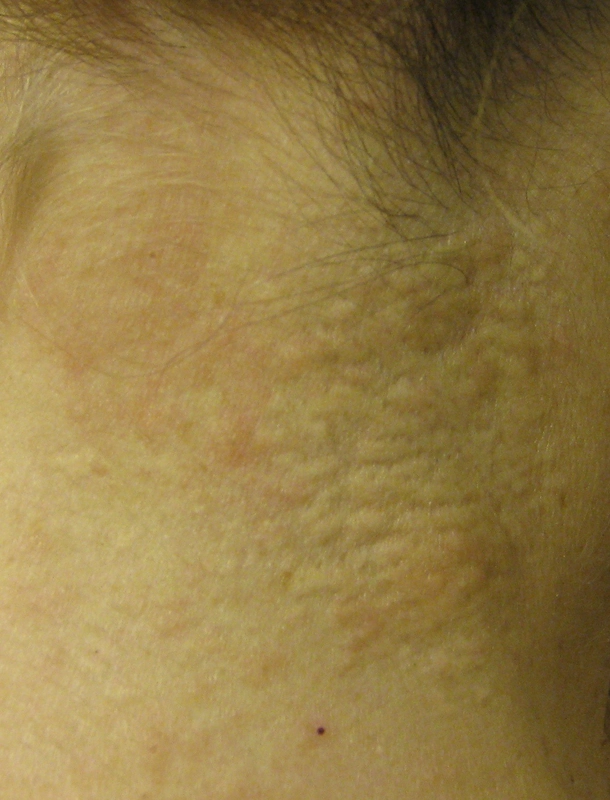
Definition
- Genetics: ABCC6 (PPi defect) — autosomal recessive → fragmentation + calcification of elastic connective tissue.
- Prevalence: 1: 25 000 – 1: 100 000.
- Clinical features: yellowish papules with a plucked-chicken skin appearance on the neck / flexures / lateral trunk, prominent chin fold (mental crease), angioid streaks of Bruch's membrane, cardiovascular calcifications, GI bleeding.
Diagnosis
- Skin biopsy from an affected flexural site: shortened, fragmented and calcified elastic fibres in the reticular dermis (calcium shown by special stains).
- Molecular genetic detection of ABCC6 mutations.
- Ophthalmological examination (angioid streaks, peau d'orange of the fundus) and cardiovascular assessment.
Differential diagnoses
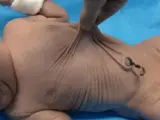 Cutis laxa (generalised elastolysis)
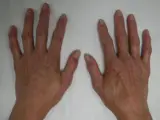 Limited systemic sclerosis (CREST syndrome)
 Ehlers-Danlos syndrome
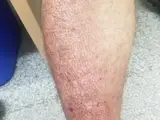 Cutaneous amyloidoses
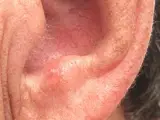 Actinic keratosis
Image credits for the thumbnails
- Cutis laxa (generalised elastolysis): APSP J Case Rep, CC BY 4.0, via Wikimedia Commons · CC BY 4.0 · Source
- Limited systemic sclerosis (CREST syndrome): James Heilman, MD, “CREST syndrome (calcinosis and sclerodactyly)”, CC BY-SA 4.0, via Wikimedia Commons · CC BY-SA 4.0 · Source
- Ehlers-Danlos syndrome: Rollcloud, “Skin-hyperelasticity-2”, CC0, via Wikimedia Commons · CC0 · Source
- Cutaneous amyloidoses: Tinss, “Lichen amyloidosis on leg 1”, CC BY-SA 4.0, via Wikimedia Commons · CC BY-SA 4.0 · Source
- Actinic keratosis: Future FamDoc, “Actinic keratosis on ear”, CC BY-SA 4.0, via Wikimedia Commons · CC BY-SA 4.0 · Source
Treatment principles
- There is no causal treatment; the focus is on multidisciplinary care and the prevention of complications.
- Regular ophthalmological follow-up allows early treatment of choroidal neovascularisation; cardiovascular risk factors are managed rigorously.
- Skin changes can be corrected surgically if required; genetic counselling is offered.
Specific treatment regimens with drugs and doses are covered in the DermaFuchs app.
Keep learning in the app
References (selection)
Cross-references
Keep learning: test yourself
One question from the DermaFuchs app on Pseudoxanthoma elasticum (PXE, Grönblad-Strandberg) – tap an answer.
Question 1 of 1
Which genetic defect leads to fragmentation and calcification of elastic connective tissue in pseudoxanthoma elasticum?
Answer
Correct: ABCC6 (PPi defect). ABCC6 gene defect leads to a deficiency in pyrophosphate (PPi), causing fragmentation and calcification of elastic connective tissue.
More questions like these – with explanations and spaced repetition – in the app.
Note: This page is intended for medical education and does not replace diagnosis or treatment decisions in individual cases.