Polyarteritis nodosa
- Synonyms
- PAN
- Specialty
- Dermatology · Vascular skin disorders
- Images
- Clinical 2
- In the app
- 3 flashcards
- Last updated
- 10/2026 · Dr. Pascal Bafteh
Contents
Images (2)
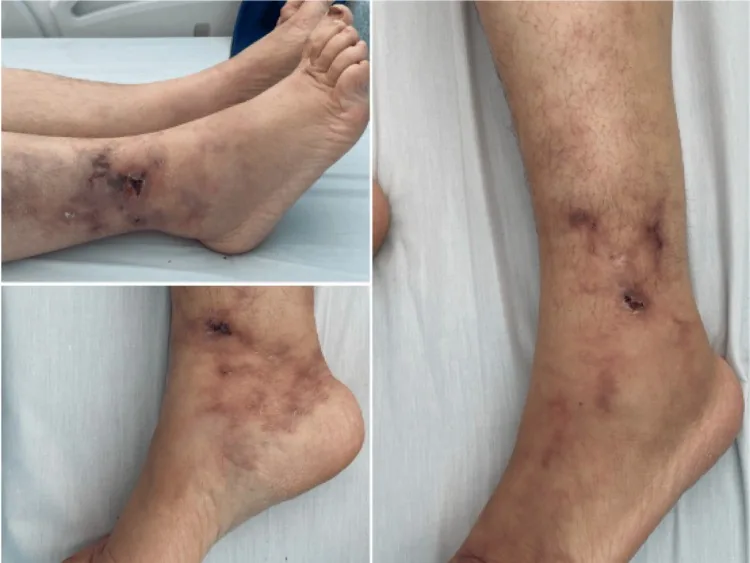
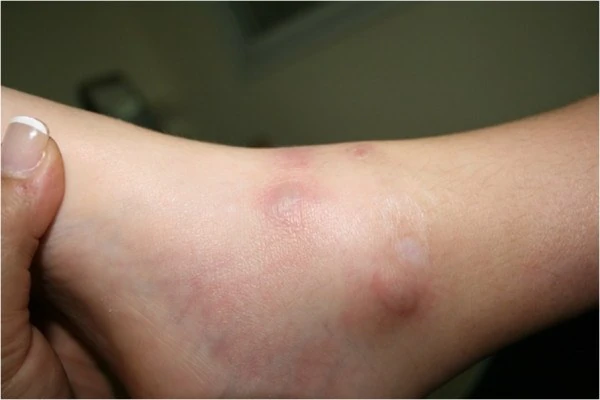
Definition
Polyarteritis nodosa is a necrotising vasculitis of medium-sized and small arteries without glomerulonephritis and without involvement of arterioles, capillaries or venules; ANCA are typically negative. A systemic form and cutaneous polyarteritis nodosa limited to the skin are distinguished.
- Medium-sized vessels, no glomerulonephritis. Cutaneous: Livedo racemosa + nodular vasculitis. Association: Hepatitis B.
Clinical features
- Skin: painful subcutaneous nodules along vessels, livedo racemosa, ulceration and necrosis, mainly on the lower legs.
- Systemic: fever, weight loss, mononeuritis multiplex, muscle and joint pain, testicular pain, abdominal pain due to mesenteric involvement, arterial hypertension due to renal artery involvement.
Diagnosis
- Deep skin biopsy from a nodule including deep dermis and subcutaneous fat (punch biopsies of the superficial dermis miss the lesions): necrotising arteritis of small to medium-sized arteries.
- Hepatitis B and C serology (positive in about 20%), ANCA (negative), urinalysis (proteinuria, haematuria) and kidney function; if systemic disease is suspected, arteriography showing typical aneurysms of medium-sized arteries.
Differential diagnoses
 Livedo racemosa
 Erythema nodosum
 Limited systemic sclerosis (CREST syndrome)
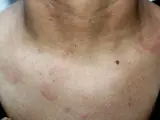 Lupus erythematosus
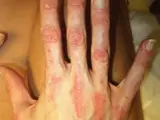 Dermatomyositis
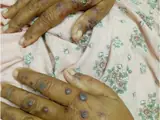 Granulomatosis with polyangiitis (GPA) – skin manifestations
- Polyarteritis nodosa
Image credits for the thumbnails
- Livedo racemosa: Nantsupawat T et al, “Livedo reticularis of left leg”, CC BY-SA 3.0, via Wikimedia Commons · CC BY-SA 3.0 · Source
- Erythema nodosum: James Heilman, MD, “ENlegs”, CC BY-SA 3.0, via Wikimedia Commons · CC BY-SA 3.0 · Source
- Limited systemic sclerosis (CREST syndrome): James Heilman, MD, “CREST syndrome (calcinosis and sclerodactyly)”, CC BY-SA 4.0, via Wikimedia Commons · CC BY-SA 4.0 · Source
- Lupus erythematosus: Meriam Hajji, CC BY 4.0, via Wikimedia Commons · CC BY 4.0 · Source
- Dermatomyositis: Mohammad2018, CC BY-SA 4.0 · CC BY-SA 4.0 · Source
- Granulomatosis with polyangiitis (GPA) – skin manifestations: Ullah N, Jabin A, Isar H et al. (Ann Med Surg (Lond) 2026), CC BY 4.0, via PubMed Central (PMC13461037) · CC BY 4.0 · Source
Treatment principles
- The purely cutaneous form usually runs a chronic, relapsing but benign course and is treated with non-steroidal anti-inflammatory drugs and topical or systemic glucocorticoids.
- Systemic polyarteritis nodosa requires multidisciplinary management with systemic glucocorticoids, combined with immunosuppressants when major organs are involved.
- In hepatitis B-associated disease, antiviral treatment of the underlying infection takes priority.
More on this topic in the DermaFuchs app.
Keep learning in the app
References (selection)
Cross-references
Mentioned in
More vascular skin disorders
- Purpura fulminans
- Giant cell arteritis (temporal arteritis)
- Great saphenous vein varicosity
- Stasis dermatitis (venous eczema)
- Deep vein thrombosis
- Leg ulcer (ulcus cruris)
- Urticarial vasculitis (normocomplementaemic and hypocomplementaemic)
- Antiphospholipid syndrome – skin manifestations (livedo racemosa, Sneddon syndrome)
Keep learning: test yourself
One question from the DermaFuchs app on Polyarteritis nodosa – tap an answer.
Question 1 of 1
Polyarteritis nodosa (PAN) is classically associated with which viral infection?
Answer
Correct: HBV. Hepatitis B virus (HBV) infection is a classic trigger for Polyarteritis nodosa, causing immune complex-mediated vasculitis.
More questions like these – with explanations and spaced repetition – in the app.
Note: This page is intended for medical education and does not replace diagnosis or treatment decisions in individual cases.