Systemic sclerosis
Exam relevance: in 4 of more than 50 board exam reports · rank 33
- Synonyms
- scleroderma, SSc
- Specialty
- Dermatology · Connective tissue diseases
- Images
- Clinical 2 · Histology 1
- In the app
- 1 flashcard
- Last updated
- 10/2026 · Dr. Pascal Bafteh
Contents
Images (3)
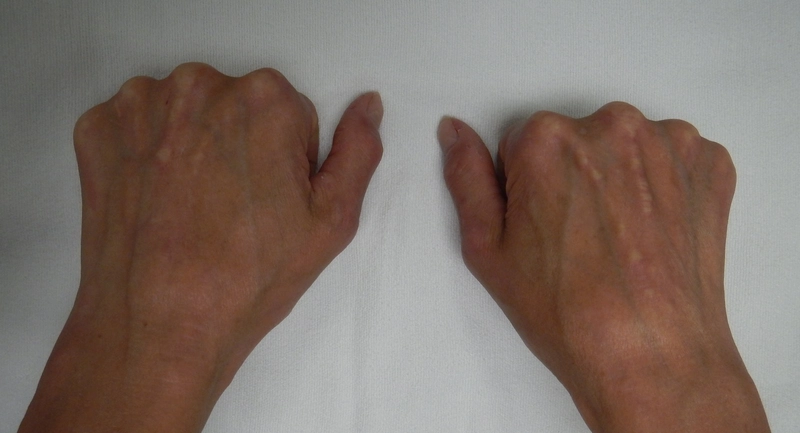
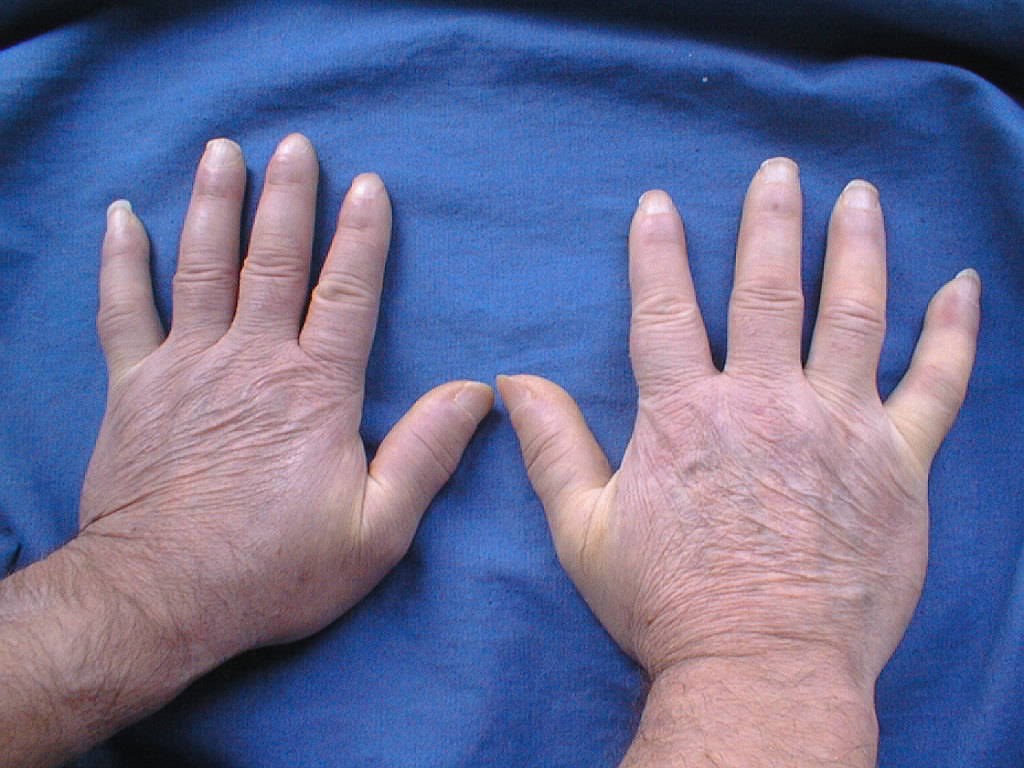
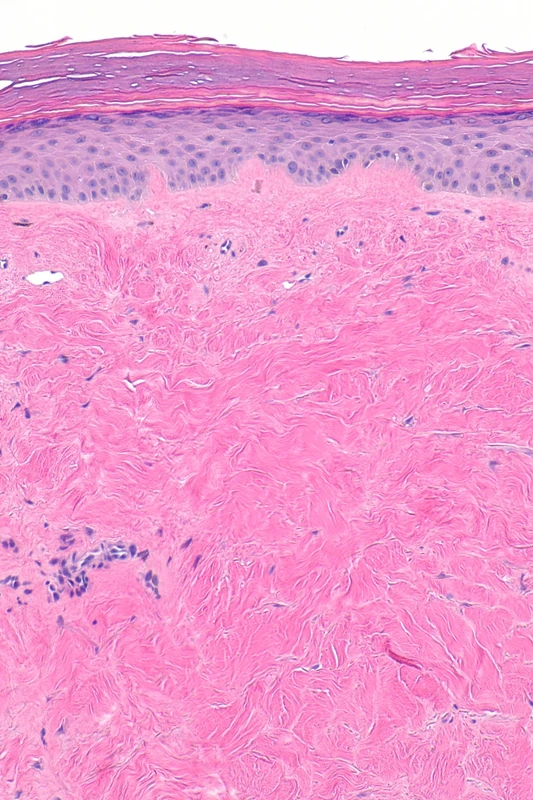 Histology
Definition
Systemic sclerosis is a rare autoimmune connective tissue disease with hardening of the skin and fibrosis of internal organs on the basis of a vasculopathy. The limited cutaneous form (skin involvement distal to elbows and knees and on the face, formerly CREST syndrome) is distinguished from the diffuse cutaneous form with widespread skin involvement including the proximal limbs, often rapidly progressive and with significant organ involvement.
- Pathogenesis: Vasculopathy + Fibrosis + Autoimmunity. Early sign: Raynaud's phenomenon (> 90 %).
- Clinical: Raynaud's phenomenon (early sign), oedematous 'puffy fingers' → sclerodactyly with flexion contractures, mask-like facies with microstomia and radial perioral furrowing, telangiectasias, and acral digital ulcers ('rat-bite' necroses).
Occurrence & epidemiology
The disease is rare (30–500 cases per million); women are affected up to five times more often, and the peak age of onset is roughly between 35 and 55 years. Organ involvement mainly concerns the oesophagus, lungs (interstitial lung disease, pulmonary hypertension), heart and kidneys (renal crisis).
Diagnosis
- Antinuclear antibodies: the pattern points to subgroups – anti-centromere rather in the limited form, anti-Scl-70 (topoisomerase I) rather in the diffuse form with lung involvement.
- Nailfold capillaries: abnormal capillaries are a classification criterion; also anti-RNA polymerase III (diffuse form, renal crisis).
- Skin thickness by the modified Rodnan skin score (mRSS).
- Organ work-up: annual screening for interstitial lung disease and pulmonary arterial hypertension (lung function with FVC and DLCO, echocardiography, ECG; DETECT score), high-resolution CT if lung fibrosis is suspected, kidney function and blood pressure.
Differential diagnoses
 Limited systemic sclerosis (CREST syndrome)
 Dermatomyositis
 Cutis laxa (generalised elastolysis)
 Lupus erythematosus
 Scleroedema adultorum of Buschke (scleredema)
Image credits for the thumbnails
- Limited systemic sclerosis (CREST syndrome): James Heilman, MD, “CREST syndrome (calcinosis and sclerodactyly)”, CC BY-SA 4.0, via Wikimedia Commons · CC BY-SA 4.0 · Source
- Dermatomyositis: Mohammad2018, CC BY-SA 4.0 · CC BY-SA 4.0 · Source
- Cutis laxa (generalised elastolysis): APSP J Case Rep, CC BY 4.0, via Wikimedia Commons · CC BY 4.0 · Source
- Lupus erythematosus: Meriam Hajji, CC BY 4.0, via Wikimedia Commons · CC BY 4.0 · Source
- Scleroedema adultorum of Buschke (scleredema): Ranabahu M, Karunarathna W, Asanthi J et al. (Cureus 2024), CC BY 4.0, via PubMed Central (PMC11178434) · CC BY 4.0 · Source
Treatment principles
- Treatment is organ-based and multidisciplinary; regular screening for pulmonary, cardiac and renal involvement is central.
- Raynaud's phenomenon and digital ulcers are treated with protection from cold, smoking cessation and vasoactive drugs, while skin sclerosis and interstitial lung disease are treated with immunosuppressants or antifibrotic therapy.
- Physiotherapy and occupational therapy preserve mobility; systemic glucocorticoids are not used to treat skin sclerosis and are used only cautiously because of the risk of scleroderma renal crisis.
- Scleroderma renal crisis is treated promptly with ACE inhibitors; in early, rapidly progressive disease with skin and lung involvement, autologous stem cell transplantation is an option at experienced centres.
Guideline: AWMF guideline register (no. 060-014)
Specific treatment regimens with drugs and doses are covered in the DermaFuchs app.
Keep learning in the app
References (selection)
Cross-references
Mentioned in
Keep learning: test yourself
One question from the DermaFuchs app on Systemic sclerosis – tap an answer.
Question 1 of 1
What is an early sign of scleroderma occurring in over 90% of patients?
Answer
Correct: Raynaud's phenomenon. Raynaud's phenomenon is an early sign of scleroderma, occurring in over 90% of patients due to vasculopathy.
More questions like these – with explanations and spaced repetition – in the app.
Note: This page is intended for medical education and does not replace diagnosis or treatment decisions in individual cases.